Long Day’s Journey Into Night

HOME, Manchester

Written by Eugene O’Neill

Directed by Dominic Hill

This is co-production by HOME and Citizen’s Theatre of Eugene O’Neill’s semi-autobiographical and Pulitzer award winning play. Director Dominic Hill has shaped an exquisitely raw study of a family trapped in the throes of addiction and regret. Written in 1942 it covers one fateful day in the life of the Tyrone family as they acknowledge the hopeless reality they exist in and the ways in which they each seek to escape their pain. As younger son Edmund reflects, Who wants to see life as it is, if they can help it? Each one of them is a shadow of their original selves, consumed by their addictions and in Edmund’s case; quite literally by tuberculosis.

Tom Piper has created a haunting and deeply evocative set for this production. It is the bare exposed bones of a house reflecting the exposed failings and regrets of the family. It looked unfinished like the framework of a house where the architects plans got lost or waylaid and no one had the skills or temerity to try to fill in the gaps. In a similiar fashion Mary Tyrone is such a childlike wraith she has never fully grasped her role as a homemaker, wife or mother. The foggy opaqueness of the walls echo the transparency of this family’s lies and excuses. There is nowhere to hide and as the projected sounds of restless movement or conversation echoes from rooms further back in the house, it feels like the audience has no choice but to eavesdrop just like the family do.

The design of the house also echoes the theme of the fog which prevails throughout the play. It is a potent signifier of the ways in which each of the family seek to lose themselves from reality in a fog of alcohol or morphine or memories. As Mary reflects how I love the fog, it hides you from the world…… No one can find you or touch you any more. Tellingly it is the foghorn she hates, a blessed beacon of safety for some, but for her a wretched call back to reality.

It is the profoundly narcissistic Mary who dominates the play with her desperate neediness and appalling insensitivity to the feelings and needs of her family. Bríd Ní Neachtain embodies the essence of this fluttering morphine addicted waif. She is girlish and gay or plaintive and rueful, then flits into prickly, resentful and defensive. Her performance brings alive every facet of a women who was spoilt and cosseted by her father and husband, but who has been disappointed by marriage and family life and aging. This lying dope fiend is at times truly a fiend as she deflects her own shortcomings unto her family. One son is cruelly scapegoated for the death of her middle son while the youngest gets no comfort when diagnosed with consumption but is vilified and blamed for making her worry and therefore need her morphine fix. Yet this performance by Nì Neachtain also evokes pity for this once pretty and talented young women who has become an aging embittered addict.
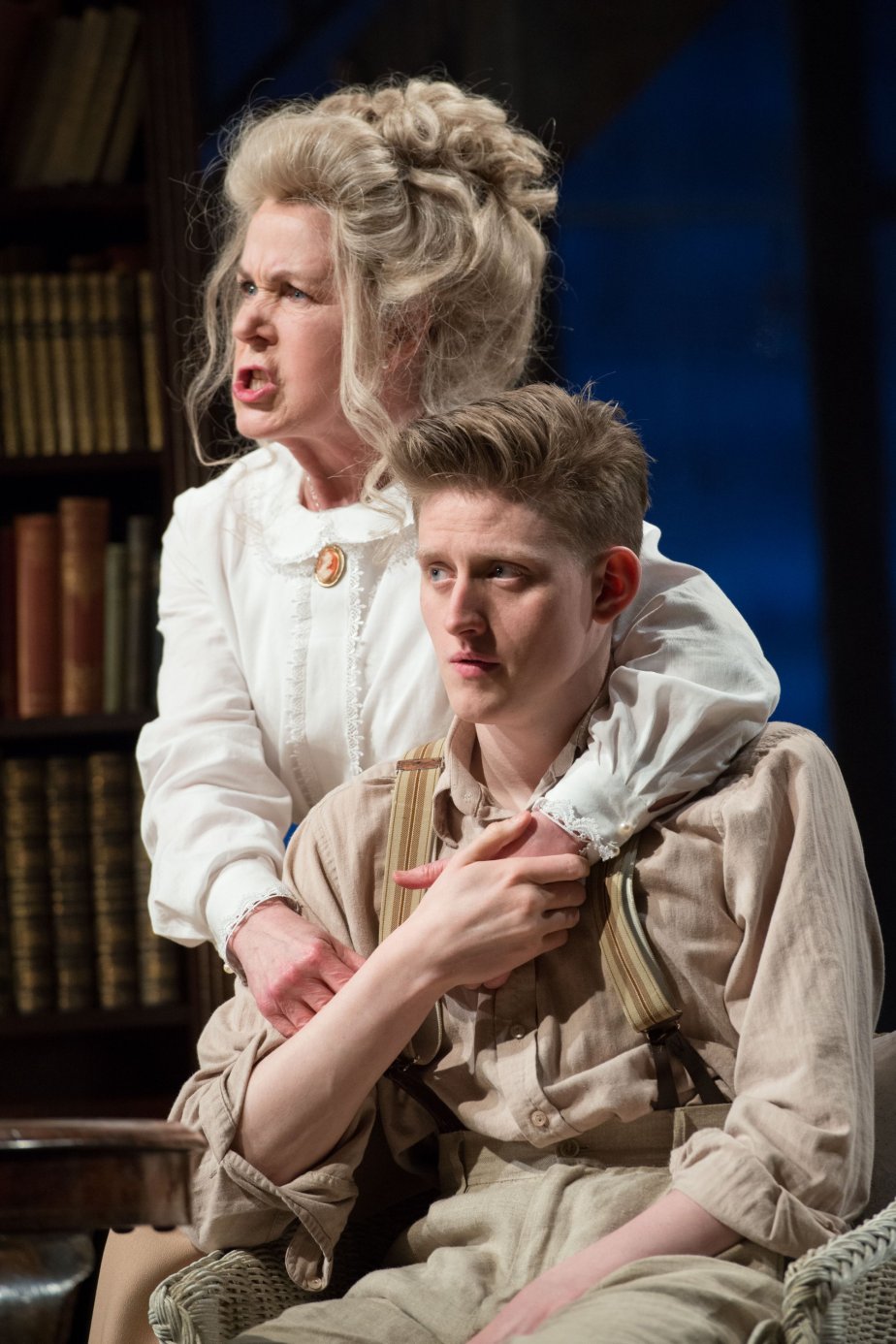
George Costigan does a warmly, upbeat James who desperately hopes that each trip to the sanatorium for his wife will bring a permanent cure, yet who quickly moves to defeated and despondent as he is disappointed once again. An actor who gave up artistic success for financial security, yet is trapped as his lifelong fear of penury and the poorhouse mean he cannot enjoy his wealth. Costigan fills the role, perfectly evoking James’s Irish background from the Irish Famine and poverty while delighting in his passion for Shakespeare and his boyish glee as he opens yet another fresh bottle of whisky. He also brings the meanness of an unpredictable drunk who can be despicable to his boys one minute while hugging them the next.

Sam Phillips as Jamie is a beautiful wasted drunk who has learned to be wily and full of self pity and excuses from his addict parents. The true degree of family damage is surely in his final scenes with brother Edmund when he chillingly warns his brother against himself The dead part of me hopes you won’t get well. Lorn MacDonald as Edmund is heart rending as he is in denial about his health and when the worst is confirmed he realises that no one in the family is equipped to support him. Wheezing and glistening with tears and spittle his performance is haunting and raw. This family emotionally flay each other through the course of this long day and MacDonald displays every moment of pain on his pale, anguished face. The only truly cheery spirit is the maid, a lively Dani Heron who is not contaminated by the family dynamics and is happy to join her mistress in a whisky.

This is such a bleak insight into addiction and co-dependency in a family and O’Neill was writing about his own family as the only one still alive. It reminds us all of how the echo of past family stories define the present and often the future. It was one of the last plays he wrote before becoming unable to write due to Parkinson like symptoms affected his hands. There is a brutal irony when he describes his mother’s trembling hands in the play and in recalling her drug addiction at a time when his own wife was also an addict. As Mary says The past is the present, isn’t it? It’s the future too. This is a family who need to cling on to their tragedies in order to justify their failures.

It speaks as clearly today as it did when first published of the destructive impact of addiction and unresolved grief. Performed in Glasgow and now in Manchester it is doubly pertinent today as both are cities with drug problems and a growing issue of homelessness. As James relates his fear of the poorhouse it is a sobering reminder that in Britain today there are no longer even poorhouses just pavements.

HOME 10 – 26 May

Images by Tim Morozzo
Dollywould

HOME

By Louise Mothersole and Rebecca Biscuit

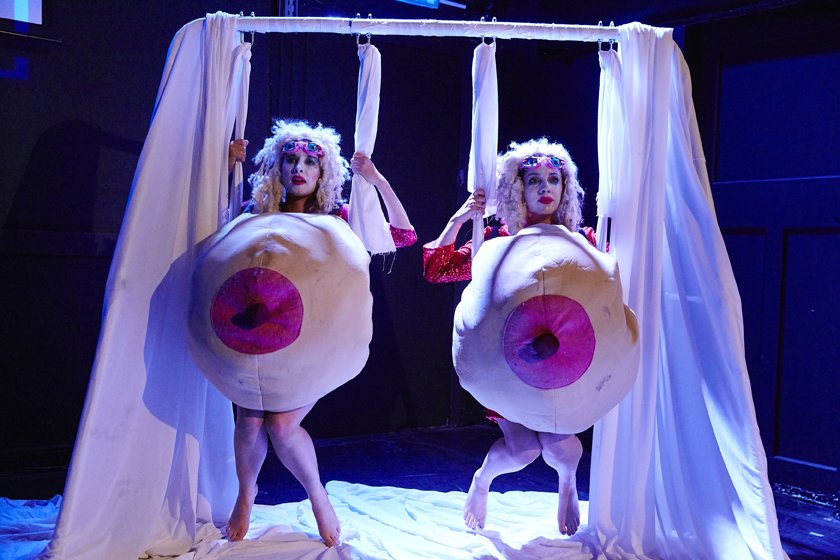
Where are they?? What’s wrong? The set is shrouded in grubby white sheets and there is no sign of the girls. The clock is ticking, the theatre is rammed and anticipation is rife. We fucking love Sh!t Theatre! Moments later they hit the stage and the particular bedlam that is Dollywould is underway. This is their follow up show to the hugely successful Letters To Windsor House. There is a notable shift from local to global issues as they ramp up the madness and move from fringe performance to as they cheerfully say mainstream crossover show. Thankfully when Mothersole and Biscuit say mainstream it involves painting their faces chalk- white, donning some fearsome wigs and swigging Mateus Rosé from bottles. The result is cheerfully reassuring as they end up looking just like their idol Dolly Parton. Well if you imagine Ms Parton being cloned together with some sheep, Marie Antoinette and a couple of crack whores. We fucking love Sh!t Theatre.

This new show focuses on some big issues – death and immortality , genetic cloning and brand merchandising, friendship and Dolly Parton’ s hits and tits. Dollywould is messy, boozy, sharply clever and always endearing. Watching the performance feels like sprawling on the couch watching your best mates roll in from the pub on a Friday night having dreamed up some madcap, genius concept and keen to share it before they pass out or throw up.

They use their trademark mixture of song, projection images and film and hard-core indepth research coupled with mimicry, a double swing, balloons and bodybags and giant inflatable boobs plus lots of kissing and hugging. What is “real” authentic and “real” fake? Is Dolly the infamously cloned sheep as real as any other sheep? Is Dolly Parton the butt of a joke about big hair and boobs or a woman in control of a carefully crafted brand? Regardless of how they alter their image on stage both women remain resolutely real with body hair, real breasts and filmed evidence that they both poo and wee but don’t seem to flush.

Dollywould is based on their trip to Dollywood last year and the discovery that Knoxville is also home to a research facility locally known as The Tennessee Bodyfarm as it studies decomposition. The premise behind their research visit is sound and the neat ways they use to link in the cloning of Dolly the sheep ensure that lots of ideas are thrown out for consideration. As each performance they do will be a clone of the original, just like Dolly on tour or at a Dolly lookalike competition or future Dolly sheep from the same mammary cells. In each case the same but different just like the projected images stretching out on the screen behind Becca and Louise.

Perhaps at the very heart of this show is the warmth and connection between the performers. In Letters To Windsor House they were painfully open about the cracks in their relationship and there was palpable tensions on stage. The research trip to Dollywood feels like a road trip back to friendship and camaraderie. When they speak of Dolly Parton and her longterm companion Judy and their rift and reunion it seems to resonate. As they say on several occasions It was chaos, but they’re fine now. They are never more connected than when they actually merge to become a gigantic pair of quite literally swinging boobs. Moments when they speak in unison but one deliberately fluffs their line is a reminder of the recurring theme each the same, but different. In the show they reflect on being nearly 30, thankfully they seem to be finding a way to navigate maintaining their individual identities while preserving the magic that is Sh!t Theatre.

HOME 3-5 May

Corrido de la Sangre

HOME

The Tiger Lillies

Director Mark Holthusen

Writer Pedar Bjurman

Music and Lyrics Martyn Jacques

The Tiger Lillies have been delighting and possibly revolting audiences for nearly 30 years. This “anarchic Brechtian street opera trio” are Grammy nominated, world class purveyors of unapologetically deviant and defiant shows. Commissioned by HOME, Manchester, Corrido de la Sangre is a vivid, glorious celebration of the rip roaring circus that is the Mexican Day of the Dead. Ruthless and gruesome no one escapes unscathed as this dark and gleeful trio play their twisted tunes.

Three musicians on a stage within a stage, pasted in garish make up and suitably clad to evoke their long dead characters, this corrido band rises from hell to play again and tell the ghastly tale of their demise. From the opening number it is clear that this is no grotesque parody but is a high calibre, darkly anarchic cabaret.

The band are skilled musicians playing a range of instruments from piano and ukulele – Martyn Jacques to upright bass and musical saw – Adrian Stout and Jonas Galland on a range of drums. Martyn Jacques sings with a laconic and dispassionate falsetto that can be pure and sweet or acid sharp and vitriolic. At times it feels like Dave Vanien from The Damned has met Noel Coward in the catacombs and formed some unholy musical alliance with a mariachi band.

The lyrics of each song drive the narrative along with vivid imagery that is not for the mawkish or easily offended. Orphan is sweetly plaintive and poignant, La Bruja mournful and haunting while Scarface is a shocking and visceral description of the ghastly disfiguring of a young women. I bought the soundtrack and I’m still humming along to the bizarrely upbeat Good Doctor and the haunting Borderland.

Visually it is gorgeous. The staging is intimate, and the combination of projections, shadow puppetry and papercut artwork create a constant feeling of wonderment as reveal after reveal alters the staging like a kaleidoscope and creates a sense of the performance being peeled back through the years like Russian dolls unfolding in size. The backdrop gives a sense of the decaying splendour of old Mexico and the ragged holes suggest the disintegration of cloth like flesh from a corpse. The projection of colours and shapes from fiesta lace and flowers to the gold of icons weeping blood to Mexican skies and flames of hell is visually stunning. It evokes the magical realism of Frida Kahlo but with the scale of Diego Rivera folk art murals. Director Mark Holthusen has created a beautiful visual spectacle that pulsates like a vast beautiful beating heart.

As the good doctor says – Once you are in, you can never get out. Leaving the performance at HOME last night I was tempted to ask for a lock in and for the deadly trio to rise again and sing another corrido.

At HOME 20th April – 5th May

Viva

The Tiger Lillies

Images by Jonathon Keenan

MINEFIELD

HOME

Written and Directed by Lola Arias

A LIFT production

A leading voice in Argentinean theatre Lola Arias has created something quite extraordinary with Minefield. Bringing together on a stage, six veterans of The Falklands War who do not speak each other’s language and who were facing each other on the battlefield in 1982. This theatrical venture is itself a potential minefield as it is a piece of lived history representing their individual, unique experiences of the war. This is not theatre retelling the history of either a war, a country, or of particular regiments in specific battles but it is a deeply personal sharing of what it is like to live through a war and forever carry the emotional consequences like a permanent kit bag.

The six men are all now veterans in their fifties. David Jackson spent the war listening and transcribing codes while sometimes keeping one ear tuned to Tony Hancock on BBC World Service. He is now a psychologist counselling veterans having himself suffered PSTD (Post traumatic stress disorder). Lou Armour was front page news in both countries when taken prisoner in The Falklands at the outbreak of the war on 2nd April 1982 . Now he teaches children with learning difficulties and may have caught the acting bug. Sukrim Rai was one of the reknown Gurkhas who now works as a security guard and can finally live in the U.K.

The Argentinians are Ruben Otero who survived 41 freezing hours in a lifeboat after the ARA General Belgrano was sunk. He wears a t shirt stating the Malvinas belong to Argentina and plays in a successful Beatles tribute band. Gabriel Sagastume was a reluctant soldier who is now a criminal lawyer and is absorbed by details of the war. Marcelo Vallejo was a mortar direction controller, who struggled with PTSD and depression. He survived addiction and a suicide attempt by drowning. After support and treatment he learned to swim and is now a successful triathlon champion.

The reality is they are neither heroes or monsters but just a group of guys sent to do a job. The major difference between them is language and the overhead subtitles are a constant reminder of how differences can be overcome.

The men’s stories are told in chapters using a range of techniques. The use of rubber masks effectively put Margaret Thatcher and General Galtieri on stage. Screen projections show the exquisite minutiae of love letters to Gabriel’s wife or tiny airfix soldiers on a map retelling a story of hungry men pinching food from a farm and being blown up by a land mine. A tiny plastic leg in a stripe sock evokes the remains of a lost friend and comrade. Front page images from GENTE in Argentina show Lou after his capture. Powerful usage of sound includes the sound recording of the actual jet fighters that nearly killed David and his comrades. At other times the men become a group singing and playing guitar and drums together. There is the light relief of a squaddie’s disco or the thundering drum solo of Ruben whose shouts for help went unheeded for 41 hours. An Argentinian wallet gratefully given to a fearsome Gurkha who felt it was better to capture than kill. The poignancy of Marcelo donning the battered cape he retrieved from the Malvinas 27 years later. A close up of Lou as he remembers the death of a young soldier who in speaking English as his dying words has haunted Lou ever since.

A therapy session between David and Marcelo is a powerful reminder of how this piece has worked as group therapy for these men. Cathartic at times and also re-opening old wounds on occasions such as April 2nd, the Argentinian Remembrance day. The skill of this piece is to never preach but to seek to share, reflect and understand how our past informs our present. As a psychotherapist I appreciate the delicate balance that Lola Arias has created and maintained in this group therapy approach to this piece of unique verbatim theatre.

Minefield has brought together six men who are united by sharing the same experience of losing friends and leaving them behind on a rocky, unforgiving landscape. This war lasted ten weeks according to Google, but for these men it was 74 days because each day mattered just as each life lost, injured or mentally scarred mattered. They mattered then and they still matter now. As they perform their last song together they unite as a potent force asking their audience,

What would you fight for? Would you go to war?…..Have you ever killed anyone?… Have you watched a friend die?

The final words are from Sukrim in his native language. Translated they simply and wisely say,

Killing is never winning. Fight with the pen NOT with the bullet!! If the pen wins, fine… If not, nobody is killed.

HOME

Viva! Spanish and Latin American Festival 2018

LIFT Festival 2018

All images by Tristram Kenton

The Flying Lovers of Vitebsk

HOME

Writer Daniel Jamieson

Director & Co-Choreographer Emma Rice

Kneehigh & Bristol Old Vic

Originally performed as Birthday over 25 years ago The Flying Lovers of Vitebsk is a celebration of love and art on so many levels. The love child of writer Daniel Jamieson and director Emma Rice who also acted in the original,it was revived in 2016 and has been a hugely successful production for Kneehigh and Bristol Old Vic. This lush homage to another set of young lovers- artist Marc Chagall and his beloved muse and first wife Bella Rosenfeld paints a picture on the stage that is both sensual and transcendent.

The love story is told in flashbacks as a widowed Chagall recounts the romance over the telephone to his son-in-law, the art historian Franz Mayer. They met and fell in love in Vitebsk, Belarus in 1909 and married in 1915 when Chagall returned from successes in Paris and Berlin. Trapped in Russia because of WW1, they were to witness the Russian Revolution and Chagall established the Vitebsk Arts College and painted in the Moscow New Jewish Theatre. Bella gave birth to their daughter Ida and carried on her own writing. They later fled to Europe, before WW2 and the Holocaust forced them to escape France on 1941 for America where Bella died in 1944.

The central performances are flawless. Marc Artolin and Daisy Maywood are utterly believable and sing, dance and emote with a form of enhanced theatricality that perfectly fits this dreamy, magical piece. The sense of a place so vibrant and colourful reduced by war to memories and black and white postcards is beautifully evoked. Every movement is choreographed to create a sense of immersion in Chagall’s paintings and in their hopes and dreams, and their visual and sensory world. Also on stage throughout are multi-instrumentalists Ian Ross and James Gow who bring another layer of rich authenticity playing music with French, Yiddish and Russian influences and a definite klezmer vibe.

Magical touches like a red helium balloon floating away as a fleeting love interest blushing like a radish. Colourful hats portraying animals from his paintings and symbolic fruits like the etrog are images from a lost world as the honeymoon trunk is unpacked. The inspired wit of using puppetry chairs to allow the lovers to dance the Hora or chair dance at their wedding which symbolises that in a good marriage you always strive to go ever higher, as these soaring lovers did in so many of his paintings. There are moments where images from paintings come to life through tableau scenes like when a canvas of a rabbi is unfolded in front of Bella and her own arms come through it as life and art merge.

Designer Sophie Clist has created a set which is compressed yet airy. It allows paintings to come to life and lovers to soar. It also gives a sense of a boat at sea, a reminder of the dispossessed on the move, always either leaving or returning. The lighting by Malcolm Rippeth has all the vibrancy of classic Kneehigh productions but in this piece is even more potent. The painterly depth and richness feels almost visceral at times with the wedding scene having a neon quality. Everything here is heightened and vital, from the tick of a clock and the slow drip from the ceiling to the lily white face and blackberry curls with eyes so blue like splinters from heaven.

Rice and Jamieson have created something of timeless tenderness. A lost world is seen again as we walk in the lover’s shoes through extraordinary times in history. The unpacking of the shoes and journals is utterly poignant, a reminder of so many journeys and stories recorded, and evoking the piles of shoes in Auschwitz belonging to the Jews who couldn’t escape. Chagall comes vividly to life as a pioneer of Modernism and as one of the most famous Jewish artists of the twentieth century. His Bella is painted as he saw her long flying over my canvas guiding my art…..Love and fantasy go hand in hand.

HOME until April 7th

Tour details

Images by Steve Tanner

CIRCLE MIRROR TRANSFORMATION

HOME

Written by Annie Baker

Directed by Bijan Sheibani

Circle Mirror Transformation is the award winning second play by Annie Baker who won the 2014 Pulitzer Prize for drama. Staged in a recreation centre it covers a six week amateur drama class where five ordinary people come together through drama exercises and during refreshment breaks. The genius lies in the inherent simplicity and ordinariness of everything and everyone. Baker writes with delicacy and acute insight into the human need for connection and attachment. How we circle around each other and seek out what is familiar or attractive, how we mirror each other in order to attach and how we all experience transformation in the process.

This small town drama group has strong echoes of group therapy sessions. All five actors give great performances and director Bijan Sheibani ensures the group dynamics that Baker has nurtured get fully explored. Amelia Bullmore utterly embodies the facilitator Marty who is all sinewy energy and positive encouragement, with a lot more going on behind that calm facade. James, her husband is likable, steady and reliable yet seemimgly, easily swayed by a fresh pretty face. Lauren is sixteen and equally diffident, difficult and delightful as she grows from child to adult. Teresa is all fluid grace and beauty but internally is floundering and ambivalent about her place in the world. Con O’Neill gives newly divorced Schultz a rich blend of blundering, puppyish exuberance and affection, coupled with a whiff of hangdog desperation.

Designer Samal Blak has created a set for the community centre space that is instantly recognisable in its ordinariness and utilitarianism. The brilliance is in the mirrored wall that reflect images of the actors on stage and of the audience. In watching them we see ourselves reflected in all their interactions, in their hopes and disappointments. We see both the complexity and the often, utter randomness of how we connect in our world.

The sound and lighting sync perfectly in a way the characters never can. The nine strip lights are always in unison with the bars of sound – controlled and predictable unlike the counting exercise where the characters repeatedly fail. A perfect indicator of how difficult it is to make our mark with each other while giving others the space and security to dare to make theirs.

Circle Mirror Transformation is special because it shines a brilliant and tender light on the fragility of all of us, in our need for connection, acceptance and love. It highlights the circle of life which is in constant flux even when there is apparent stillness. Sometimes I think everything I do is propelled by my fear of being alone.

At HOME 2-17 March 2018

Winter Solstice

HOME

By Roland Schimmelpfennig

Translated by David Tushingham

Directed by Alice Malin

This production of Winter Solstice is co-produced by the Orange Tree Theatre and Actors Touring Company. The original production was first staged a year ago and coincided with the inauguration of a certain tow haired individual. Written by Roland Schimmelpfennig as a response to the resurgence of the far right in Europe, it remains an elegantly chilling observation of the dangers of harmful and subversive views infiltrating society and home. As glass after glass of red wine is poured on Christmas Eve so too is the slow and steady drip, drip, drip of poison from the lips of a benign stranger in this family home.

Lizzie Clachan gives us a stage sparsely set with trestle tables and swivel chairs. The tables are messy and disordered with water bottles, grapes, tic tac sweets, and empty plastic tubs and tape. This is the rehearsal room space in a theatre but could be a craft space for children. The performance runs straight through without an interval and is mainly fully lit giving an real sense of eavesdropping on an improvised scene rather rather than watching a play.

The result is curiously engaging. Schimmelpfennig has written this piece so the cast voice all the stage directions and create the sound effects themselves. The result is clever, funny and creative. A dropped glass baubles has the sound of shattering but is a dropped Satsuma squashed underfoot. Juice sprays out instead of shards of glass. Albert pops pills that are grapes or tic tacs. Throughout Alice Malin’s direction (reviving that of Ramin Gray) ensures that the cast are mainly seated on swivel chairs. They glide across stage moving tables to change the staging. This grows the sense of people trapped, unable or unwilling to exercise free will and stand on their own feet. Albert and Bettina are unable to not have Corinna visit each Christmas or curtail the length of her stay, just as they seem unable to leave a unhappy marriage. They are unable to stop a stranger with his suitcase entering their home on Christmas Eve. Perhaps in the same way we the audience are not offered an interval, and even if anyone wanted one, no one in the theatre speaks out.

The cast of five all give strong and compelling performances. They all play flawed characters who are each in their own way unpleasant and mean spirited. Fittingly there are no shining examples of humanity here even though we see parents, grandparents, artists and intellectuals. All are selfish, cruel and philandering and no one seems to have much empathy or kindness. The sinister stranger at the door appears initially to personify the better traits of humanity.

David Beames is excellent as the silken tongued snake who is courteous, benign and benevolent. He personifies the horror of the ingratiating stranger at the table playing music to a mainly rapt audience while his conversation becomes peppered with almost imperceptible Neo-nazi statements. We all seek others to meet our unmet needs from childhood. If what we seek is guidance,reassurance and nurturing, then we are all susceptible. The truly terrifying realisation is that we are all vulnerable to the voice of calm and reason. The insidious charm of a Pied Piper softly whispering as he leads us towards the “Right”path. We have to stop this mixing. This contamination. We had a garden and tgen the aphids came…..Boundaries exist……Beware of aphids.

It is only the hapless and cowardly Albert who as a social historian picks up on the subtle menace of this German doctor from Paraguay. Felix Hayes gives a vivid portrayal of this weak adulterer as he repeatedly unravels and pops pills to try to manage his anxiety and fear. He tries to speak up and expose this stranger/doctor/Butcher of Auschwitz but seen as weak and ineffective, he is unsupported by family and friends. A lone voice in the madness while an innocent child sleeps upstairs.

This dark and clever comedy is never boring. It is a timely lesson in observation and an invitation to really listen and dissect what we hear. With two apparent endings the rehearsal room scene has a crazed Albert lash out and assault Rudolph splashing red wine like blood with the childishly crafted Christmas tree flattened and destroyed. We see Rudolph reveal his true allegiance. Then the alternate staging of a real home with the fairy tale image of a real Christmas tree lit with candles and proper elegant glasses for a toast. Perhaps this really is a move from staged rehearsal to real life on this stage. The chilling image is of the stranger fully accepted. As the last candle is snuffed out, we, the audience are left in darkness. This is a call to arms, to light our own candles, listen to our own voices, heed our conscience. We all need to be watchful and ensure that no one ever has another Christmas in an Auschwitz.

At HOME until Sat 17th February

Narcissist in the Mirror 

Written & Performed by Rosie Fleeshman

Produced & Directed by Sue Jenkins

HOME

This one woman show by Rosie Fleeshman dazzles from start to finish. The set alludes to the plush dressing room of a Hollywood Diva. The opening track Youre Gorgeous by Babybird nicely frames this piece about a girl who craves adulation and success as best daughter, lover, actress and grammar Nazi.

This is a real gem with sparkling prose, well judged in its blend of dark pathos and gutsy humour. Fleeshman charms and repels with equal flare without ever losing her audience. The standing ovation is well deserved as throughout she uses acutely observed images to enthrall a rapt audience before swiftly making us laugh out loud her wry, blunt humour

The narrative feels authentic  throughout so even her references to her family feel true even when most raw and unflattering. In the end this makes the piece all the stronger as the self awareness and lack of self pity suggest a family that is ultimately flawed but also close and strong- her mother, actress Sue Jenkins is producer and director. The dynamics and dramas of a family of actors is vivid and this narrative could easily lend itself to an excellent novel as well as a play.

The stories of first fumblings, real love and the rabbit hole of Tinder as a means to fill a void are artfully portrayed. The prose is just great as Fleeshman paints domestic images and dating vignettes with the care and precision she doubtlessly painted her tiny London flat with Street Symphony No2. 

Life as a trained actress who is an actor waiting to act is described with no self pity but tells a poignant story of every casting call opening a door on another life then giving the key to someone else. 

Writing Narcissist in the Mirror may have been an exercise in self therapy and healing as well as a means of taking control of her career. The woman on stage is too self aware to really be a Narcissist but she is certainly a perfectionist and probably her own harshest critic. There has been all the  waiting and the yearning to be seen, really really seen and accepted. I really hope as she takes her bows that she truly recognises that she can skip to her own beat and certainly disarm with ability.

At HOME 16/17th January PUSH2018 

5 Encounters on a Site Called Craigslist 

YESYESNONO 

HOME

Having sat down in Theatre 2 at HOME I have a quick introduction to Sam who is politely engaging with a number of audience members. We exchange names and pleasantries before Sam heads to the microphone on stage. This winner of Total Theatre Award for an Emerging Company/Artist 2017 is also Sleepy Boy who wants to suck cock, 22, bisexual in E1. 

Welcome to Sam who is curious about how he engages with others in the world and how humans connect with each other especially in a technologised world. Standing barefoot on stage in t-shirt and dungarees he appears slightly vulnerable but also quite detached from the words he speaks as he leads us through 5 sexual encounters with various men.

There is a lot of audience participation and although Sam is keen to create a “safe” and “democratic” space for this theatrical exploration/group therapy session, I am not certain how comfortable or safe everyone actually was. Of course theatre is there to push boundaries and allow for new experiences but there were moments when boundaries may have have blurred between cooperation and coercion. The intriguing aspect of this is how conscious or not Sam and the participants were as this is also a performance about power dynamics in relationships.

There are some endearing moments in this piece such as when Sam sits on a picnic rug with a participant. They feed each other grapes as he asks questions from the 36 Questions that lead to Love based on the work of psychologist Arthur Aron and others. The theory is that humans can accelerate intimacy by mutual vulnerabilty or sustained, escalating, reciprocal, personal self-disclosure. Demonstrations of romance and emotional intimacy are evoked in various creative ways alongside the cool, factual descriptions of perfunctory sexual acts.

There are other elements that seem to work less well such as some of the props the participants are told to use on stage that seem like random, naive ideas that are irrelevant to the actual performance. The nudity also felt slightly awkward, not because it was nudity on stage but simply because it seemed unnecessary at that point in the narrative.

The overall sense of 5 Encounters on a Site Called Craigslist is of a piece that is still evolving as the performer absorbs more from each audience and possibly from the contents of the boxes on stage holding the answers to Question 22. Watching this pale, blond young man in his simple attire made me think of the David Bowie character in The Man Who Fell to Earth who walked quietly amongst us as an Alien absorbing and reflecting on what makes us human. 

At HOME as part PUSH2018 til Wed 17th January 

The Manchester Project

HOME

Monkeywood Theatre Company 

Director: Martin Gibbons

The Manchester theatre company Monkeywood have created The Manchester Project as a celebration of Manchester and what it means to be Mancunion. Manchester is home to all the 19 writers and the actors involved and fittingly it is being performed at HOME.
On the stage are a series of simple white cubes and hexagonal blocks which evoke the honeycombs of a hive in which the Manchester we know interconnects and holds our creative worker bees/Mancunions. The bee has been  our symbol since The Industrial Revolution and adorns the mosaic floors of our Town Hall, our public bins and the tattooed skin of a community resilient in the face of terrorism. 

It is easy to think of the Manchester we know as portrayed by Coronation Street or on the music tours with The Haçienda and The Salford Lads Club or the rousing poetry of Tony Walsh or Mike Garry. What Monkeywood have done is to give a voice to the wider arena of the whole city spread across 19 tiny plays that criss cross the City from Chorlton to Droylsden to Middleton to Rusholme and back to its core the City Centre. 

First up is Reuben Johnson performing his own piece Little Hulton. Opening with a blast of fresh energy he moves across the platforms recreating the playgrounds of his childhood like a bee between flowers. This beautiful, questioning piece conveys a sense of attachment- we may leave this city but it has the power to pull us back.

Reuben Johnson – Little Hulton

There are five actors on stage and 19 plays. It is astonishing and impressive how the actors power through such a range of varied pieces without pause or break. There is a lot to take in as each tiny play is packed with poetic imagery. The brevity ensures that each writer wants to make every single work count and create impact.  The direction by Martin Gibbons creates a sense of flow which is seamless and elegant. The music used is a smattering of iconic tracks opening with Joy Division Love Will Tear Us Apart and ending with Buzzcocks Ever Fallen In Love. The Manchester bands and the buzz of a solitary bee mesh these little gems into a cohesive whole.

We flit to Levenshulme where the tone is gritty and sarky and the image is of meat raffles and possible hook ups at the weekly nude bathing sessions. James Quinn and Curtis Cole are clearly relishing the words of writer Gareth George. Prestwich by Becky Prestwich brings the lions of Heaton Park and the largest mental asylum in Europe. Eve Steele really shines as she evokes the sense of being different or other whether in spirit, religion or ethnicity.

Timperley conjures up the iconic Frank Sidebottom while Rusholme revisits the bee with the black and yellow uniform of a school born from Manchesters’ proud history of female emanicapation. Rebekah Harrison’s Droylsden is a poetic, tender and evocative portrait of a young soldier not forgotten by his community. Meriel Schofield and James Quinn bring quiet dignity to a piece that reminds us of the losses and sacrifices that run deep in the story of every community. 

Old Trafford glimpses the memory of the cosy domesticity of a couple in their first home with an image of a couple dancing in their kitchen while over in Burnage a cab meter is running and there’s Sunday dinner at Our Kids. In Middleton we queue in Tommy’s Chippy with writer Chris Hoyle who vividly portrays small minds, small town chatter as he prepares for his escape to the City centre via the newly “done up” bus terminal. A young homosexual given joyous opportunities to explore in Canal Street.

Chris Hoyle – Middleton

Didsbury reminds us of Manchester’s rich, musical heritage where everyone seems to have a story in their front room. Samantha Siddall explores heritage and what we hold dear in our community in Denton as a town planner looks at the outcome of his work. Chorlton has the largest public graveyard in Europe as Becky Garrod recalls family strolls and rituals. Withington sees James Quinn relish the closure of Greggs as Pasta La Vista as old and new businesses try to co-exist in the community.

Ian Kershaw writes poignantly of Harpurhey with the racist comics in The Embassy Club and the horrific burning of the local dogs home. The tram stop at Cornbrook is a bleak, blank canvas yet peel back the layers of history and Eve Steele and Sarah McDonald Hughes see Pomona Palace with the magic of lions and tigers in its pleasure gardens. 

Cathy Crabb takes us back in time to a pub in Failsworth where Meriel Scholfield brillantly evokes a truly beautiful man Ernie Jump, whose front teeth are fashioned from Scrabble blocks. In Moss Side despite stereotypical expectations Curtis Cole conveys kindliness and humour and carnivals without the risk of being shot or sodomized! Sarah McDonald Hughes deftly paints Flixton as having little of merit bar differing sized fields yet there is still fun to be had in a place where nothing happens. 

Eve Steele – City Centre

The closing piece by Eve Steele is of course the City Centre and what a celebration it is. I fucking love town. It is a passionate love poem to Manchester city centre for being my place as a mad little punk. My second home. 

The Manchester Project is glorious. It is a five star theatrical TripAdvisor for Manchester. Like the honey from a bee it is a sticky, messy, sweet and golden stream that glues us together as Mancunians. 

At HOME January 12th and 26th as part of PUSH2018.


Portrait Photographer – David Fawcett