Winter Solstice

HOME

By Roland Schimmelpfennig

Translated by David Tushingham

Directed by Alice Malin

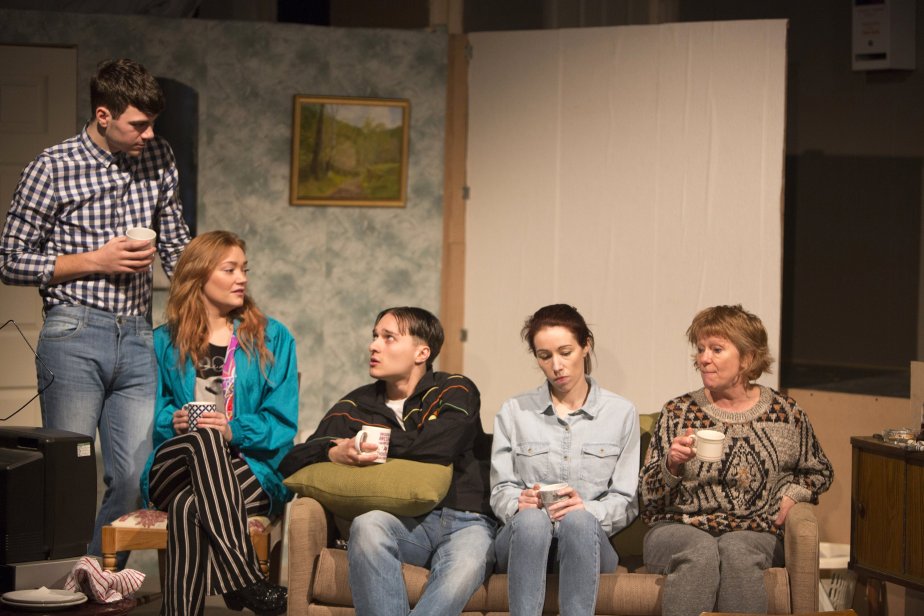
This production of Winter Solstice is co-produced by the Orange Tree Theatre and Actors Touring Company. The original production was first staged a year ago and coincided with the inauguration of a certain tow haired individual. Written by Roland Schimmelpfennig as a response to the resurgence of the far right in Europe, it remains an elegantly chilling observation of the dangers of harmful and subversive views infiltrating society and home. As glass after glass of red wine is poured on Christmas Eve so too is the slow and steady drip, drip, drip of poison from the lips of a benign stranger in this family home.

Lizzie Clachan gives us a stage sparsely set with trestle tables and swivel chairs. The tables are messy and disordered with water bottles, grapes, tic tac sweets, and empty plastic tubs and tape. This is the rehearsal room space in a theatre but could be a craft space for children. The performance runs straight through without an interval and is mainly fully lit giving an real sense of eavesdropping on an improvised scene rather rather than watching a play.

The result is curiously engaging. Schimmelpfennig has written this piece so the cast voice all the stage directions and create the sound effects themselves. The result is clever, funny and creative. A dropped glass baubles has the sound of shattering but is a dropped Satsuma squashed underfoot. Juice sprays out instead of shards of glass. Albert pops pills that are grapes or tic tacs. Throughout Alice Malin’s direction (reviving that of Ramin Gray) ensures that the cast are mainly seated on swivel chairs. They glide across stage moving tables to change the staging. This grows the sense of people trapped, unable or unwilling to exercise free will and stand on their own feet. Albert and Bettina are unable to not have Corinna visit each Christmas or curtail the length of her stay, just as they seem unable to leave a unhappy marriage. They are unable to stop a stranger with his suitcase entering their home on Christmas Eve. Perhaps in the same way we the audience are not offered an interval, and even if anyone wanted one, no one in the theatre speaks out.

The cast of five all give strong and compelling performances. They all play flawed characters who are each in their own way unpleasant and mean spirited. Fittingly there are no shining examples of humanity here even though we see parents, grandparents, artists and intellectuals. All are selfish, cruel and philandering and no one seems to have much empathy or kindness. The sinister stranger at the door appears initially to personify the better traits of humanity.

David Beames is excellent as the silken tongued snake who is courteous, benign and benevolent. He personifies the horror of the ingratiating stranger at the table playing music to a mainly rapt audience while his conversation becomes peppered with almost imperceptible Neo-nazi statements. We all seek others to meet our unmet needs from childhood. If what we seek is guidance,reassurance and nurturing, then we are all susceptible. The truly terrifying realisation is that we are all vulnerable to the voice of calm and reason. The insidious charm of a Pied Piper softly whispering as he leads us towards the “Right”path. We have to stop this mixing. This contamination. We had a garden and tgen the aphids came…..Boundaries exist……Beware of aphids.

It is only the hapless and cowardly Albert who as a social historian picks up on the subtle menace of this German doctor from Paraguay. Felix Hayes gives a vivid portrayal of this weak adulterer as he repeatedly unravels and pops pills to try to manage his anxiety and fear. He tries to speak up and expose this stranger/doctor/Butcher of Auschwitz but seen as weak and ineffective, he is unsupported by family and friends. A lone voice in the madness while an innocent child sleeps upstairs.

This dark and clever comedy is never boring. It is a timely lesson in observation and an invitation to really listen and dissect what we hear. With two apparent endings the rehearsal room scene has a crazed Albert lash out and assault Rudolph splashing red wine like blood with the childishly crafted Christmas tree flattened and destroyed. We see Rudolph reveal his true allegiance. Then the alternate staging of a real home with the fairy tale image of a real Christmas tree lit with candles and proper elegant glasses for a toast. Perhaps this really is a move from staged rehearsal to real life on this stage. The chilling image is of the stranger fully accepted. As the last candle is snuffed out, we, the audience are left in darkness. This is a call to arms, to light our own candles, listen to our own voices, heed our conscience. We all need to be watchful and ensure that no one ever has another Christmas in an Auschwitz.

At HOME until Sat 17th February

The Kitchen Sink

Oldham Coliseum Theatre

Written by Tom Wells

Directed by Chris Lawson

The Kitchen Sink has a warm rich vein of humour with a steady flow of lively banter and acerbic quips. This is an undoubtedly upbeat take on some serious kitchen sink dramas. This is an Everyman, everyday family dealing with financial worries, plumbing woes; and managing disappointment, frustration, fear and grief. The kids are in flux as they try to find their place as adults. Dad is stubbornly clinging to a past that has no place in the future or even in the present. Mum is chucking lifebuoys to all and sundry in the shape of courgette muffins. In this scene of adversity there is also buckets of love and empathy. The Kitchen Sink is for everyone who has felt like screaming in their kitchen and it is an infectious reminder that we could be up on the kitchen table and dancing and singing along to Dolly Parton.

The staging works really well and Anna Reid’s design conveys the shabby family kitchen in need of a complete overhaul. The faded oranges and beiges of this utilitarian kitchen are brought alive by the people who inhabit this room as in so many homes. The wonky Christmas tinsel and Billy’s incongruous portrait of Dolly Parton are the little touches that make this home unique. The lighting is clever as each scene changes in muted semi darkness as family life continues to ebb and flow with a steady heartbeat of home and hearth.

The family are Northern working class with Kath, a feisty Mother who works two low paid jobs and yearns for change and rails against stagnating in a place that is a good place to come from, but not a good place to end up. Sue Devaney plays Kath with an infectious energy which never dims. She works hard at family, at work and in life but she is never a martyr but instead retains a kittenish, playfulness whether stripping off unto a newspaper or casually savouring her first spliff. There are moments where I wished the laughter dialled down a little to allow more space for her heartfelt plea for just a tiny change without the World ending. The poignancy and tenderness in the scene in which Kath has made the buffet for Pete’s Gran’s funeral is a joy to watch. The simple compassion of a Mother who loves to “mother” being “Mother” to the bereaved and orphaned Pete.

William Travis provides a dour, slightly gloomy Martin who is a good foil to wife Kath. Initially they seem ill- matched as her sunny playful nature seems at odds with his downbeat gruffness. Yet the moments of real laughter between the two shine as their strong emotional connection is evident. This is marriage at its best- there is humour, forbearance, compassion and earthy attraction. They may have a barely half-filled jar of 20 pences as savings security but they have a fortune in a rock solid union.

The children are less richly drawn. Billy played with great sweetness by Sam Glen, is ill equipped for Art College in London where his heartfelt homage to Dolly Parton is greeted as “kitsch” and “cool”. His warm and affectionate relationship with his mother is spontaneous and full of horseplay which belies the more awkward one with his father. This is a home where children are undoubtedly loved but where an artistic, gay and slightly diffident son is slightly held at arms length by a father who struggles to relate to him. Sophie played by Emily Stott is barbed wire brittle and is clearly a wounded soul. Her Mother senses something is wrong and Sophie is clearly very close to her father yet no one seems able, or dares to probe too deeply. Perhaps in every family the dark stuff lying at the bottom of the U- bend is avoided where possible. Like the makeshift mends on the kitchen sink until it finally erupts and make do and mend is no longer an option.

The most finely drawn character is Pete the young plumber and would-be suitor to Sophie. David Judge delivers a beautiful performance full of awkward grace and sensitivity. The quiet resilience and steadfast devotion to those he loves is a study in grace and gentleness. Despite or because of his own losses, he is the only one to really see Sophie’s pain and try to help her. This play subtly highlights how children can be loved and valued but sometimes “missed” in the business of making ends meet with multiple jobs or unsociable working hours.

The Kitchen Sink is filled with the music of Dolly Parton. This is a soundtrack full of songs bursting with energy and poignant, heartfelt melodies- a perfection reflection of this family at this particular kitchen sink. In the ladies loos after the show both cubicles were engaged with girls singing Dolly at the top of their voices!! I’m not a country music lover but I’ve been playing her all week. Small changes. Thanks Kath!! As the character says I got on the Circle Line in the wrong direction- Nothing happened- I just sat it out. This play has an ask for all of us. Do we want to sit it out or get off and go a different direction and see what happens.

At Oldham Coliseum

Fri 9 – Saturday 24 February 2018

Narcissist in the Mirror 

Written & Performed by Rosie Fleeshman

Produced & Directed by Sue Jenkins

HOME

This one woman show by Rosie Fleeshman dazzles from start to finish. The set alludes to the plush dressing room of a Hollywood Diva. The opening track Youre Gorgeous by Babybird nicely frames this piece about a girl who craves adulation and success as best daughter, lover, actress and grammar Nazi.

This is a real gem with sparkling prose, well judged in its blend of dark pathos and gutsy humour. Fleeshman charms and repels with equal flare without ever losing her audience. The standing ovation is well deserved as throughout she uses acutely observed images to enthrall a rapt audience before swiftly making us laugh out loud her wry, blunt humour

The narrative feels authentic  throughout so even her references to her family feel true even when most raw and unflattering. In the end this makes the piece all the stronger as the self awareness and lack of self pity suggest a family that is ultimately flawed but also close and strong- her mother, actress Sue Jenkins is producer and director. The dynamics and dramas of a family of actors is vivid and this narrative could easily lend itself to an excellent novel as well as a play.

The stories of first fumblings, real love and the rabbit hole of Tinder as a means to fill a void are artfully portrayed. The prose is just great as Fleeshman paints domestic images and dating vignettes with the care and precision she doubtlessly painted her tiny London flat with Street Symphony No2. 

Life as a trained actress who is an actor waiting to act is described with no self pity but tells a poignant story of every casting call opening a door on another life then giving the key to someone else. 

Writing Narcissist in the Mirror may have been an exercise in self therapy and healing as well as a means of taking control of her career. The woman on stage is too self aware to really be a Narcissist but she is certainly a perfectionist and probably her own harshest critic. There has been all the  waiting and the yearning to be seen, really really seen and accepted. I really hope as she takes her bows that she truly recognises that she can skip to her own beat and certainly disarm with ability.

At HOME 16/17th January PUSH2018 

5 Encounters on a Site Called Craigslist 

YESYESNONO 

HOME

Having sat down in Theatre 2 at HOME I have a quick introduction to Sam who is politely engaging with a number of audience members. We exchange names and pleasantries before Sam heads to the microphone on stage. This winner of Total Theatre Award for an Emerging Company/Artist 2017 is also Sleepy Boy who wants to suck cock, 22, bisexual in E1. 

Welcome to Sam who is curious about how he engages with others in the world and how humans connect with each other especially in a technologised world. Standing barefoot on stage in t-shirt and dungarees he appears slightly vulnerable but also quite detached from the words he speaks as he leads us through 5 sexual encounters with various men.

There is a lot of audience participation and although Sam is keen to create a “safe” and “democratic” space for this theatrical exploration/group therapy session, I am not certain how comfortable or safe everyone actually was. Of course theatre is there to push boundaries and allow for new experiences but there were moments when boundaries may have have blurred between cooperation and coercion. The intriguing aspect of this is how conscious or not Sam and the participants were as this is also a performance about power dynamics in relationships.

There are some endearing moments in this piece such as when Sam sits on a picnic rug with a participant. They feed each other grapes as he asks questions from the 36 Questions that lead to Love based on the work of psychologist Arthur Aron and others. The theory is that humans can accelerate intimacy by mutual vulnerabilty or sustained, escalating, reciprocal, personal self-disclosure. Demonstrations of romance and emotional intimacy are evoked in various creative ways alongside the cool, factual descriptions of perfunctory sexual acts.

There are other elements that seem to work less well such as some of the props the participants are told to use on stage that seem like random, naive ideas that are irrelevant to the actual performance. The nudity also felt slightly awkward, not because it was nudity on stage but simply because it seemed unnecessary at that point in the narrative.

The overall sense of 5 Encounters on a Site Called Craigslist is of a piece that is still evolving as the performer absorbs more from each audience and possibly from the contents of the boxes on stage holding the answers to Question 22. Watching this pale, blond young man in his simple attire made me think of the David Bowie character in The Man Who Fell to Earth who walked quietly amongst us as an Alien absorbing and reflecting on what makes us human. 

At HOME as part PUSH2018 til Wed 17th January 

The Manchester Project

HOME

Monkeywood Theatre Company 

Director: Martin Gibbons

The Manchester theatre company Monkeywood have created The Manchester Project as a celebration of Manchester and what it means to be Mancunion. Manchester is home to all the 19 writers and the actors involved and fittingly it is being performed at HOME.
On the stage are a series of simple white cubes and hexagonal blocks which evoke the honeycombs of a hive in which the Manchester we know interconnects and holds our creative worker bees/Mancunions. The bee has been  our symbol since The Industrial Revolution and adorns the mosaic floors of our Town Hall, our public bins and the tattooed skin of a community resilient in the face of terrorism. 

It is easy to think of the Manchester we know as portrayed by Coronation Street or on the music tours with The Haçienda and The Salford Lads Club or the rousing poetry of Tony Walsh or Mike Garry. What Monkeywood have done is to give a voice to the wider arena of the whole city spread across 19 tiny plays that criss cross the City from Chorlton to Droylsden to Middleton to Rusholme and back to its core the City Centre. 

First up is Reuben Johnson performing his own piece Little Hulton. Opening with a blast of fresh energy he moves across the platforms recreating the playgrounds of his childhood like a bee between flowers. This beautiful, questioning piece conveys a sense of attachment- we may leave this city but it has the power to pull us back.

Reuben Johnson – Little Hulton

There are five actors on stage and 19 plays. It is astonishing and impressive how the actors power through such a range of varied pieces without pause or break. There is a lot to take in as each tiny play is packed with poetic imagery. The brevity ensures that each writer wants to make every single work count and create impact.  The direction by Martin Gibbons creates a sense of flow which is seamless and elegant. The music used is a smattering of iconic tracks opening with Joy Division Love Will Tear Us Apart and ending with Buzzcocks Ever Fallen In Love. The Manchester bands and the buzz of a solitary bee mesh these little gems into a cohesive whole.

We flit to Levenshulme where the tone is gritty and sarky and the image is of meat raffles and possible hook ups at the weekly nude bathing sessions. James Quinn and Curtis Cole are clearly relishing the words of writer Gareth George. Prestwich by Becky Prestwich brings the lions of Heaton Park and the largest mental asylum in Europe. Eve Steele really shines as she evokes the sense of being different or other whether in spirit, religion or ethnicity.

Timperley conjures up the iconic Frank Sidebottom while Rusholme revisits the bee with the black and yellow uniform of a school born from Manchesters’ proud history of female emanicapation. Rebekah Harrison’s Droylsden is a poetic, tender and evocative portrait of a young soldier not forgotten by his community. Meriel Schofield and James Quinn bring quiet dignity to a piece that reminds us of the losses and sacrifices that run deep in the story of every community. 

Old Trafford glimpses the memory of the cosy domesticity of a couple in their first home with an image of a couple dancing in their kitchen while over in Burnage a cab meter is running and there’s Sunday dinner at Our Kids. In Middleton we queue in Tommy’s Chippy with writer Chris Hoyle who vividly portrays small minds, small town chatter as he prepares for his escape to the City centre via the newly “done up” bus terminal. A young homosexual given joyous opportunities to explore in Canal Street.

Chris Hoyle – Middleton

Didsbury reminds us of Manchester’s rich, musical heritage where everyone seems to have a story in their front room. Samantha Siddall explores heritage and what we hold dear in our community in Denton as a town planner looks at the outcome of his work. Chorlton has the largest public graveyard in Europe as Becky Garrod recalls family strolls and rituals. Withington sees James Quinn relish the closure of Greggs as Pasta La Vista as old and new businesses try to co-exist in the community.

Ian Kershaw writes poignantly of Harpurhey with the racist comics in The Embassy Club and the horrific burning of the local dogs home. The tram stop at Cornbrook is a bleak, blank canvas yet peel back the layers of history and Eve Steele and Sarah McDonald Hughes see Pomona Palace with the magic of lions and tigers in its pleasure gardens. 

Cathy Crabb takes us back in time to a pub in Failsworth where Meriel Scholfield brillantly evokes a truly beautiful man Ernie Jump, whose front teeth are fashioned from Scrabble blocks. In Moss Side despite stereotypical expectations Curtis Cole conveys kindliness and humour and carnivals without the risk of being shot or sodomized! Sarah McDonald Hughes deftly paints Flixton as having little of merit bar differing sized fields yet there is still fun to be had in a place where nothing happens. 

Eve Steele – City Centre

The closing piece by Eve Steele is of course the City Centre and what a celebration it is. I fucking love town. It is a passionate love poem to Manchester city centre for being my place as a mad little punk. My second home. 

The Manchester Project is glorious. It is a five star theatrical TripAdvisor for Manchester. Like the honey from a bee it is a sticky, messy, sweet and golden stream that glues us together as Mancunians. 

At HOME January 12th and 26th as part of PUSH2018.


Portrait Photographer – David Fawcett
Hot Brown Honey

HOME

Briefs Factory presents Hot Brown Honey 

Six vibrant First Nation women wearing identical shellsuits on a stage dominated by a huge gleaming, pulsating honeycomb hub. Our MC is Busty Beatz  (Kim Bowers) a co-founder of Hot Brown Honey and she is loud and  proud and magnificent towering above everyone astride the honey dome. Below is the other founder, Director and Choreographer Lisa Fa’alafi who I met briefly as I took my seat in the theatre. These women are chatty and welcoming as they stroll  around the aisles before the show. They are upfront and direct, almost immediately the audience is told a collection toward their childcare will be passing through the aisles because as Lisa says The Revolution can not happen without  childcare. 

Suddenly the performance ramps up the energy. I can’t fully hear everything. I’m blinking as the lights flash powerfully on the honeycomb dome. The performers are hi octane and nothing is going to stop them. It’s too loud!! It’s too bright!!! It’s too……DO NOT ADJUST YOUR SET. WAKE UP. GET ON BOARD. ROCK THE BOAT. THIS MAY JUST BE THE TRIP OF YOUR LIFE.

There is zero tolerance of stereotyping as MC Beatz quotes from the 2009 TEDTalk by Chimamanda Ngozi Adichie The Danger of a Single Story. There are no single stories here and this is reinforced by a show that defies any genre. This is burlesque, cabaret, song, beatboxing, hip hop, poetry, hula hooping, aerial silks, sermon and comedy. This is an EVENT and like its orchestrators it cannot be pigeonholed.

This is an intelligent, passionate celebration of womankind in all its colours, shapes and creeds of politics, religion and sexuality. There is a strong burlesque influence running through all aspects of this show. This is burlesque as gender politics defying any attempts at body shaming. Women standing proud and celebrating perfect boobs, giant inflatable  boulder boobs, pussies that may or may not have  seen childbirth, giant padded feline pussies, bodies curvy or lean, skin that gleams or has cellulite or skin blemishes. Women using burlesque to own their own bodies using the frequent vivid costume changes to drive the stories. Fa’alafi describes the experience as the decolonisation of our thoughts and inhibitions. The poet and playwright Maya Angelou was also a burlesque dancer in her early years; and it a very powerful tool of expression and liberation.

There are group sequences ramming home the message We Are Not Maids. Shellsuits are shed to reveal cheeky Princess Megan t-shirts then shed again to reveal maid costumes. MC Beatz dons a massive Afro for the anthem Don’t Touch My Hair.  Fa’alafi delights with a reverse striptease parodying the fantasies of bare breasted Polynesian maidens in grass skirts. This is no coy blushing maiden or unskilled island girl. Our Lisa is surrounded by leaves but deftly fashions shoes and bags like a fashion forward icon. The glorious voice of ‘Ofa Fotu rips apart the James Brown anthem It’s a Man’s Man’s Man’s World while she wears a stifling costume that clearly alludes to a golliwog doll. Elena Wangurra battles the confines of the Australian flag and triumphantly emerges as a superhero in the vivid colours of the Aboriginal flag. The beat box skills of Hope One pound through the speakers while Crystal Stacey spins hoola hoops with the dexterity that most women multi task. Domestic violence is portrayed in a way that is gut wrenchingly shocking. Crystal Stacey performance was my personal highlight as she escaped violent assault by using aerial silks. Her performance was exquisite and horrifying and incredibly poignant. Literally hanging by a thread this was a truly visceral evocation of desperation, determination and resilience. We do this for the Women who cannot speak. We are taught that silence will save us. But we will make noise.

The Speaker of this Hive asks Will you stay the same or rock the boat? The Hot Brown Honey mantra throughout this amazing show is DECOLONISE AND MOISTURISE or as Faalafi  says We want to decolonize the World , one stage at a time. The audience are on their feet dancing. The atmosphere is electric. The Party Manifesto is clear and this is one party you won’t want to miss.

HOME until Saturday 23rd Dec

The Siege of Christmas 


CONTACT
Directed by Alan Lane

Contact Young Company

CONTACT AND SLUNG LOW

Having just seen a big, high octane pantomime earlier this week I was curious as to see how Contact Young Company (CYC) would  approach a Christmas family show. Under the direction of Alan Lane from the wonderful Leeds based Slung Low this was Christmas entertainment at its magical best. 

This promenade performance starts in the foyer as everyone dons headphones which serve to immerse everyone in the performance as it feels like we are all on an Nutcracker Army comms exercise or a festive Mission Impossible!!

Despite the reassuring tone of Dan the Front of House manager there is clearly something seriously amiss at CONTACT. The building has been taken over by some seriously grouchy mince pies and the spirit of Christmas is under siege trapped somewhere in the building we are now locked out off.

What’s more the snow has focused all it’s fall just by the foyer and things are getting a bit chilly. Thank heavens that there is a sudden appearance from a tooled up, highly skilled ninja-like Nutcracker toy soldier who is in search of helpers to save the spirit of Christmas. Sneaking us in via a back door we creep through the darkened with our youngest soldier proudly clutching the remnants of our vital map. This production brilliantly uses the technique of splitting up the audience on the promenade parts to ensure everyone will access needs is included and involved at every stage.

Once inside we encounter a range of magical characters battling their misgivings about Christmas. Elf-like despondent toymakers, sulky teenage fairies who have mislaid their fairy dust, a melting showgirl in a globe  and disheartened life size crackers who can’t pull and feisty rapping  Xmas wrap which has somehow come alive.  

This mission teaches its audience many useful life skills such as how to do the nutcracker freeze , how to custard creep, and how to stop a snow globe from over heating in a building set at a constant 28 degrees. Most importantly of course it reminds us of kindness, co-operation and empathy in an often unequal, unfair World.

All the cast act their wings off and children and adults alike are spellbound by the unfolding scenes. This show makes glorious use of the simple things we associate with Christmas- crackers, twinkling lights, glitter, snowflakes and silly festive jumpers. By the time we have crept through the building gathering resources for our final siege I defy anyone to not feel touched, a little bit humbled and a whole lot more in the mood for Christmas. 

This is a perfect final show for CONTACT as it highlights it’s focus on young people while allowing theatre lovers to say goodbye to a much loved building before it closes its doors for an exciting new rebuilding and refurbishment  programme in 2018. Christmas is looking sparkly and the future of CONTACT is looking bright. 

At CONTACT until Dec 20th

Dick Whittington 


The Opera House, Manchester 
Written by Alan McHugh with additional material by The Krankies

Directed by Michael Gyngell

This Qdos Entertainment production of Dick Whittington certainly delivers as a visually spectacular festive theatre trip. It takes traditional panto and gives it a huge 21st century makeover. Dick first appears when launched on stage in a jetpack and there are 3D special effects and mind blowing visual creations from The Twins FX. 

This is still bright, loud and colourful pantomime but the narrative is more sound bites than traditional storytelling. It keeps many of the traditional characters but ditches the panto dame and OTT costumes for a hybrid Principal Boy/Panto Dame in the form of John Barrowman in the tightest velvet trousers and skimpiest white shorts. This Dick is possibly more focused on maintaining his reputation as the biggest Dick in Panto than he is on saving London from a plague of rats!!

The other major characters this production is built around are the Seventies comedy duo The Krankies. Ian Tough as Councillor Krankie and his wife Janette Tough as his son Jimmy who reprise their famous despairing father/naughty son doubleact. This unlikely pairing with John Barrowman is incredibly successful and creates a comedy masterclass in comic timing and ad libbing. Apparently Barrowman will only do Panto if The Krankies are on the bill and this is their seventh successful appearance together. They are quite simply a joy to watch, as the on stage chemistry particularly with Barrowman and Janette Tough is achingly funny. The banter often feels genuinely unscripted and frequently veers from naughty to positively blue- this is a trio singing from the same rather smutty songsheet. 

The other main characters are all strong performances with Jacqueline Hughes delivering a delightful The Spirit of Bow  Bells and Lauren Hampton as  a sweet and winsome Alice. Phil Corbitt is a suitably nasty villain as King Rat and provides lots traditional boos and hisses. Sadly the rest of the cast are underused and although we have Ryan Kayode as a Manchester/Cheshire cat complete with local accent we don’t see enough of Dick’s famous sidekick. 

A lot of the audience are here for Panto at Christmas but this is very much a vehicle for John Barrowman with lots of references to iconic shows such as Dr Who and Arrow. In the ghost scene he even wears a cheeky skimpy onesie that’s clearly inspired by The Tardis. This combined with numerous references to his sexuality mean that it is impossible to ever fully suspend reality and simply see Dick Whittington on stage.

There are lots of catchy songs delivered with loads of energy. Barrowman baritone voice is unsurprisingly excellent throughout while Janette Tough singing is unsurprisingly awful throughout and well used for comic effect. Her turn as MacDonna in conical bra and G string may be the oddest thing I’ve ever seen on stage but the goodwill she creates makes it strangely acceptable.

The special effects are high impact and give this show an added memorable dimension. The 3D underwater scene was genuinely scary  and exciting. The big events in each Act were thrilling for all ages. Rudolph and his sleigh fly out over the audience and turn upside down with Dick seemingly inches from the audience in the stalls. Later we see Wee Jimmy in the mouth of a gigantic shark shooting out over the stage and into the audience.

There are lots of panto positives in this production. The underwater version of The Twelve Days of Christmas is pure silliness and includes lots of super soaker action  aimed at the audience. The costumes for the dancers are extravagant and sometimes really beautiful such as in the winter scene. However there are also points where this panto veets off being family friendly fun and dips into gasp-out- loud smuttiness. I’m sure some of this will go right past the younger audience but for older children there may be awkward q&a’s for red faced parents.

At OPERA HOUSE until Sunday Jan 7th 2018

REAL MAGIC

HOME

Director Tim Etchells

Devised with and Performed by Jerry Killick, Richard Lowdon and Claire Marshall

Forced Entertainment bring their latest show Real Magic to real theatres and real audiences and so the endless loop of absurdity continues. Attempting to critique this show is probably as ridiculously hopeless and pointless as trying to guess the word on this gameshow/mind reading show. Real Magic is like musical chairs for demented amnesiacs.

Three people on stage. Three roles to adopt. Three possible words to guess. Three answers given regardless of who asks who the question. Three chicken suits. The magic perhaps lies in the myriad of ways this short, basic scenario plays out. The three actors gift this absurd, apparently mediocre scene with a wide range of emotional pitch and timing that shifts through upbeat fun to encouragement to intimidation to sheer desperation.

From early on it is apparent that this fruitless task is looping just like the canned applause. The internal dilemma for the watcher is when is this going to end?…..Will it magically resolve?…. Do I care?…..How many more times can they do this?…..Can they really keep this going for 85 minutes?

At certain points Jerry asks the would-be mindreader Are you feeling good? Are you feeling safe? Are you feeling confident? The same might be asked of the audience as the show progresses. Ultimately I guess this show is challenging our consumption of mediocre television shows and our sometimes tunnel vision around our perceptions about our world. If nothing else Real Magic is a masterclass in the art of cognitive dissonance and the risks of stubbornly resisting change.

The overly long performance does hit home the sense of time wasting watching banal television. There are lots of allusions to crappy gameshows parodying hosts such as Chris Tarrant. The word CARAVAN in this pointless show within a show is a cheeky reminder of 70/80s shows where people won caravans but didn’t own driving licences or cars. 

I found myself drifting at times but perhaps that was exactly the intention. Did the chicken suits remind me of the jumpsuits worn in Guantanamo Bay? How many people were relentlessly interrogated when they could never knowingly answer certain questions in the way the interrogator desired? Was this absurd and bizarre scene a cut from the impenetrable Red Room in Twin Peaks? I keep seeing Jerry on the floor, sweaty and wild eyed like Killer Bob, with Claire in her evening dress as Laura Palmer and affable Richard in the suit as Agent Cooper. Perhaps I just watch too much television and need to go to the theatre more. 

If I took anything useful from the show it was questioning How do we elicit change?  Is it by encouragement, co-operation, education, by example or by intimidation? Or perhaps more worrying is the fear that we never change and just like the characters in Real Magic we are trapped in a nightmarish loop repeating our mistakes over and over and always failing to learn from them.

 At HOME until Dec1

Interview with Tim X Atack. Winner of The Bruntwood Prize 2017.

The 2017 Winner of the Bruntwood Prize for Playwriting was announced last week at a ceremony at The Royal Exchange Theatre. Tim X Atack was awarded the £16,000 prize for his play Heartworm. The Bristol based composer and sound designer has already had success as a playwright with works such as The Bullet and The Bass Trombone, Dark Land Light House and The Morpeth Carol and has his own company Sleepdogs.

Heartworm was one of 1,898 entries and there were also three Judges Prizes and two commendations. The biennial prize is Britains biggest playwriting competition. It has previously been won by playwrights such as Duncan Macmillan, Alastair McDowell and Katherine Soper. Heartworm will be developed and staged at The Royal Exchange and The Royal Court.

So, a week on, how are you feeling?

Still really elated, it feels pretty surreal as I didn’t expect to get this far. It feels really great to be starting to work on developing it at some point in the New Year.

You say you didn’t expect to get that far, but you submitted almost every time – is this your fifth time?

Yes, this is the fifth.

So there must be something motivating you…..

I think The Bruntwood Prize has always been a kind of deadline in the diary for every grassroots playwright. So I’ve written something nearly every single time but I haven’t necessarily expected it to be better than previous years – it was the same with this play.

So when you look back now over previous submissions and you compare with Heartworm – for you – would Heartworm be the winner?

(Laughs) I think they all have different qualities and I’m surprised that Heartworm connected with so many people and got as far as it did in The Bruntwood. I think it’s surprising in that some of my other plays aren’t as insidiously strange as Heartworm. Some of the others have more of a ring of authorial statement to them, especially the ones I wrote many years ago. In some respects they are the kinds of plays you might expect to connect a little bit more with the language we currently use in playwriting. I’m still working on a few of the others, developing further drafts to hopefully go on to production.

Ah I was hoping you might answer like that! I tend to think of writing plays and nurturing words like bringing up children so you wouldn’t want to favour one over another!!

No, I think that’s absolutely right. I really enjoy working on things over a long period of time. The band I’m in usually release an album about every 6 or 7 years – and the first thing I did when I got back to Bristol after winning was to record some vocals for a song that’s about 12 years old! I like letting things percolate for a while and seeing if they stand the test of time before releasing them into the world. Heartworm took about 2 years to write on and off, but I’ve entered The Bruntwood Prize before with things I’ve been working on for a decade or so in different ways.

So you’re in a band as well?

Yeah, I started my career as a composer and also did other things such as stand up comedy but throughout all that I’ve been in a band – about 23/24 years. Its a radiophonic pop group called Angeltech.

You already know The Royal Exchange as you’ve been working on the sound production for Jubilee….

That’s right. Its been an astonishing production to work on, it really felt like a very, very progressive show to be a part off. I was very proud of it, and it was also a riot of fun to do too…..

Fun in terms of the cast? Or working with Chris Goode?

Working with the cast, working with Chris, working with The Royal Exchange which was a fantastic theatre to do this in – it really feels like we’ve been given the run to do whatever we need to do for that particular production. Chris Goode runs an amazing rehearsal room. He’s a very collaborative person and it is really shows in the way he invites his cast and creatives in to put a lot of themselves into what’s happening in the rehearsal room.

I interviewed Pauline Mayers in June, she said exactly the same about him. We are lucky to have him at The Royal Exchange……So was this your first time working there?

I was at The Studio space while on tour a few years ago with my own company, Sleepdogs. It was a one man show called The Bullet and the Bass Trombone about a symphony orchestra that gets caught in a city during a military coup.

How did it feel to be currently working here and then accepting the Bruntwood on the same stage?

It was like a weird cheese dream especially when I saw people I’d been working with up in the tech desk. Some of the cast came to the ceremony so I could hear cheers from the gallery and recognise their voices because I’d been working with them for so long.

You have a very good ear for voices, sounds… does that give you an extra dimension as a writer when it comes to pacing and dialogue?

Yeah, I think it does. If there’s one thing I can say I definitely have as a writer is a kind of musical attitude to putting stuff together. I really enjoy soaking up the way that people talk and transferring that into the words I create. There’s always a sense of finding counterpoint melodies and textures that work interestingly opposite each other in the same way as if you mixed a piece of music. One of the reasons a lot of what I write has a kind of culture clash at the heart of it is because I’m always fascinated by what happens when these different kinds of music collide. I think that probably comes from growing up in Rio de Janeiro. Brasil is one of the world’s great melting pot cities – all kinds of voices and approaches to life there.

So Tim, all those possible voices – who would be your dream cast for Heartworm?

Laughs. Im going to annoy you now. I don’t tend to think about stuff like that. I love collaborating and I enjoy the surprises that come from the casting process. There are several things in particular about Heartworm such as I’ve stipulated in the script than none of the cast are white. The casting will require finding performers who are at ease around the dreamlike language that the play uses. I can already imagine about 10 -15 ways of performing Joni K who is the most vocal character in the play. I’m really looking forward to seeing what people do when they sink their teeth into the script.

How would you describe Joni K? Who is she?

I’m reluctant to expand on much detail which is not always the case with my plays. A lot of my works have definitely had thematic concerns but Heartworm is genuinely an exception to that. The weird thing about Joni is kind of the only definitive question that the play seems to be asking over and over again is – “Who is she?” Im really keen that the audience have the chance and the space to answer that in their own personal ways.

I was intrigued by the extract I saw at the awards ceremony. There are all sorts of thoughts going on wondering what was pulling her back to her childhood home.

The room that she is standing in is the bedroom she grew up in, in what is ostensibly a house belonging to complete strangers. I was intrigued by the questions that might race through your mind in that moment if you were the couple renting out that room. That’s what I wanted to explore.

I recently had the chance to go back and see my childhood home and the changes made to it. The thought made me feel almost physically sick.

The idea of seeing your childhood painted over makes you feel woozy doesn’t it? The idea came from thoughts of heading back to Brazil again. I’ve been once since childhood but was thinking of going for longer this time. When looking at staying in AirBnBs I found myself looking closer and closer to the street I grew up on, and thinking how weird it would be if I was able to see the flat I shared with my family.

I used that premise with Joni as a starting point to explore some complicated emotions that were bubbling up in ways I couldn’t quite put my finger on. I decided to follow almost a dreamlike process with absolutely no idea where it would lead. I wrote it in linear fashion from start to finish and was genuinely surprised myself by some of the turns it took. It was like an improvisatory process of what I might like to see on stage and I allowed myself to go wherever it felt right to go, no matter how disconcerting or self-revealing it might be. Looking back I can see some of the influences and broad emotions – the main ones being grief and loss.

Did it feel cathartic writing it?

Absolutely. If there are two kinds of human rituals – those of confirmation and those of transformation then I tend to focus on the transformatory. I prefer to write about what could this be?….. What might this be?….. Isn’t the Universe strange….

Do you think that might have been what connected the Judges to this piece?

Maybe. I’ve no idea. The judging process remains closed to me apart from what was said at the ceremony.

What would your advice be to anyone thinking of submitting for The Bruntwood Prize?

To just write, keep on writing, keep on entering. I think I’d particularly encourage an idea of writing something you would like to see on a stage no matter what the implications of that are. No matter how you think plays are produced, or normally look on stage – if there’s something you’d like to feel or experience on stage put it on paper and send it to The Bruntwood Prize. I thought I was writing something particularly personal and strange, yet it turns out of all the things I submitted that this has been the most successful.