ROSE

HOME, Manchester


wp-image-599485458.jpg


Written by Martin Sherman

Directed by Richard Beecham

Performed by Janet Suzman

The curtain goes back to reveal a simple wooden bench on which a dimly lit Suzman sits. She informs us that she sitting Shiva. As she sits, we sit. As she speaks we listen. Stillness fills the main theatre space at HOME.  Suzman as Rose commands the stage alone for over 2 hours, and is mesmerizing

Rose is simply one voice and one story picked out and told from a history of displaced people all across the World and all through History. The potency of that one voice telling one story ensures that it feels impossible not to focus and engage. There are no distractions other than subtle touches of music and a beautifully simple  moodscape of  shifting colours as a backdrop.

The first half focuses on Roses early life with her family and her first marriage to the love of her life and the subsequent birth of her daughter Esther. The images of family life and lilac trees and smooth chested men is rich and evocative. As the story moves from  the ‘shtetls’ of Eastern Europe into Nazi occupied Warsaw the memories fragment as the horrors of the ghetto permeate her life.

The second act opens with the stage now filled with benches to sit Shiva. The result is haunting, so many benches for so many dead. The stark white simplicity is reminiscent of the rows of simple crosses marking the graves of  the war dead in so many cemeteries.

Rose is now a business woman, married with a son and speaking with the accent of her adopted country. She speaks of her life in America and the choices she makes about what she recalls and what she suppresses from past memories. Her son and grandchildren continue the theme of displacement and the battle to forge a new nations identity. Her journey from the ill fated Exodus ship and the bright hope of a homeland is tainted by later events in Israel and Palestine. “The milk was slightly sour, the honey a bit tart.”

This is a beautifully crafted script by Martin Sherman and is skilfully directed by Richard Beecham to ensure that Rose is vital and real. The play avoids the stereotypes of Jewish mothers and tells a story from 20th Century history without preaching.  The star of the show is of course Rose and rightly so, Janet Suzman is astounding as this warm yet brittle and wounded survivor. Her performance is subtle and understated but every look and movement is exact and illuminates Rose with depth and clarity.

History repeats itself and Rose has observed a century of the ebb and flow of peoples and their religions and cultures. It is timely that in the 21st Century we are revisiting this play as refugees flee their homes and seek uncertain welcomes and futures elsewhere.

At HOME until 10th June


Every Brilliant Thing

1496090490092732605856.jpg

THE EDGE THEATRE

A Paines Plough and Pentabus Theatre Company
Cast James Rowland
Writer Duncan Macmillan with Jonny Donahoe
Director George Perrin

You are seven years old and your Dad tells you that your Mum has done a stupid thing. Actually your Mum is in hospital and has just tried to commit suicide. You feel guilty that you’re clearly not enough to make her want to stay alive. You’re seven years old and you need your Mum to want to stay alive. So you start to write a list of every brilliant thing which might just make her want to stay alive.
This a play with perfect pitch. It delivers on every level. What could be mawkish and heavy handed is instead life affirming and delightful. There is unbridled energy in this performance and absolute glee in each interaction but also moments of real affect where Rowland describes the reality of depression on relationships and family and the lasting impact on children.
This award winning play has toured America and Australia as well as Edinburgh Fringe and lots of small regional theatres here. It is a play that could easily run and run as it has a lot to say about life and due to its format every performance will be unique.
There is no big cast or eye catching set or clever lighting to hide behind. There is just a great script and soundtrack, with one actor on stage who is engaging with the audience well before the performance starts and whose impact lingers long after he has left the stage.
This is a uniquely engaging performance in that it exists only through the audience participating in an act of trust and taking on a range of roles on stage. Foreman gives out post it notes or annotated sketches or coffee stained scraps as the audience is first seated. As he calls out the numbers on the papers each participant becomes a part of the performance. Others are deftly engaged as actors voicing roles such as the veterinarian who euthanizes his first pet dog or the narrator’s father or his first love.
The success of each show relies on a willingness to participate that is elucidated by pure charm and warmth. From start to finish this ensures the attention of all involved as we wait for a cue for our part. The result is a theatre space full of energy and life. As the list grows so does the confidence of the participants as we move from the 7 year old child listing-

3. Staying up past your bedtime and being allowed to watch TV.
To the teenager-
994 Hairdressers who listen to what you want.
To the adult in love-
1009 Dancing in public, fearlessly.
9995 Falling in love.
To the man who has known depression and loss-
999998 Inappropriate songs played at emotional moments.
1000000 Listening to a record for the first time……
Adding to the list I write-
1000001 Watching Every Beautiful Thing on a Summer evening at The Edge Theatre.

TOURING


Schrödinger

RECKLESS SLEEPERS

20170524_210336.jpg

CONTACT MCR

In 1933 Erwin Schödinger won the Nobel Prize for his contribution to Quantum Mechanics. he theorised a box in which a cat exists as living and dead at the same time. In 1998 Reckless Sleepers built that box – and now over a decade later, they are climbing back inside.

Quantum Physics and Mathematics were not my thing at school, thankfully cats, truths, lies, love, Magritte and alcohol were. Experimenters/ Artists Reckless Sleepers reopen Schrödingers famous box and delve in seeking questions and answers. Time ebbs, flows and pulsates as do the objects and the performers. The whole performance flows circling theories and story threads like water eddying in a pool.

The black cubic set is like a mad Goths playground with endless hidden doors and portals. Performers flow in and out or are thrown up and down with the plasticity of rubber boned children. Actions are repeated with methodic rhythm or frenzied intensity as though in some kind of Obsessive compulsive ballet.

There are snowstorms observed and experienced with magical curiosity. Water is sprayed, splattered, guzzled as a sometimes  lifeforce and other times a weapon. Crisp green apples as Magritte painted bring colour, sustenance and scientific creativity. Chalk is scrawled over black walls and suits then rubbed out or washed away. White sheets adorn tables, mold masks for lovers, or become bungee cords or chalk wipes. Numbers represent contacts and change as the 5 performers make contacts with objects. It is entrancing and engaging at every point. Things are happening and can’t always be seen, the result creates a desire as the observer to become plastic and flow with the performance and miss nothing.

Throughout this clever and mesmerising piece of physical theatre runs a pure child energy that is the creative force of all experimentation. It is anarchic and challenging, poetic and balletic and fiecely clever. If my school had had a Schödingers Box and a visit from Restless Sleepers I suspect I would have happily engaged with Physics and Mathematics. “It may seem like we have done this for the first TIME” I’m hoping I haven’t just seen this for the last TIME.

UNTIL 25TH MAY

Good Grief

HOME

Written by Jack Rooke and his Nan 

Performed by Jack Rooke

Jack knows more about death and dying, grief and grieving than most people want to. He has lived through the loss  of his beloved dad when he was 15 and his delightful Gran who helped him develop this show has recently passed away.

This show is a walk through his experience. With a soft humorous voice and a wicked glint in his eyes those much loved family members are present in the room with us as certainly as they flow through his memories and his DNA.

Jack uses storytelling, family film footage and carbs to introduce the audience to death and bereavement. He uses humour to describe the journey through shock and disbelief via slices of  Soreen and custard creams and a multitude of lasagnes filled with Bechamel sauce and awkward pity.

He describes the benefits of a get out of class free card which allowed him to have a weep or a wank but most importantly gave him a badge of honour and acknowledgement of his loss.

This is a lovely piece full of charm and wimsy that feels very natural. There is banter with the audience but is never feels slick or polished. The connection he envokes is genuine but this is not about sharing his grief or fixing it. This is an intimate window into the world of loss and acceptance is an ongoing process. Jack is touring a show that has not “fixed”or “replaced” his losses. It is a means of affirming how shitty death is for those left behind but also how sweet life is when we fill it with laughter and compassion and carbs.

At HOME until 20th May then touring.

HEADS UP

HOME

Written and performed by Kieran Hurley

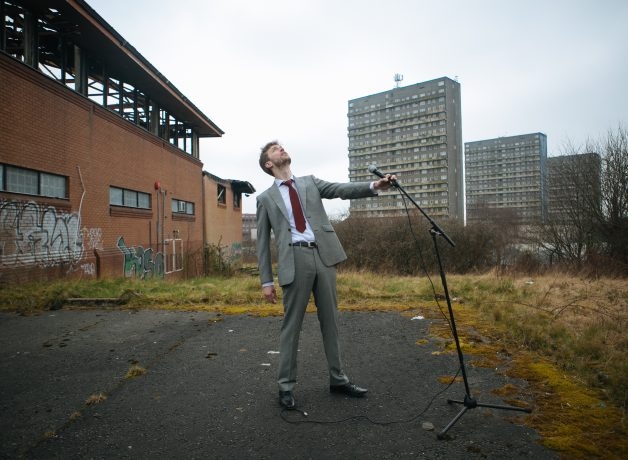
A desk, table top sound equipment, a candle in the darkness and a barefoot man in a suit. The rest is sound. A rich, melodic voice talking, talking, talking. Shifts of tempo, tales of random souls and the drip, drip, drip of impending doom. 

This 2016 Fringe Award winner is hypnotic storytelling but this is no bedtime story by candlelight, it is a ferocious and visceral assault. A tale of an apocalyptic event with a slow burning fuse that fizzes through four lives photoshoped from the media.

Mercy works in Futures and sees Armageddon coming, preaching a warning to others and seeming unhinged in her desperation. Ash is 13 and slut shamed in school, cringing in a toilet cubicle as her fragile teenage identity implodes. Abdullah is stoned and paranoid as he smiles and smiles pouring drinks in a  corporate coffee house. Leon is a coke fuelled pop star saving icebergs and bees in a fugue of media hype while his girlfriend gives birth alone.

These characters are fragmented elements of all of us. Their stories collide and connect and are reframed as the apocalypse shakes down our existence and our humanity. The sonic boom is deafening and seems to go on forever then bleeds into exquisite choral music. As Mercy repeats her mantra What we have is  now everything changes and we adapt as we always have.

Hurley is a gifted writer and a skilful storyteller. There is poetry is every gesture and anguished expression. This is a performance in which he wrings out every drop of self. The result may not be to everyones taste but at best it makes you wake up and really feel alive.
At Home until 20th May then touring.

The Road To Huntsville

20170517_200052.jpgThe Aldridge Studio, The Lowry

Part of WTF Wednesday in association with Word of Warning

Written and performed by Stephanie Ridings

Directed by Jonathon V McGrath

Cute cat GIFs are interspersed with websites for prisoners seeking penfriends or girlfriends or wives. The screen behind Stephanie fills with images of death row prisoners seeking love and a disturbingly literal happy ending. Did you know that the fourth biggest selling Author in the world, Danielle Steele has twice married prisoners? Her second wedding took place in a prison canteen after her fiancé was reincarcerated after cheating on her by raping someone else!

Stephanie is a lovely engaging woman who has just had a certain birthday and lives in Warwick with Stumpy her partner of 12 years and her one eyed fluffy housecat. She has a family with some issues and stressors based in Blackpool. She takes antidepressants but feels they may not be working. She is a performer and likes to research her subject matter thoroughly.

The show uses a blend of screen images and video interspersed with Stephanie telling the story of how she moves from internet research and ordering books from Amazon to corresponding with Jonny incarcerated on death row to being the last image he sees as he receives a lethal injection in Huntsville, Texas.

The brilliance of this performance is Ridings curiosity and how her bewilderment with the women who form relationships with these men moves to her own burgeoning connection with Jonny and his sister. The subject matter is difficult and highly sensitive regardless of how we view the death penalty yet Ridings  is never preachy or judgemental. Sitting in the front row as she sits opposite it feels like having a surreal  coffee with a girlfriend who has just visited death row on her holidays.

The tiny details make the most potent impact in this show- the institutional smell of Jonnys’ letters or the tiny windows in the prison or the view from a diner which faces Huntsville death room to the glorious lake views on the 45 mile trip from Prison to the Huntsville. Ridings has taken a huge personal emotional risk in making this piece of theatre and there are moments of genuine discomfort at her vulnerability and her decision making. The closing screen images of text messages appearing as she is trying to salvage her relationship with her partner are genuinely touching. It reminds us all of how universal is the need for love and connection whether we are at home in a faltering relationship or in solitary confinement on death row.

Winter Hill

1495020920320362048818.jpg

Bolton Octagon

Writer  Timberlake Wertenbaker

Director Elisabeth Newman

Cast Denise Black, Souad Faress, Fiona Hampton, Janet Henfrey, Louise Jameson, Susan Twist, Cathy Tyson and Eva-Jane Willis

This is a new play by acclaimed  playwright Timberlake Wertenbaker which on paper has lots to recommend it. Winter Hill is directed by one of the youngest Female Artistic Directors in the country and stars a cluster of respected actresses and a great big hunk of rock near Bolton. Having a love of strong, feisty women, politics, literature and big, craggy hills this was ticking lots of boxes. Sadly this was a mishmash of poorly defined ideas and heavy handed caricatures of older women which ended up feeling like Last of The Summer Wine with Semtex.

The story of a book group compromised of a cluster of women who are all of a certain age with a back story of radical activism and feminism. Dolly played with gutsy aplomb by Denise Black is a women ready to ramp up her activism and intends to blow up this hotel as a fingers up to big business. She is supported in varying degrees by the other women. The ensuing events are fragmented by jumps in time as her daughter tries to piece together what really happened on the Hill and we see the survivors broken and incarcerated in a range of ways. The message seems to be that women cannot have it all. You cannot be an activist mother and bake with your daughter or plant a bomb to make a noble statement without making a total hash of it

The staging feels curiously unfinished as it is a mess of scaffolding, builders tools and masonry so it often feels likes watching a bunch of  intelligent older actresses rehearsing rather than seeing a polished end result. The messy stage is of course the building site of a partially constructed hotel on top of Winter Hill in Bolton. Not just any hotel but one fit for Russian obligachs and world leaders with a helipad AND a runway!! The problem with this plot device is its improbability as Bolton is not an obvious location for billionaires and its feels somewhat uncomfortable to allude to so many flight options when Winter Hill was the scene of an actual air disaster.

There is some really strong acting from a great cast and it feels like there is a genuine camaraderie of the Sisterhood on stage. I imagine Elisabeth Newman and the cast have had a lot of fun working on this project and the passion and commitment shines through. The play explores literary heroines, feminism, green issues, activism, terrorism and a host of other issues. The script struggles to cover so many major issues adequately while flitting in and out of time frames and attempting to convey drama and humour and lot of big preachy speeches and pithy one liners. The end result is a mess of good ideas and important issues which never get fully realised.

Perhaps the biggest frustration with the play is it feels like a wasted opportunity to show talented women of a certain age on the stage being unique and vibrant and thoroughly alive. However if you like your menopausal women badly dressed, a bit bonkers and as hot headed as their hormonal flushes with weak bladders and a penchant for books and booze then this is the play for you.

Until Sat 3 June

How My Light Is Spent

Royal Exchange Theatre

By Alan Harris

Directed by Liz Stevenson

Cast Rhodri Meilir and Alexandria Riley


1494696103301217673071.jpg

How My Light Is Spent. Royal Exchange, Manchester. Photo by Jonathon Keenan.

A phone connection at precisely 7.30pm every Wednesday evening  for precisely nine minutes has become the only meaningful social connection in the life of 34 year old Jimmy living at home with his mother in Newport. Kitty, a telephone sex worker saving up to study to be a Psychologist is his only conduit into an existence where he matters and he feels fully alive.

Winner of the Judges Award in the 2015 Bruntwood prize this is a darkly comedic look at social disengagement and how easy it is to literally disappear without the social constructs of family, work and interpersonal relationships.  This two-hander could be thoroughly bleak and grim but the whimsical introduction of an actual vanishing man brings a lightness to the play.  Rhodri Meilir is excellent, giving Jimmy a fully fleshed character who is socially clumsy, lugubrious and still desperately eager to open his big Welsh heart to love.  Alexandria Riley is simply wonderful as a  bruised but never broken woman with big dreams and limited options, however her character would benefit from further development as the role of Kitty is equally important to this play.

Both actors  also very effectively voice the other characters in the play bringing alive Rita as the mother who can engage with The Salvation Army but struggles to communicate with her son except by phone or through the bedroom door. Kitty’s topiary obsessed Landlord Stevo is a small divorced man who collects porcelain dolls as fragile as his hope of buying Kitty’s love. Mallory is the brittle, gobby daughter Jimmy was estranged from who swings in the park waiting for the light to go out at home before she returns to a disinterested mother. All reflect the themes of loneliness and invisibility and dispossession.

Staged in traverse this cleverly divides the audience while ensuring we are forced to look at each other as well as at the actors. Fly Davis  has created a stark bridge which both maintains a sense of   separateness acting as a barrier to connecting and a kind of stepping stone to reaching out to others. The use of sounds of keyboards tapping and swings moving in the breeze and naff music are really evocative and allow us to see the invisible and wish to connect.The lighting crucial in a piece about invisibility delivers on every level. The closing scene brought all these together under Director Liz Stevensons sensitive eye  to create a little bit of magic that  made my arms tingle like Jimmys.

I left the theatre wondering what became of the widowed lady who I used to chat to at the local supermarket before her job  vanished to be replaced by a hideous self service till just as Jimmy’s job vanished to be replaced by a coin bin. This piece is timely because it reflects the general misery of the reality of Austerity for the working class as redundancies and relationships breakdowns create a non-class of invisible souls while reminding us of how brightly any soul can shine if nourished an nurtured.

SHERMAN THEATRE until 27 May

THEATRE BY THE LAKE 31May- 24 June


TANK

HOME

DIRECTED BY Billy Barrett and Ellice Stevens

WRITTEN BY Billy Barrett, Joe Boylan, Craig Hamilton, Ellice Stevens and Victoria Watson

This is the kind of theatre experience that might leave an audience dumbstruck at times but is guaranteed to generate conversation in the bar afterwards. BREACH have produced a piece of partly verbatim theatre that can shock and provoke but is also a sensitive and moving portrayal of how inhumane humanity can be.

In the midst of Sixties Cold War paranoia NASA funded a ridulously indulgent experiment into animal neuroscience. John Lilley headed up a laboratory on St Thomas experimenting with 3 dolphins in captivity. The main protagonists of this true story are Margaret Howe Lovatt and Peter a young male dolphin. There seemed to be little emphasis on hard science as Margaret had no qualifications as a researcher other than she was curious and liked dolphins. Lilley was also curious, mainly about what effect LSD might have on a huge brain- it might be useful to mention his best mate directed all the Flipper movies! The aim was to teach the dolphins to speak English and so improve Mankinds chance of communicating with extra terrestials should we ever meet any.

The high or low point of five years of research was a 10 week period in which Margaret and Peter cohabited in a watery home. Peter did not learn to speak English but Margaret did learn how to masturbate a dolphin so maybe not an entire waste of time!

TANK uses dried out tapes of some surviving recordings of this research to illustrate this fishy tale and lo fi microphones to reproduce Peters attempts at language. The large video screen is used to show the underwater film of Peter and Margaret while the four actors on stage work to create a prism like take on what really occurred in the lab.

The actors bicker on stage as to the detail of the actual events. Margaret was “ruggedly feminine” and wore heels or boots or ….. Pam the dolphin had dried out traumatised skin or was covered in concealed blood. This is an odd couple love story or it’s a girl wanking off a gigantic dolphin cock. At the centre of this piece is the many facets of the story. Love, science, philosophy- how do we each perceive an event and how does experience colour our viewpoint? Here the women are wearily sensible  and frustrated by the men who sexualise  events like smutty schoolboys.

Joe Boylan is superb as Peter. He physically evokes the power and curiosity of the young dolphin. His is a totally believable performance and as he dances with the others the vibrancy and naughtiness bubbling through is totally infectious. Sophie Steer as Margaret vibrates with passion and despair as she attempts to communicate with Peter. There is an innocence and a whimsy to her that makes her masturbation of this dolphin seem sensuous and natural rather than sexualised which is exactly how the research assistant described her actions years later.

There are some delicious moments as they all sensuously dance together with blank faces or as they strip down and  Boylan puts on his dolphin mask. The air of menace is never far way as they fantasize about Margarets ruination and death at the fins of a dolphin army.

This is raw and edgy and joyous, it is dark theatre. It reminds us just how crazy humans can be but there can sometimes be a little magic in the crazy. TANK is good crazy.

POSTSCRIPT:

Twenty years after these experiments I spent a summer in Windsor researching parenting and attachment behaviours in dolphins. Two mother and their babies and I got to observe and play with them. It was heaven on earth.   

Letters to Windsor House

HOME

By Sh!t Theatre

This the very best kind of pick and mix entertainment. Someone else on stage doing the karaoke, social and political commentary that never seeks to preach and an open letterbox giving a candid view of life for those at the more vulnerable end of the renting crisis in London.

20170419_194527.jpg

Rebecca Biscuit and Louise Mothersole are Sh!t Theatre and this is their very personal experience of  renting a sh!t flat in Windsor House, Hackney, North London. They share this two bedroom council flat with their friend Ruth who plans to move out to a houseboat and with Reggie the cat. The cramped space includes a pigeon sh!t splattered balcony and a hallway which has been converted to a makeshift garden. They pay nearly £500 each per month but have no contract so have no real security to safely call this home, especially when their curiosity reveals they are actually renting a sublet council flat.

Curled up on a sh!tty sofa as the audience walk in these best friends chat, sprawl and break into song just as they probably do around their home. The set also includes a disco ball, a cheery cotton rug and a pile of cardboard boxes. A projection screen is on the wall behind them with front of stage their mike stands connected to a loop pedal and two red cardboard post boxes.

Everything happens on stage in an endearing way that seems both childishly haphazard and skilfully engineered to fill this hour to achieve maximum impact. Using photos and video they walk us out of their cramped home unto the streets of this N4 neighbourhood. There are noisy Romanian neighbours they do sonic battle with at 7am, there is the local chippy #hashtag Fish & Chips, and the sometimes very loud St Johns Deaf Centre. Windsor House is one of 4 regally named blocks of council flats behind which is The Finsbury Park Homeless Family Project. Images of this rundown and depressing area appear on screen accompanied by a slick voiceover selling the merits of the new kids on the block. Woodberry Park is the second new private development to sit on the foundations  of the old council estates now demolished. These new properties are not for local families but are glossy six figure luxury flats with gyms and 24 hour concierge facilities.

Becca and Louise film themselves viewing a home they are unlikely to ever own as they are part of Generation rent. This is a moment where they fantasise about cushions in a £925,000 apartment. Back in their flat where the thin walls allow them no illusions about each others personal habits there is an ever growing sense of desperation about their future and an ever growing mound of mail representing the past lives of previous tenants.

It is human nature to be curious and often to prevaricate. Sh!t Theatre do both very well. Thanks to a quaint legal loophole they can start opening the mail. Like all our Christmases together the letters reveal colourful hints of other lives lived in Windsor House. A kaleidoscope of song, dance and social media feeds reveal Rob Jecock the adult baby or grief stricken single father, Daisy Murray and her magazine loving dad and Saad Madras who gambles his way into debt with the Turkish mafia. They buy aspirational shirts from catalogues like The House of Bruar. They cheerfully stalk their old neighbours in attempts to help them though no one appears to be interested in supporting or reassuring them re their own rental rights. In their search they are irrepressible singing silly songs, switching accents and clambering over sofas to build cardboard houses. This could have been an unholy mess.

There is a very different energy present when they break up their search to don the anonymity of their red cardboard post boxes. Here they read each other heartfelt personal letters from the sanctity of the post box as confessional. It is these moments which highlight the social housing crisis in a way that transcends shocking statistics. Ordinary loving friends who are both petrified of change and desperate to embrace new opportunities. Windsor House is for now both a refuge and a prison.

Postscript:

Ruth moves to a houseboat.

Becca moves out after a row.

Louise still lives in Windsor House.

Friendship survives.

Sh!t Theatre continues to develop new work.

The shirts from House of Bruar cost £65 each and are sh!t quality according to Louise.