JUBILEE 


The Royal Exchange 
Adapted for the stage by Chris Goode from the original screenplay by Derek Jarman and James Whaley 

Directed by Chris Goode 

The interior walls of the Royal Exchange Theatre are densely covered in graffiti. The music is ramped up – this is not Royal Exchange noise levels – this is JUBILEE. The stage is set with Toyah Wilcox at her dressing table as Queen Elisabeth I regally pondering the future. 

This is 40 years on from her anarchic role as Mads in the original Derek Jarman film. Having seen the original as a young teenager and promptly calling one of the family cats kittens after Toyah this feels like time travel for more than just Elisabeth I. Looking around the actual Royal Exchange  theatre it feels like we could be in a time travel machine. I half expected Amyl Nitrate and her girl gang to seal in the audience with barbed wire and Union Jack flag poles.

This adaptation by Chris Goode is faithful to the original film. The production is brought up to date by references to Cameron, Trump, Brexit and music tracks like Bad Girls by M.I.A but it maintains Jarman’s messy, anarchic “have a go” punk ethic. Adam Ant who played Kid in the original said Jarman was making it up as he went along. Goode is known as a director who likes to give actors space to develop and explore and this feels like an explosion of many ideas. This is not a cohesive piece of drama but is more a series of adrenaline shots fizzing round the space like Catherine Wheels. 

There are bodies copulating in various combinations, a brutish policeman is castrated, there is an autoerotic asphyxiation  murder, there is beautiful poetry, singing, dancing, political polemic and witty audience banter led by the brilliant Travis Alabanza. Chris Goode has staged a sort of A-Level drama exam take on an anarchic cabaret cabaret. Love it or hate it you won’t forget it.

There are some blistering moments like gems from the stolen crown hidden in an Aldi plastic bag by Bod. The scene looking out at all the tower blocks vividly alludes to Grenfall Towers as Sphinx describes the grey concrete towers of his childhood as an equally effective means of killing poor people as war.

The passionate rhetoric which bursts from Amyl Nitrate in the second half gives Travis Alabanza a perfect platform for their natural brilliance. This trans artist is perfectly cast and striding around in heels and Jackie Kennedy pearls and pink is both outlandish and endearing. This is the performance that both charms and terrifies in equal measure. The original performer in this role was Jordan who Jarman described as “art history as make-up”. Jordan was in Manchester this week for a Louder than Words event – I really hope she got to see this.

If there is a SPOILER ALERT  for Jubilee it is DON’T LEAVE at the interval because the first Act is overly long. The second act is a blistering finale where this “No Future” nihilistic polemic directly addresses those who remember the original film. If we were 15 back in 1977 then we have now been running the country for the last ten years. It is a sobering thought sitting in the Royal Exchange which recently had its 40 year anniversary watching Jubilee made nearly 40 years ago in 1978. 

As the performance ends Elisabeth I can hear the familiar sound of seagulls harking back to her seafaring adventurous era. However hopeful or hopeless we may feel under whatever political ideology we uphold or rail against, perhaps one certainty is seagulls swooping over stony shingle coastline. I’m sure Derek Jarman would not wish it any other way.

Royal Exchange 2-18 November

Uncle Vanya

HOME 

Written by Anton Chekhov

Adapted by Andrew Lipton 

Directed by Walter Meierjohann

Uncle Vanya was written 20 years before The Russian Revolution of 1917 and may depict a long gone era, however the themes of depression, regrets and obsessional love are timeless. The uncertainties and frailties of human emotion are all on display and are beautifully depicted in this adaptation.

The set by Steffi Wurster is vast so the home setting dwarves the characters. The walls extend up to encompass everything and everyone, effectively creating a sense of claustrophobia. The raised piano ensures that the comfort of music remains out of reach for Yelena. The sense of decay and gloom seeps out of the walls. Even a garden scene plays out within the gloom of the house. There is literally no escape for Vanya and Sonya. The estate dominates everything as both prison, and home and hearth. 

The key human emotions of Anger, Fear, Joy and Sadness are all evoked in subtle ways. The layers of each performance ensure that each character is defined and memorable. There is always a sense of fatalism here and human curiosity about how each character chooses to respond. The emotion connection with the audience becomes truly intimate when characters  address us as though personally sharing with us one to one. 

The Professor is a man whose success and potency is fast waning and the only new challenges he faces are illness and death. Nick Hodder’s Vanya brilliantly evokes a man who has given up in body and spirit. He is only 47 but feels his life is not only over but has never really started. The tragicomedic outcome of his brief reach for love and hope is  perfectly pitched. In contrast Jason Merrells gives Astrov vitality and curiosity which lifts the gloomy house. He imbues new thinking and change yet is born too soon to really make a difference for himself. Despite their differences neither man is likely to get the future they crave and will continue to exist rather than thrive.

The older women seem stoic and content in their roles within the house. The younger female characters are similarly trapped by the social norms. Hana Yannas is perfect cast as a beautiful and brittle trophy wife full of longing and repressed energy. She is mystified at the possibility of breaking free and having love and passion rather than wifely duty and social position. Katie West is luminous on stage, her Sonya is an innocent and it is her sense of hope in an weary old world that holds everyone together. Her physical plainness is viewed as an obstacle to love and passion so she is as equally thwarted as Yelena. She remains unseen by Vaskov despite being a good match for the middle aged doctor. The tragic irony that both her and Vaskov would rather have nothing if not a great love, and therefore both are likely to get nothing. She is at peace in a spiritual way, resigned to a life of duty and tending to the needs of others rather than fulfilling her own desires in her earthly life.

The ephemeral nature of love and hope seem to dictate that emotional survival comes from taking solace in solid things like food, vodka, work or nature. In Uncle Vanya we see all too painfully what may be the outcome from missed opportunities or possibilities not acted upon. If only Vanya had seized his moment with Yelena 10 years earlier or if Astrov was more of a pragmatist than a dreamer then Sonya would have a very different life. The  invitation in this production is Seize the Day for each day is a once in a lifetime opportunity. 

Fri 3Sat 25 Nov at HOME 

The Weir 

OLDHAM COLISEUM 

Written by Conor McPherson 

Directed by Adele Thomas

Co-production English Touring Theatre and Mercury Theatre Colchester

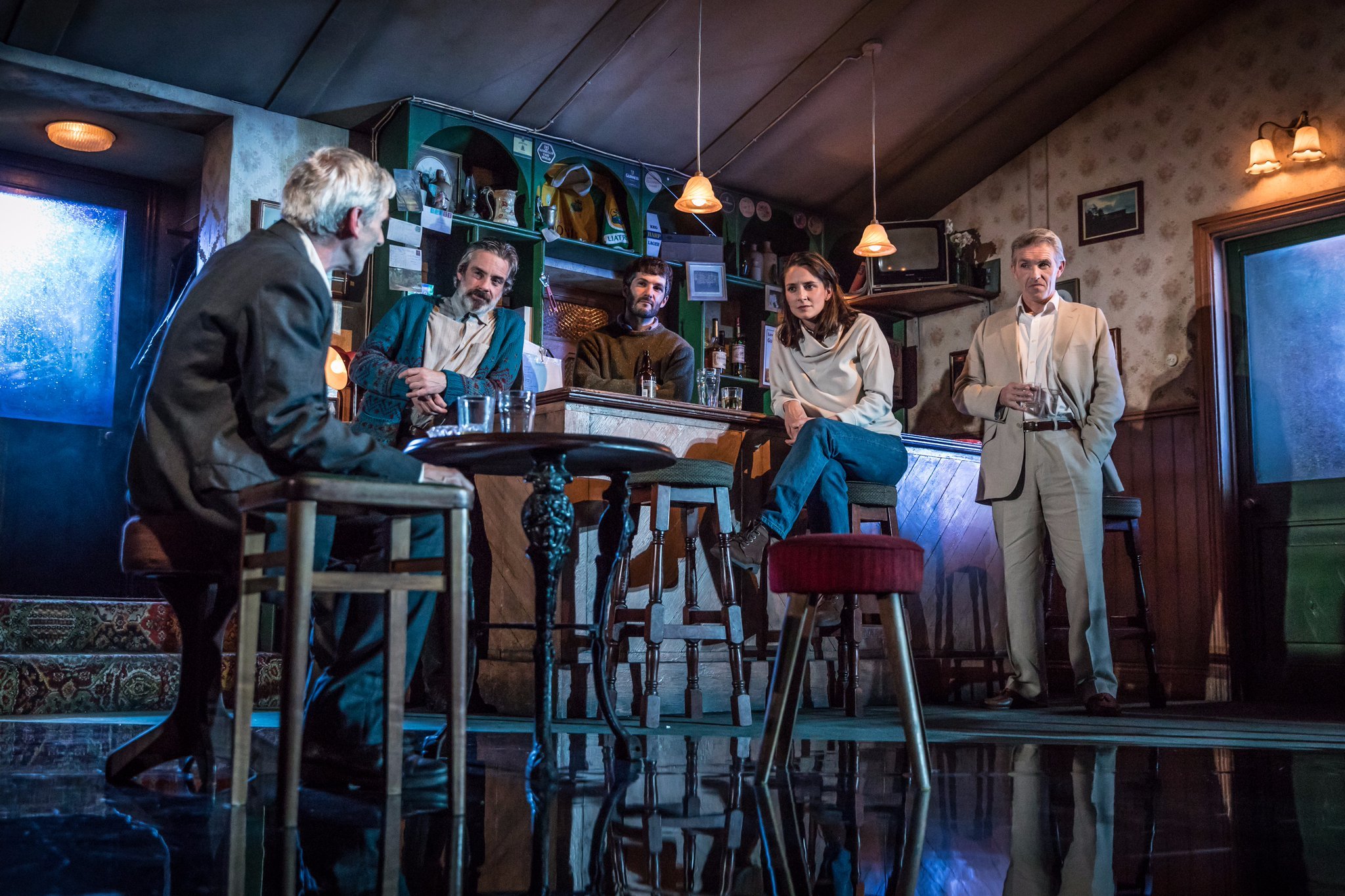
First staged at the Royal Court Theatre twenty years ago, The Weir remains an exquisite example of story telling on every level. From the first moment of this remote Irish pub opening for business to the closing of the door and dimming of the lights this is spellbinding theatre.

Nothing really happens in this quiet bar throughout the evening and yet this a night that will be woven into the local story telling traditions in years to come. The themes of loneliness, stoicism and loss are entwined in how much identity in rural Ireland is defined by the land and family. The four men are all from this remote part of County Donegal. The young publican  Brendan  and his regulars Jack and Jimmy are seemingly resigned to their solitary lives. Their individual obligations to Sisters, to the Mammy or to maintaining the local vehicles define their identities in this small isolated community. Finbar has got out, left the loneliness for marriage, commercial success and life in the neighbouring town yet he seems the most vulnerable of the four men. Newcomer Valerie has “blown in” seeking solitude as a panacea to grief.

The sharing of old stories and myths intertwined with lived experiences connect all five in ways that soothe that inner loneliness, and beautifully reveals the sensitivity in each of these four awkward local men. The relationships between the characters are perfectly pitched to reveal all the subtle elements of their shared history in this community. 

Growing up in a rural Irish village I knew every man on the Stage and every worn barstool and smoke stained lamp and old photo on the walls. The actors personify their characters as though they have drunk them in reflectively like a pint of stout or Harp. When Valerie occassionally jars in the gentle pace it is only because she is an outsider, blown in from the big city. 

As drinks are drunk and stories are told the magic of small lives richly lived is evident. This bar has no need of a jukebox, the tiny television is unused and nothing more is needed than the human voice and the wind singing under the door.

OLDHAM COLISEUM 24-28th October 

On tour

SOMETHING DARK

HOME 

LEMN SISSAY

Dark, In Darkness always comes the question,Where is the light?”

Lemn  Sissay literally bounces unto the stage as though about to launch into a stand up routine. The first twenty minutes are indeed a stand up routine in the sense that this is a connection process. Who are we, how do we respond, are we accepting or rejecting? This is the quicksilver poet, the actor, performer, public speaker and private man and inner child. In giving the audience an extra bonus introduction before the play there is an unspoken understanding that this connection is about boundaries and safety.  In therapy we talk about the three Ps- Protection, Permission and Potency. In this instance they seem vital to this piece.

During the performance he remarks, that  “You shouldn’t tell your story in the way that I’ve told mine if you’ve not come to terms with it. Your well-being has got to be in mind.” On stage he exudes strength, confidence and a wickedly playful sense of humour. He creates a safe space for himself and for the audience in how he performs his own life experience. I sincerely hope that when he steps away from the stage those carefully constructed and honed inner strengths remain robust.
Something Dark is Lemn Sissays one man play telling the extraordinary and shocking story of his childhood in foster care from birth and in four  state childrens homes from age eleven to eighteen. It seems impossible to believe that Wigan Social Services countenanced such appalling disregard for a Mothers wishes for her child’s well being and safety. The second half of the play follows his journey to seek out his birth mother living in The Gambia and find a sense of family both there and in his parents homeland, Ethiopia. 

Any sense of family however dysfunctional is a gift for a man who at twenty had no one in his life that had known him more than two years. “I was the only proof of my own existence,” As he reminds us family gives us reference points, family provides  a set of disputed memories over a lifetime which inform how we see ourselves in Society. As someone who once stood pregnant for the first time at a parents graveside I can connect with that acute sense of being adrift and unknown without parents or siblings  to validate my stories and memories. 

The performance is rich and full of life, full of resilience and persistence. This work embodies our need in Society to embrace acceptance and tolerance. It eloquently screams out our need to address how we view young people in care and ensure that every aspect of their well-being is paramount while they are being parented by the State.

The performance is both uplifting and painful to watch as this clever, engaging and quite beautiful man reads his story and leads us on a journey so very dark and yet so brilliantly light. Light- because standing on that stage telling his story so poetically and advocating so passionately for young people in the care system, he radiates a light much brighter than the spotlight upon him.

For a human being born into such a dark place he epitomises nothing but light and has certainly fought long and hard “for the right to light.”

Journeys Festival International/ Orbit Festival

13th October 2017

DUCKIE 

CONTACT
Writer/ Performer – Le Chocolat Gateau
Produced/Developed – In Company Collective
There are moments when I wish I could rewind time with my children and go back to when they were very young. Today was such a day, watching the gorgeous DUCKIE I wished my teenage darlings were ten years younger and there in the audience with me. This show is a wonderfully deft merging of cabaret, children’s theatre, fairy tale reimagining and a big dollop of old Hollywood magic.
Cabaret performer and Opera singer Le Gateau Chocolat takes the much loved tale of The Ugly Duckling by Hans Christian Anderson and goes to the circus to seek out soulmates for this lonely misfit, the runt of the litter. To the delight of the child in all of us, the mischievious performer portrays a duck who cannot quack but belches instead. His lonely duckie can’t quack or dance, he is too small to be a muscleman and too big, too yellow, too tall…… DUCKIE would seem to be a duck who is seriously down on his luck.
The voiceover which speaks to DUCKIE and at times the audience is soothing and reassuring- a bit like having Judy Dench voicing your bedtime story. The rest is simply the gorgeous baritone voice of Le Gateau Chocolat which is like having your senses bathed in warm chocolate fondant. The songs often tweaked to fit the story range from Disney classics through to The Pussycat Dolls Don’t cha and La Cage Aux Folles I am what I am to Cyndi Laupers Girls just want to have fun.
Visually the set is deceptively simple but with dressing up clothes tucked away and bright umbrellas popping out it holds gems of surprise. The lighting design is magical and reminds me of the country village circus tours of my childhood. Throughout his costume changes there is always the fluid physicality, warmly, gleaming eyes and glittery lips. This is a performer who is totally at ease with his audience, both young and simply young at heart. It would be hard not to be drawn into DUCKIE’S world and empathise with his plight.
When the insults come increasingly thick and fast and the voicing of them sounds more and more like children the true dark background to the story shines through. DUCKIE is rendered small, wounded and vulnerable as he looks out in confusion at a world that will not let him belong. His salvation through a beautifully rendered little mouse is touching and ensures a fairytale happy ending. We shun or ridicule what is “ugly” not because it’s ugly but simply because it is different. DUCKIE delivers a message of acceptance and tolerance that resonates with adults and sews a seed in young children that hopefully blossoms in every new generation.
CONTACT 24-25 OCTOBER

Parliament Square 

A Royal Exchange Theatre and Bush Theatre Co-production 

Written by James Fritz

Directed by Jude Christian

This is the world première of Parliament Square which received a Judges Award in The Bruntwood Prize for Playwriting in 2015. It explores whether political protests can change the world, and if a violent act of conscience could really make a profound difference or simply be deemed an act of madness. 

This production is sparsely staged so it relies on the strength of the writing and the central performances. For a play which centres on a single act of high octane drama and covers a significant period of years in its aftermath, there is very little action. This is a play which may work better in a more intimate space and for me it felt like it’s natural home was the Royal Exchange studio space. It is however testament to the writing by James Fritz and the direction by Jude Christian that the play is always engrossing and the running time of 100 minutes flew by. 

The opening scenes with the central character Kat and the starkly named Voice create an initial sense of confusion. Is this a discussion/argument between friends/family/lovers or is this an internal battle of conscience or possibly even a manifestation of a women with D.I.D (Dissociative Indentity Disorder)? The use of disembodied voice overs to convey a sense of family cleverly creates a growing awareness of what is about to happen to all those involved if Kat is successful in her plan

The internal struggle for Kat is beautifully played out by Esther Smith and the raw confusion around what to do is peppered by little gems of exquisite ordinariness. The mundane shock at the cost of a single peak time train fare to London or the poignancy of regret at no more sex or lasagne or the brutal finality of the last thing to see being “a fucking Tesco”. There is a definite sense of  this women preparing to give up a real life full of love and laughter. It is less evident what is actually driving her toward this extreme act of defiance. It is both intriguing and frustrating that there is no obvious causal factor other than “things are getting worse”. There appears to be nothing remarkable about Kat and no signs of psychological dysfunction yet she is getting on a train with the sole purpose of auto-cremating in a public space. 

Fire is the probably the most feared of all forms of death. The sociologist Emile Durkheim separated suicides into four types: the egoistic, the altruistic, the anomic (moral confusion), and the fatalistic. Perhaps self-immolation captivates so thoroughly because it wins on all counts. It is the ultimate act of both despair and defiance, a symbol at once of resignation and heroic self-sacrifice.

The simple act of counting is horrifyingly chilling. 15 seconds are all that must be endured and it is over. The objective achieved and the pain ceased. As the seconds are counted out in real time it is simply unbearable and the sudden rupture at 8 seconds is agonising relief. 

The second half deals with the aftermath. It plays out in hospital and rehabilitation as Kat and her family are reunited and have to find their individual ways to come to terms with what has happened. Society is untouched and largely unaware of Kat’s sacrifice, it is her and her family who are irrevocably impacted by this single act of political defiance. In the end it is whether or not the politics of family life can remain the same or not.

The dramatic use of light/dark/light in the hospital scenes is extremely effective at creating Kats slow and agonising reawakening and recuperation. This device is further developed as we see flashes of life carrying on over the years. Hospital appointments, job promotions, family barbecues  and a child’s birthdays convey the passing years as society becomes more fractured and threatening. The stop/start flashes of life are reminiscent of the flickers of a cigarette lighter in reluctant or wary  hands. The allusion to fire is also poignantly captured in a passing remark about “hundreds suffocating and no one surviving above the 13th floor”. The comparisons to austerity measures, broken Britain and Grenfall Towers were clear.

The relationship with her mother is the most interesting and Joanne Howarth is excellent as another strong woman who despairs of what has happened but is pragmatic in what needs to happen next for Kat to have a viable future. She articulates her frustration, “What’s wrong with a fucking petition?” and protects her child with a blanket of silence in the belief that rather than be viewed as a hero she would be seen as a lunatic. 

The interplay between Kat and Tommy her husband and with her rescuer Catherine work less well. Their characters all need more development to be more believable. The extreme nature of the core of this play is such that it does not feel authentic that a marriage would not have been severely impacted by Kats actions. The reappearance of her rescuer seems more of a plot device than an authentic action. I cannot believe that the character would not have feared a similar failed outcome as that of Kat. It is a very moving final scene but I can’t help seeing the closing scene as either Kat revisiting Parliament Square after years of unremitting pain and finishing what she started, or with her and her rescuer Catherine standing together in a final unified act of protest.

Royal Exchange Theatre 18 – 28th October 

Bush Theatre 30th November – 6th January


PEOPLE, PLACES & THINGS

HOME

Written by Duncan Macmillan

Directed by Jeremy Herron                          with Holly Race Roughan

Almost 2 years after it’s world premiere at the National Theatre’s Dorfman Theatre Headlong open the first UK tour of People, Places  & Things at HOME. The play retains the original set, but has a new cast and is updated to include reflect recent major political events.

The stark white set is like a tabula rasa before the sudden ear splitting plunge into period drama with Emma as the fragile Nina from Chekhov’s The Seagull. Seconds later and time fractures again like a skipping cd and the seamless shift to the reception area of a rehab unit reveals a second audience facing us with traverse like staging. This device toys with the layers we may all sometimes hide behind. It also  manages to convey that sense in therapy that someone literally  has your back.  In many respects the seating of the audience serves as a second circle of trust in this therapeutic space.

If there is a huge amount of pressure on Lisa Dwyer Hogg to follow the award winning performance of Denise Gough it is not apparent. She delivers a wonderfully brittle, fractured addict trying to survive her many demons. The frequent use of gallows humour sits well with her Northern Irish accent and places her securely in a family of distant fathers and relentlessly harsh mothers.

Her Nina/Emma/Sarah is “excellent at being other people and totally useless being myself.” Like so many addicts she displays a toxic combination of low self esteem and grandiosity, doubting herself as an actress while challenging her doctor to “be cleverer than this. I need you to match me.”

Bunny Christie’s set facilitates the craziness of withdrawal. Aspects of the walls and floor move and shift like prisms and open up to reveal floating images, and alternate Emmas fragment and appear through walls and furniture like ants crawling on skin during withdrawal. 

The therapy space reveals the raw vulnerabilities of those in recovery seeking to deal with pain, make amends in the 12 step programme and ‘practice’ ways to avoid the triggers of people, places and things. As a therapist I can vouch for the authenticity of these characters, the fragility of their sobriety and the beauty of those ‘lightbulb moments’ when new truths are revealed.

The closing scenes are brutal and harrowing as a family explores honesty and their separate truths. Therein lies the painful reality that sometimes the people, places and things we most yearn for are truly the most dangerous. The final moment on stage sees a fragile survivor seeking acceptance from us the audience. 

Booking details

22nd Sept- 7th Oct.

We’re Not Really Here – A Football Opera

CONTACT, MANCHESTER 

Knowing nothing much about football and having been to an actual match once (Manc Utd vs Chelsea 30 years ago), I admit to having major reservations about We’re not really here.

I met the co-creator Yahya Terryn at CONTACT in July and I was intrigued by his curiosity about what goes on in the stands and how the footballers experience the crowd from the pitch. He has created these performances in various countries and last night Manchester City picked up the baton/ball/whatever.

CONTACT was crackling with energy and waiting in the foyer felt how I might imagine waiting to come out the tunnel. The audience sat on the Stage while the performers/actual City fans faced us from the stands. As they spill out unto the terrace and the music pumps there is a tangible feeling of anticipation. 

This is exciting theatre regardless of how anyone views football or its fans. The shouting, chanting and singing is phenomenally powerful. At times joyful and infectious, but in other moments warlike, tribal and intimidating. The action is full on interspersed with freeze frame moments where snapshots of the fans reveal  them as individuals but also their personal motivations for being part of this tribe. 

This felt like a authentic take on the fans. Single blokes of all ages, young women snacking on crisps and hotdogs, families kitted out in all the gear, dads bonding with their lads with squabbles and hugs in equal measure. The end result is mainly heart warming and infectious but the speed at which things can potentially turn nasty is sobering and slightly unnerving.

The overall experience is brilliant and the concept creates a genuinely stimulating theatre experience. Further development of the individual interactions and personal stories would help to more fully develop this piece.

Did it work as a response piece? I think Yahya Terryn got his answer last night – ex Man City player Paul Lake who kicked off proceedings was sat directly in front of me with his family. He seemed to be loving every moment and sitting beside his young son was mirroring another father and son on stage. As for me I might not wait another 30 years before my next football match. Result!!

Until September 23rd

OUR TOWN

Royal Exchange Theatre

Thornton Wilder’s 1938 OUR TOWN is often perceived as a cosy, nostalgic view of happier days when life was simpler and slower. Sarah Frankcom’s ensures that Wilder’s original frustration at “the aggressive complacency of the middle class” is more  evident than simply a depiction of small town New Hampshire life before WW1.

The Stage Manager (an excellent Youssef Kerkour) involves the audience throughout  the three acts depicting Birth, Marriage and Death with an actual sense of  real time collaboration. In the opening act Frankcom goes a step further and places some of the audience on stage amongst the actors. We sit and watch life in Grovers Corners much like the dead do from their white chairs on the hill. The effect will differ for the individual. Some will be bored or irritated by the minutiae of daily life and others will be absorbed in the tiny details of everyday rituals.

On the surface the characters are unremarkable and lead insignificant lives. Emily is “naturally bright” yet naive as to the opportunities open to her beside marriage and family. Her father is a journalist yet seems to think the only news of value is local and parochial. Dr Gibbs sees illnesses but is blind to his own wifes’ hopes and dreams. Almost everyone bar the town drunk has a sense of propriety and order to the extent of almost seeming like autobots in a tidy town. When strong emotions crack the surface they seem as dangerous and undesirable as the unwanted automobiles which will literally not sleeping dogs lie.

The tension gradually builds as characters respond to larger life events. The marriage highlights family stresses most of us recognise. Fear of change, last minute bridal nerves, mother’s fears for children leaving the nest, a fathers resignation over giving away his terrified daughter are all beautifully realised. Norah Lopez Holden as Emily is excellent throughout, and the quietly distraught Graeme Hawley as her father soothing her bridal jitters while twisting his fingers in anguish is heart rending.

The final act brings together the dead from past and present. The standout moment in a set so devoid of props is beautifully realised and quite exquisite. The resounding message is do not “spend and waste years like you had a million to waste.” Pay attention to the smallest detail (notably one of the few props at the start and the close is a simple sunflower), as life is so precious and so fleeting.

I grew up in a small town where everyone knows each other, and the local shop is visited daily for supplies of milk, bread and gossip. The graveyard is home to my parents, grandparents and ancestors; to neighbours, friends and local gentry. Visiting last month I imagined them all together chatting and reminiscing on the hill above the deerpark. I like to think they would agree with Wilder and want us all to live each day like it really matters. The here and now may be the very best of what is to come.

Until October 14th 

THE WEDDING

HOME


Gecko opened their tour of The Wedding at HOME and the space has been buzzing all week. Last night was no exception and Gecko delivered a frenetic performance which was high on energy and buzzing with ideas and concepts.

The performance opens in darkness and noise starts to whoop behind and above the heads of the audience and moves swiftly round the theatre. Clever use of sound creates a vivid sense of what is about to happen as a performer bursts out of a chute in his underwear into a pile of teddies. Picking one up he rather reluctantly exchanges it for a wedding dress. It evokes the end of childhood freedoms and the donning of adult constraints. This exchange is officiated over by a stern woman in business dress clutching a clipboard. In this way the stage is set for Creator Amit Lahav to realise his “dystopian world in which everyone of us is a bride, wedded to society.”

The show is a blend of set dance pieces, physical theatre, circus performance and puppetry. There is always a lot happening on stage whether it is inferred from one immigrants face appearing from a suitcase to the exuberance of a Jewish wedding party. There is frequent shifts of musical styles, languages and cultures. We are all wedded to whatever society or culture or religion we are born into. The rupture of divorce from lover, job, culture or community is usually brutal whether we choose it or it is imposed upon us.

Blanked out bureaucratic faces look down from a height at office workers suffocating in endless stale routines, and often the dance reflects the jerking spasms of marionettes whirring into submission. At another point veils are torn away and we simply see another human being hiding his ordinariness behind giants stilts- no bigger or greater than anyone else on stage.

This is a piece that will probably continue to change and develop. It feels chocoblock with ideas like children spilling out of a play chute pumped full of E numbers. There is too much to take in to fully appreciate everything on stage. 

The end piece is triumphant as everyone comes together in a marriage of love rather than a wedding to state. The singing, clapping and stomping fill the theatre til it is booming with life. Home is where the heart is and last night Gecko truly put their hearts into the core of HOME.