Blog

Peter McMaster:27

Image: Oliver Rudkin

CONTACT THEATRE

Created by: Peter McMaster

Performed by: Peter McMaster and Nick Anderson

We enter through the curtains unto the main stage as though we are entering a large black confessional box. We are greeted by two men in Skeleton unitards. Is this the afterlife? Is this where all the dead 27 year olds artistes gather on a Tuesday night?

Peter McMaster explores the vulnerabilities around masculinity and the choices we may make about how fast and furious we drive toward 27 and what lies beyond. What unfolds is brutally visceral and beautifully tender.

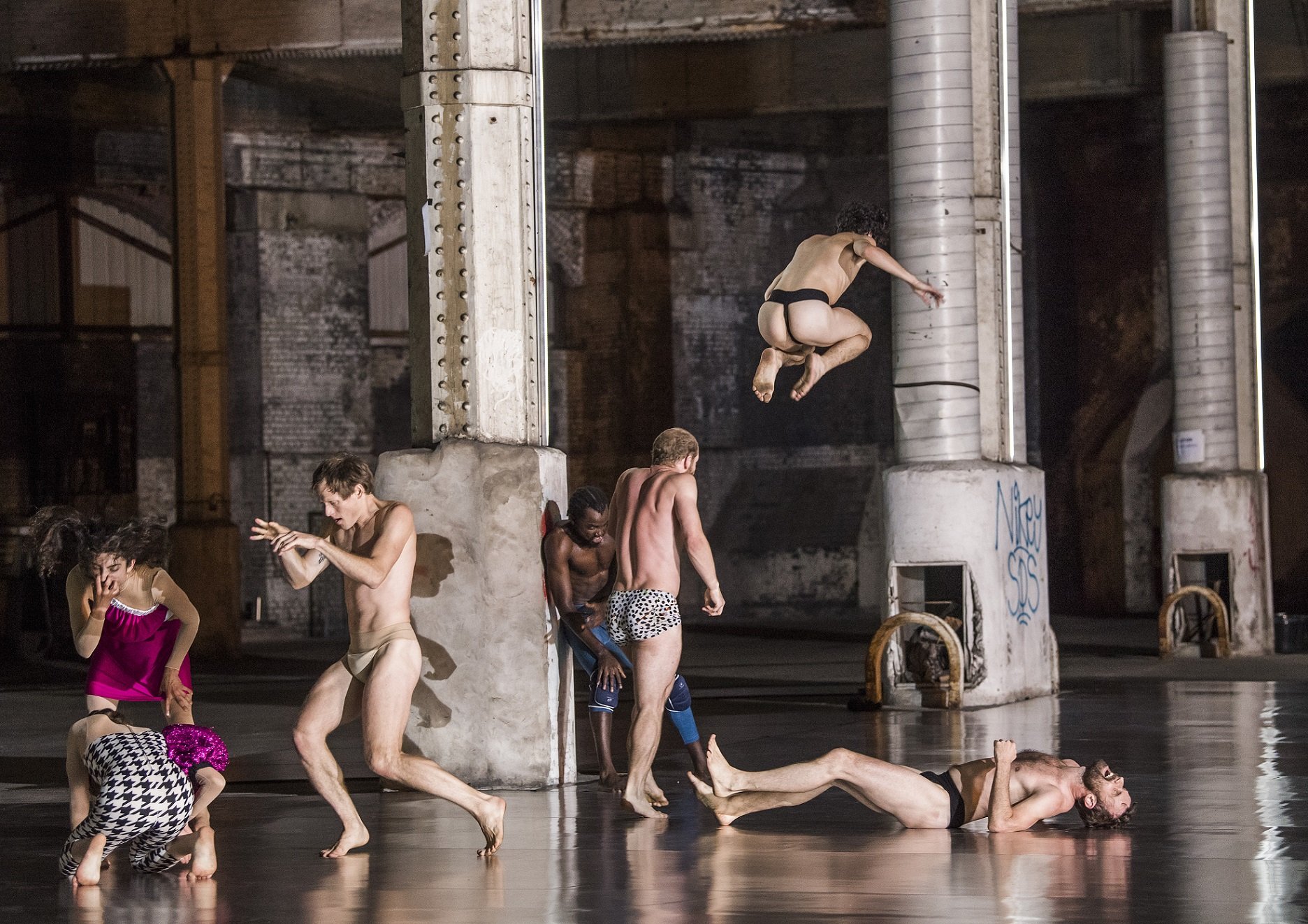
The scene is set and as these two men hold hands they evoke a powerful image of tenderness and trust. It reminded me of my son at 3 years old clutching his best friends hand as they jumped off a wall together rolling and tustling in the warm Greek sand. There is much rolling and tustling on the stage too. Bodies slam into each other with a raw intensity that blends aggression, curiosity, lust and love. Yellow tape marks out the space like a sporting event and it does indeed feel like Alan Bates and Oliver Reed wrestling in Women In Love.

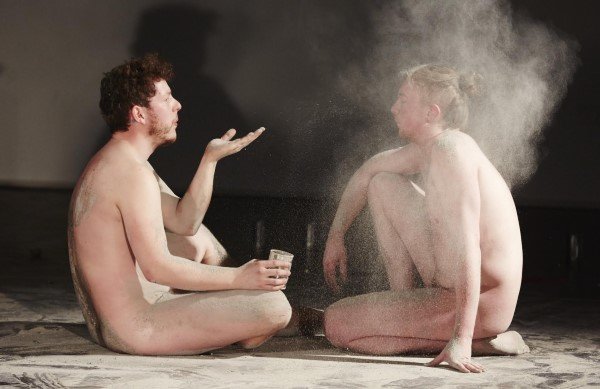
The intimacy of the performance revs up a notch as the two performers start to disrobe requesting assistance from the audience.  This could go very wrong but the vibe of warmth and trust in the space allows it to be natural and unforced. As we assist it is playful and charming. The naked male body becomes unthreatening and is simply the casing for the two lifeforces on stage. 

Remember that you are dust, and to dust you shall return.
Ash is frequently shaken across the stage to remind us of the impermanence of life at 27 or any age. At times the ceremony feels like a hedonistic take on Ash Wednesday. As they roll and throw and support each other round the space, sweat and ash clad their bodies. The fresh, pink flesh becomes deathly grey and dulled. The dirt on the outside echoes the darkness on the inside that they apologise for, unrolling scrolls of apologies that we help them read out. The dirt on the outside echoes the shame on the inside but as a celebration of life experience, and living through your excesses and your mistakes.

The musical backdrop is straight from the back catalogue of the 27 Club – Nirvana, Amy Whitehouse, Jimi Hendrix. The impact of the music highlighting the story combined with the power and grace of McMaster and Anderson ensures a truly memorable experience. 

I left 27 feeling incredibly glad to be alive in that space watching that show on that summer evening. I was 27 when my Father died and for a while I just wanted to be with him. To be just ashes. A performance like 27 is a celebration of choosing life. I would see it again in a heartbeat.

What If I Told You?

Written and Performed by PAULINE MAYERS

Directed by CHRIS  GOODE 

The Studio, The Royal Exchange 

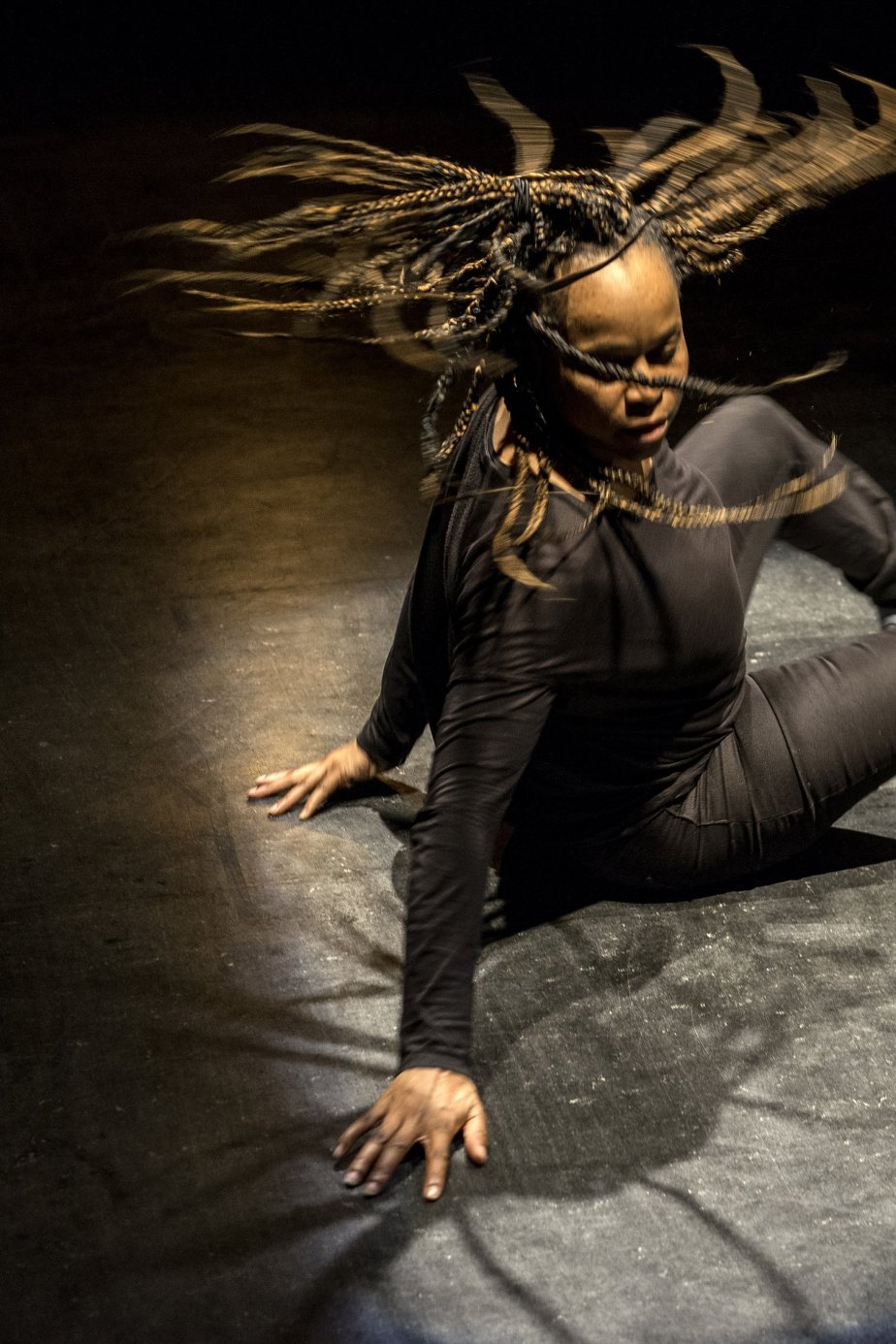
Pauline Mayers is a Rambert Ballet trained dancer, a choreographer, a writer and a theatre maker. She is a Hackney girl who has travelled the World as a dancer. She is a women of a certain age who has lived through significant  physical injuries and the emotional pain of depression.  She is a performer and an experimenter and an explorer. She is a black woman who has had a mixed response from the dance world about having a black body  to channel ballet through. More recently she has also experienced the closed doors that often greet an older dancer.

Talking to her in interview recently and watching her perform this  evening there is an undoubted warmth and engagement with others that is striking. As she opens the show her gaze attempts to connect with each member of the audience with a white hot intensity. This will draw in many audience members but for some may prove uncomfortable to fully engage with.

What If I Told You? uses theatre, movement and dance to explore prejudice and the conscious and unconscious assumption around skin colour. The piece weaves elements of her personal history and dance experience with the story of Dr J.Marion Sims often referred to as the father of modern Gynaecology. 

Dr Sims practised medicine in the nineteenth century and made major discoveries in the field of Gynaecology. His work was and remains highly controversial as he used black slave women as his subjects and refused to use anaesthetic deeming them less able to feel pain than white women.

The piece uses audience interaction and participation throughout. It is most powerful as we recreate a montage of a painting of Sims with Anarcha (a patient he experimented on many times), and two other white doctors observing while two tramatised black women peek through a curtain to see what awaits them. This is the impact of the piece that has stayed with me. Imagining that Anarcha might have been Pauline and seeing a lovely young black woman I know who could have been waiting her turn. Sims and another doctor were portrayed by white middle class men I also knew. It was deeply unsettling to imagine whose shoes we might walk in, in another place or time. 

There are some very rich moments to observe and there are some lovely interactions and connections as the audience participate in the movement of the piece. There is however a frustration that in weaving these elements together so much there is a risk that the piece loses some of its impact. An hour limits some of the storytelling when we also are participants. Pauline is so engaging I wanted more of her and less of me!!

Koan is a Japanese word for public thought. Its the audience thinking and speaking and reflecting together. Its a radical act of self care and empowerment. 
The Koan completes the second half of the show and is led by poet Khadijah Ibrahiim. Koan is a Japanese word for public thought. This is an important part of the piece as it is an exploration of subjective experience and a continuation of sharing what is “sameness” as opposed to “otherness”. 

The genuine hope in What If I Told You? is that each of us leaves the space with a keener and more empathic perspective on our neighbours. 

“There are periods of history where skin colour is used as a means to separate and disconnect us. I really feel what hurts you, hurts me. We are all human beings. There is only one race.”
This is a very personal piece. Pauline says it is an invitation to walk in her shoes for an hour. As with any subjective experience this will be more potent for some than for others. This is undoubtedly painful and chilling at times however it is also celebratory. Having stubbornly fought to be recognised as a black dancer and struggled with the loss of that career this show is also a homecoming. Theatre has welcomed her as a performer and story teller and her joy and appreciation is evident in this piece.

SHOWING 19/20 JUNE


Interview with Pauline Mayers


Getting a sense of Pauline Mayers before her new show What If I Told  You opens at The Royal Exchange Studio ahead of going to The Edinburgh Festival. Warm, funny and sharply intelligent. 

What led you into dance? Did you start from an early age? 

I’ll give you two versions because there’s what I remember and what my Mother remembers. There’s being 13 and although I had a very happy childhood, things were not going quite so well at 13/14. And the only way I could be out of the house was to do something constructive so I went along with a friend to the White Lion Youth Centre in Islington….My Mum would say from an early age 7/8 she remembers me trying to tap dance. I would try to emulate Gene Kelly laughs. My Mum,”You always wanted to be a dancer.” There’s what I remember and what my Mother witnessed. So somewhere in between.

I’m actually a Psychotherapist. That’s really typical of how we remember our past and how others define our past. Often they are very different, very different stories indeed. 

YES! There’s also something about what you remember and what you tell yourself you remember laughs based on scant pieces of information you kinda make a whole- “Oh that must be what happened”…..I think memory and history are all tied up with subjectivity, almost never objective and coming from various different angles. I kind of imagine it as a big 360 degree motion capture thing. There’s yourself in the middle and you have all these cameras swirling around you and depending on where the camera is people remember that part or version of you……Certainly doing the show, this piece; and looking back on photographs of me at Secondary School. I remember me as a very quiet child yet pictures show 13 year old me with my leg cocked up as high as I could get it so I clearly was not the shy child I recall!!

Perhaps you were a shy child but movement released something in you?

I think that’s definitely true, I do, there’s an absolute exhilaration and freedom. Movement was also like a Rubik cube, a challenge to unlock and solve, and I enjoyed trying to get my body round these tricky ways of moving. The getting up and performing was always secondary to the act of developing myself as a physical being. That curiosity of what happens if I do this? It’s the absolute laboratory laughs I used to absolutely love that.

So you eventually went to The Rambert School?

My training was intense, amazing  and wondrous; also terrifying, depressing and lonely. A few teachers had a very fixed idea of what dancers should look like and I didn’t fit the look of the dancer that they were imagining in their heads.

How did you cope with that?

It was my drive to be the thing that I wanted to be. My philosophy was I’m paying the same amount of fees as everyone else so I’m going to take your information and I’m going to be like a sponge and be this thing that you say I can’t be!!

That makes sense from a psychological perspective. We tend to adapt or rebel!

Absolutely! A teacher saying “Oh Pauline dear. Go to the back of the class. You really can’t do this.” I remember saying, “I can’t do it yet but the point of being here is that you teach me so I can!”

You were clearly there for a reason…

I think I felt if I didn’t do the dancing I would die…..It was a matter of life and death. How I felt when I danced was euphoric, falling in love, it was like I could be me….. I’ve tried to leave dance a number of times in the last few years. I can’t do anything else- not in a negative way but in a – I would not be me if I don’t do it.

You left dance in 2011 and moved into choreography. Was that about what’s happens to dancers at a certain age?

Absolutely. It’s a very big question especially for certain forms of dance. I came up against a wall of NO. I had all these amazing experiences dancing travelling around the World. I had an extensive set of skills and yet I was being told NO.. I was 41 and I’ve done this thing called Dance but I’m not being respected for that. I wasn’t being listened to. I wasn’t even being acknowledged.

That can happen to women of a certain age and you weren’t that old!!!

When it comes down to people of colour it’s like the Highlander effect. There can be only One! It really felt like I wasn’t that one. It felt like me coming in and wanting to tell unique stories was not needed because we’ve already got our person. I needed to walk away for my own sanity. In 2011 I shut the door on dance. It felt like theatre welcomed me with absolutely open arms. I had all these extraordinary collaborations. I realised I can contribute, The ideas I have in my head create value to any collaboration I do. So between 2011-2015 I worked solidly whereas 2005-2011 I was constantly on the dole!!!

So the rules in dance and theatre seem very different?

In the theatre I was just this curious bird who just wanted to find things out from people and that was ok. I could investigate like in a laboratory. In dance arenas only certain people were given permission to frame those questions. 

I’m intrigued- through out our conversation you’ve mentioned terms like experimenting, investigating, curiosity. I know you mention Dr J Marion Sims in the piece- what made you reference his experiments?

His experiments had an air of theatrics. He wanted an audience and doctors came from all over to see him create these tortuous gynaecological  experiments or mutilations on black women. He thought they felt no pain so used no ether. Even for his time what he did was extreme. He was a celebrity surgeon using black slave women as they were not valued.

How do you move between such a grim story and the lighter moments in your show?

I think it’s  humourMy own story could be seen as really grim laughs Right- young girl from Hackney leaves home at 15, ended up being a dancer til 30, then being freelance then 7 years having no money and bailiffs at the door, having depression and then the last 6 years full of amazing work. I love laughing and the joy of hearing people laugh.

So how did you come to work with Chris Goode?

Huge laughter…I had decided to go into theatre. I had a Twitter account but no real idea of its  power. I was up at 1am and this tweet from West Yorkshire Playhouse said first person to tweet back gets a wristband for TRANSFORM 2011. Chris was doing something called ‘open house’-based around Our Town come and join- you can observe or take part. I hadn’t noticed last bit and being a dutiful dancer turned up with notebook and pen.I thought I’d be observing how theatre is made but I opened the door to Chris and a group of actors sat in a circle. He gave me the biggest smile and said “Hello would you like to come and join us?” Before I knew what was happening I was involved with all the experimentation with the actors and then performed with them that night!! I went back another 2 nights and it was the most exhilarating thing I had done in a really long time.

Amazing!

Chris is extraordinary. He never leads the way you would imagine.The people in the room have all the skills and the attributes within them. They just need a space explore that so Chris was holding the space for all of us to meet, to be curious and to experiment and look at questions-What if….? Shall we…..? Such beautiful open language .. He then invited me to work with him again at Mayfest in Bristol and again at TRANSFORM 2012. It’s the curiosity. Nothing is quite as it seems because its not.

I find that process fascinating. Like light bulb moments.

Yes absolutely. I think he has a very unique gift. Virtually everyone I have met who works with him have opened out and jumped forward. It’s quite spectacular the way he brings people together at a crossroads in their lives. They are somehow transformed working with him. Working with him felt like the Universe opened up for me in a way I’d never seen before…And it continues to do this to this day and I feel it’s from that very first experience of working with him.

In “What if I told you?” are you aiming to facilitate that kind of experience for the audience?

Yes I suppose in a way.

Your show sounds like full on audience partipation.

 It is. I prefer to term it as an experience of walking in my shoes.

Ok

Audience participation can be limiting. You can ask them to do a task and they may or not do it. I feel we are all being story tellers in the space. We are creating and recreating moments from my life and moments from the past to inform where we go from this moment on. We are creating a memory together. That what the show does is the conduit to the Koan which is the second half of the show and is more important.

Koan?

Koan is a Japanese word for public thought. It’s the audience thinking and speaking and reflecting together. It’s a radical act of self care and empowerment. The space is held by a facilitator who leads the discussion, the poet Khadijh Ibrahiim. It enables people to have a space to pause and reflect – Now I’ve seen this what does it mean to be human?

Are you present in the room during the Koan or do you step away?

I’m nowhere to be seen!!!laughs Thats a very conscious thought. I’ve done my bit! I’ve given my experience and had the audience live in my shoes for an hour.

Perhaps you need time to process that too…..

 What I want is for the audience to come to their own conclusion. They already have a sense of the idea of colour prejudice as ridiculous. Yet we are still dealing with the complexities of it. We are using a very loaded term by using the term race. We are imagining it far bigger and greater than the actual act of racism is. The slave trade was about making money and eventually racism was tied into that. There are periods of history where skin colour is used as a means to separate and disconnect us. I really feel what hurts you, hurts me. We are all human beings. There is only one race.

Slavery went on for 400 years, The mass movement of people from an entire continent in a machine-like way. It sought to eradicate the history and culture if a continent and replace it with something that never came from there.

When something happens on that huge a scale for that long it can almost start to lose its true impact. It’s too big.

Absolutely. In What If I Told You I want to say to people we are human beings first and foremost. We love. We hate. We forgive. We have empathy and  compassion in equal measure. What’s your experience? What’s mine? How do they connect? What’s the common denominator? And then move forward from that- we might have a chance to really talk about this in ways that we need to talk in order to heal.

If one person goes to What If I Told You  and is changed by that experience and says “I’m thinking differently about skin colour and I want to share that with others” then I have done exactly what I set out to do.

It feels like a really timely piece to be performed especially here in Manchester.

We love and we hate. It’s a piece that grows with time not diminishes. It’s a piece to reflect on. People are surprised by the horror of it, by the joy of it, by the challenge of it.

I look forward to seeing it Pauline. Good luck with taking it to The Edinburgh Festival.

Thanks.
SHOWING AT THE ROYAL EXCHANGE STUDIO 19/20  JUNE  

Interview with Pauline Mayers 

Getting a sense of Pauline Mayers before her new show What If I Told  You opens at The Royal Exchange Studio ahead of going to The Edinburgh Festival. Warm, funny and sharply intelligent. 

What led you into dance? Did you start from an early age? 

I’ll give you two versions because there’s what I remember and what my Mother remembers. There’s being 13 and although I had a very happy childhood, things were not going quite so well at 13/14. And the only way I could be out of the house was to do something constructive so I went along with a friend to the White Lion Youth Centre in Islington….My Mum would say from an early age 7/8 she remembers me trying to tap dance. I would try to emulate Gene Kelly laughs. My Mum,”You always wanted to be a dancer.” There’s what I remember and what my Mother witnessed. So somewhere in between.

I’m actually a Psychotherapist. That’s really typical of how we remember our past and how others define our past. Often they are very different, very different stories indeed. 

YES! There’s also something about what you remember and what you tell yourself you remember laughs based on scant pieces of information you kinda make a whole- “Oh that must be what happened”…..I think memory and history are all tied up with subjectivity, almost never objective and coming from various different angles. I kind of imagine it as a big 360 degree motion capture thing. There’s yourself in the middle and you have all these cameras swirling around you and depending on where the camera is people remember that part or version of you……Certainly doing the show, this piece; and looking back on photographs of me at Secondary School. I remember me as a very quiet child yet pictures show 13 year old me with my leg cocked up as high as I could get it so I clearly was not the shy child I recall!!

Perhaps you were a shy child but movement released something in you?

I think that’s definitely true, I do, there’s an absolute exhilaration and freedom. Movement was also like a Rubik cube, a challenge to unlock and solve, and I enjoyed trying to get my body round these tricky ways of moving. The getting up and performing was always secondary to the act of developing myself as a physical being. That curiosity of what happens if I do this? It’s the absolute laboratory laughs I used to absolutely love that.

So you eventually went to The Rambert School?

My training was intense, amazing  and wondrous; also terrifying, depressing and lonely. A few teachers had a very fixed idea of what dancers should look like and I didn’t fit the look of the dancer that they were imagining in their heads.

How did you cope with that?

It was my drive to be the thing that I wanted to be. My philosophy was I’m paying the same amount of fees as everyone else so I’m going to take your information and I’m going to be like a sponge and be this thing that you say I can’t be!!

That makes sense from a psychological perspective. We tend to adapt or rebel!

Absolutely! A teacher saying “Oh Pauline dear. Go to the back of the class. You really can’t do this.” I remember saying, “I can’t do it yet but the point of being here is that you teach me so I can!”

You were clearly there for a reason…

I think I felt if I didn’t do the dancing I would die…..It was a matter of life and death. How I felt when I danced was euphoric, falling in love, it was like I could be me….. I’ve tried to leave dance a number of times in the last few years. I can’t do anything else- not in a negative way but in a – I would not be me if I don’t do it.

You left dance in 2011 and moved into choreography. Was that about what’s happens to dancers at a certain age?

Absolutely. It’s a very big question especially for certain forms of dance. I came up against a wall of NO. I had all these amazing experiences dancing travelling around the World. I had an extensive set of skills and yet I was being told NO.. I was 41 and I’ve done this thing called Dance but I’m not being respected for that. I wasn’t being listened to. I wasn’t even being acknowledged.

That can happen to women of a certain age and you weren’t that old!!!

When it comes down to people of colour it’s like the Highlander effect. There can be only One! It really felt like I wasn’t that one. It felt like me coming in and wanting to tell unique stories was not needed because we’ve already got our person. I needed to walk away for my own sanity. In 2011 I shut the door on dance. It felt like theatre welcomed me with absolutely open arms. I had all these extraordinary collaborations. I realised I can contribute, The ideas I have in my head create value to any collaboration I do. So between 2011-2015 I worked solidly whereas 2005-2011 I was constantly on the dole!!!

So the rules in dance and theatre seem very different?

In the theatre I was just this curious bird who just wanted to find things out from people and that was ok. I could investigate like in a laboratory. In dance arenas only certain people were given permission to frame those questions. 

I’m intrigued- through out our conversation you’ve mentioned terms like experimenting, investigating, curiosity. I know you mention Dr J Marion Sims in the piece- what made you reference his experiments?

His experiments had an air of theatrics. He wanted an audience and doctors came from all over to see him create these tortuous gynaecological  experiments or mutilations on black women. He thought they felt no pain so used no ether. Even for his time what he did was extreme. He was a celebrity surgeon using black slave women as they were not valued.

How do you move between such a grim story and the lighter moments in your show?

I think it’s  humour. My own story could be seen as really grim laughs Right- young girl from Hackney leaves home at 15, ended up being a dancer til 30, then being freelance then 7 years having no money and bailiffs at the door, having depression and then the last 6 years full of amazing work. I love laughing and the joy of hearing people laugh.

So how did you come to work with Chris Goode?

Huge laughter…I had decided to go into theatre. I had a Twitter account but no real idea of its  power. I was up at 1am and this tweet from West Yorkshire Playhouse said first person to tweet back gets a wristband for TRANSFORM 2011. Chris was doing something called ‘open house’-based around Our Town come and join- you can observe or take part. I hadn’t noticed last bit and being a dutiful dancer turned up with notebook and pen.I thought I’d be observing how theatre is made but I opened the door to Chris and a group of actors sat in a circle. He gave me the biggest smile and said “Hello would you like to come and join us?” Before I knew what was happening I was involved with all the experimentation with the actors and then performed with them that night!! I went back another 2 nights and it was the most exhilarating thing I had done in a really long time.

Amazing!

Chris is extraordinary. He never leads the way you would imagine.The people in the room have all the skills and the attributes within them. They just need a space explore that so Chris was holding the space for all of us to meet, to be curious and to experiment and look at questions-What if….? Shall we…..? Such beautiful open language .. He then invited me to work with him again at Mayfest in Bristol and again at TRANSFORM 2012. It’s the curiosity. Nothing is quite as it seems because its not.

I find that process fascinating. Like light bulb moments.

Yes absolutely. I think he has a very unique gift. Virtually everyone I have met who works with him have opened out and jumped forward. It’s quite spectacular the way he brings people together at a crossroads in their lives. They are somehow transformed working with him. Working with him felt like the Universe opened up for me in a way I’d never seen before…And it continues to do this to this day and I feel it’s from that very first experience of working with him.

In “What if I told you?” are you aiming to facilitate that kind of experience for the audience?

Yes I suppose in a way.

Your show sounds like full on audience partipation.

 It is. I prefer to term it as an experience of walking in my shoes.

Ok

Audience participation can be limiting. You can ask them to do a task and they may or not do it. I feel we are all being story tellers in the space. We are creating and recreating moments from my life and moments from the past to inform where we go from this moment on. We are creating a memory together. That what the show does is the conduit to the Koan which is the second half of the show and is more important.

Koan?

Koan is a Japanese word for public thought. It’s the audience thinking and speaking and reflecting together. It’s a radical act of self care and empowerment. The space is held by a facilitator who leads the discussion, the poet Khadijh Ibrahiim. It enables people to have a space to pause and reflect – Now I’ve seen this what does it mean to be human?

Are you present in the room during the Koan or do you step away?

I’m nowhere to be seen!!!laughs Thats a very conscious thought. I’ve done my bit! I’ve given my experience and had the audience live in my shoes for an hour.

Perhaps you need time to process that too…..

 What I want is for the audience to come to their own conclusion. They already have a sense of the idea of colour prejudice as ridiculous. Yet we are still dealing with the complexities of it. We are using a very loaded term by using the term race. We are imagining it far bigger and greater than the actual act of racism is. The slave trade was about making money and eventually racism was tied into that. There are periods of history where skin colour is used as a means to separate and disconnect us. I really feel what hurts you, hurts me. We are all human beings. There is only one race.

Slavery went on for 400 years, The mass movement of people from an entire continent in a machine-like way. It sought to eradicate the history and culture if a continent and replace it with something that never came from there.

When something happens on that huge a scale for that long it can almost start to lose its true impact. It’s too big.

Absolutely. In What If I Told You I want to say to people we are human beings first and foremost. We love. We hate. We forgive. We have empathy and  compassion in equal measure. What’s your experience? What’s mine? How do they connect? What’s the common denominator? And then move forward from that- we might have a chance to really talk about this in ways that we need to talk in order to heal.

If one person goes to What If I Told You  and is changed by that experience and says “I’m thinking differently about skin colour and I want to share that with others” then I have done exactly what I set out to do.

It feels like a really timely piece to be performed especially here in Manchester.

We love and we hate. It’s a piece that grows with time not diminishes. It’s a piece to reflect on. People are surprised by the horror of it, by the joy of it, by the challenge of it.

I look forward to seeing it Pauline. Good luck with taking it to The Edinburgh Festival.

Thanks.
SHOWING AT THE ROYAL EXCHANGE STUDIO 19/20  JUNE  

A Spanish Adventure

THE EDGE THEATRE

Written and Directed by Janine Waters

Music and Lyrics by Simon Waters 

“Welcome to the mass movement of giving a toss about stuff” Julie Hesmondhalgh, Patron, The Edge.

It’s 1936 and the far right are threatening the existence of a small family run art centre in the days before the Spanish Civil War.  It is an easy leap to today and the ongoing erosion of arts Funding in Britain. Community Arts organisations such as The Edge do battle every day to keep their doors open and get funding to make Art that really makes a difference.

Today was testament to when it all comes together and something wonderful happens. This afternoon a welcoming Dressing Room cafe and a flowery garden and cosy red theatre space was filled to capacity to celebrate The Arts Council money being well spent. The 3 year association between The Edge and The Booth Centre has flourished. 

The Booth Centre Theatre Company filled the space with drama, music, dance and mime. The show was funny, clever and provocative throughout. The cheers and claps at the end were not polite but well earned and infectious. 

I talked to one of the especially impressive performers afterwards. Catherine Bowen-Colthurst has both volunteered at The Booth Centre and been a service user. The benefits and opportunities in theatre which she has experienced are obvious. As is her quiet delight in her involvement and the diligence and talent which she brought to her performance.

The afternoon ended in Patron Julie Hesmondhalgh opening the new studio space as The Edge adventure on another day and hopefully never have to close their doors through lack of funding.

Saturday 17th June

BEARS


Image by Chris Payne


A Powder Keg and Royal Exchange Co-Production

Royal Exchange Studio

The stage looks like a rundown bear pen in a post- apocalyptic zoo. Despite the welcome mat this is clearly no cosy Bear home that Goldilocks has chanced upon. The Bears are styled in the fashion of Mad Max meets well worn patched up teddy bears. They are both bizarre and delightful as they set their dinner table to eat salt and peppered KitKat with knives and forks. These are civilised bears adopting human behaviours in a no longer civilised world.

We want people to see a piece that is about climate change without it preaching to them or without it fearmongering to the point where people just turn away from it. I think that is one of the main reasons a lot of people don’t focus on climate change as one of the overriding problems of the world.
Powder Keg won the 2016 Hodgkiss Award to develop this piece about climate change and conservation. It is not remotely preachy –  especially as the bears do not speak any words. It is however a humorous and at times enchanting look at the impact of consumerist waste. We may smile as the bears playfully try out a variety of aerosol deodorants then casually throw them away. We might be amused as they scramble through boxes of rubbish bearing high street brands like Cafe Nero or Starbucks. The message is however very clear. We have choked the planet with waste to the point where we have been extinguished and now the last animals left know nothing other than to emulate their destroyers.

The physicality and movement of the performers is deft, and effective in evoking the bears in their habitat. The cast have created 3 very watchable bears however the pacing needs some work as the middle 20 minutes flounders needing further dramatic development. The last section picks up pace and with a clever use of lighting and more of an already good soundscape it develops to a striking conclusion.

There are some beautiful moments as the bears play and scavenge and squabble. The most striking moment is perhaps the magical use of fairy lights. Ultimately so poignant and heartrending as they become like barbed wire enveloping  the tragic, bewildered animal.

The use of brightness and darkness works effectively to portray the last gasps of our technological world. The closing scene of the bears downsizing their home bangs home a powerful message about the shrinking icecaps. These bears are the natural descendants of those earlier cuddly eco creatures The Wombles. Sadly 40 years on and we seem to still need reminding that our planet remains in crisis.

Persuasion

wp-image-1261629296.jpg

Caroline Moroney, Samuel Edward-Cook and Cassie Layton in Persuasion. Credit Johan Persson

Royal Exchange, Manchester

By Jane Austen

Adapted by Jeff James with James Yeatman

Directed by Jeff James

Persuasion might just be close to Perfection. This modern take on a two hundred year old Jane Austen novel by Jeff James is a gloriously uplifting froth fest. In the beautiful old Royal Exchange building sits a perfectly placed modern theatre and inside it James amps up the volume on a brilliant Frank Ocean soundtrack and ditches the bonnets for bikinis and the breeches for speedos.

“Penelope, turn the music down! I can hardly hear myself think over your harpsichord!” The opening line sets the tone for this production. This is a sharply observed perceptive rom com which uses Austen’s analysis of constancy in love and marriage. Married Mary is shrewish and discontented,  true to the original and yet as easily at home in John Lewis or the Knutsford Aldi. Sir Walter is narcissistic and fighting his advancing years like a bare-chested Mick Jagger strutting round Cannes rather than taking the waters in Bath. The deliciously carefree Louisa and Henrietta are every naïve young girl out for a good time seduced by the idea of love rather than the reality.

Alex Lowde has created a stunning lightbox platform which scissors out to function as a a kind of fashion catwalk for a sports/luxe collection S/S2017 and an Essex nightclub. The high point being when the tide comes in and high spirits and wanton ways flood the stage in a stunning spectacle which probably has most of the audience contemplating joining the cast on stage.

The strong sense of camaraderie is apparent from early on. The cast sit in the auditorium merging into the audience and casually strip down and change costumes so it seems like  we have joined them in their dressing rooms. The result is spontaneous applause as Anne and Wentworth finally get it together.

The whole cast seem to be having a blast. Man mad Cassie Layton and Caroline Moroney  can sparkle and fizz with energy or sway on the dance floor like mannequin autobots.  Samuel Edward-Cook and Lara Rossi are convincing as the lovers hoping to reunite even as Anne struggles to “want to want again”. The whole production has great comic timing and uses Austen’s dry wit to great effect.

Love and Constancy win the day as a mature, reflective Anne who can also dance like a demon and flick irritants off the stage, gets the relationship she wants. Persuasion is all about the love and the importance of trusting ourselves in decisions of the heart. That is as relevant today as in Austen’s lifetime.

At The Royal Exchange until 24 June


ROSE

HOME, Manchester


wp-image-599485458.jpg


Written by Martin Sherman

Directed by Richard Beecham

Performed by Janet Suzman

The curtain goes back to reveal a simple wooden bench on which a dimly lit Suzman sits. She informs us that she sitting Shiva. As she sits, we sit. As she speaks we listen. Stillness fills the main theatre space at HOME.  Suzman as Rose commands the stage alone for over 2 hours, and is mesmerizing

Rose is simply one voice and one story picked out and told from a history of displaced people all across the World and all through History. The potency of that one voice telling one story ensures that it feels impossible not to focus and engage. There are no distractions other than subtle touches of music and a beautifully simple  moodscape of  shifting colours as a backdrop.

The first half focuses on Roses early life with her family and her first marriage to the love of her life and the subsequent birth of her daughter Esther. The images of family life and lilac trees and smooth chested men is rich and evocative. As the story moves from  the ‘shtetls’ of Eastern Europe into Nazi occupied Warsaw the memories fragment as the horrors of the ghetto permeate her life.

The second act opens with the stage now filled with benches to sit Shiva. The result is haunting, so many benches for so many dead. The stark white simplicity is reminiscent of the rows of simple crosses marking the graves of  the war dead in so many cemeteries.

Rose is now a business woman, married with a son and speaking with the accent of her adopted country. She speaks of her life in America and the choices she makes about what she recalls and what she suppresses from past memories. Her son and grandchildren continue the theme of displacement and the battle to forge a new nations identity. Her journey from the ill fated Exodus ship and the bright hope of a homeland is tainted by later events in Israel and Palestine. “The milk was slightly sour, the honey a bit tart.”

This is a beautifully crafted script by Martin Sherman and is skilfully directed by Richard Beecham to ensure that Rose is vital and real. The play avoids the stereotypes of Jewish mothers and tells a story from 20th Century history without preaching.  The star of the show is of course Rose and rightly so, Janet Suzman is astounding as this warm yet brittle and wounded survivor. Her performance is subtle and understated but every look and movement is exact and illuminates Rose with depth and clarity.

History repeats itself and Rose has observed a century of the ebb and flow of peoples and their religions and cultures. It is timely that in the 21st Century we are revisiting this play as refugees flee their homes and seek uncertain welcomes and futures elsewhere.

At HOME until 10th June


Every Brilliant Thing

1496090490092732605856.jpg

THE EDGE THEATRE

A Paines Plough and Pentabus Theatre Company
Cast James Rowland
Writer Duncan Macmillan with Jonny Donahoe
Director George Perrin

You are seven years old and your Dad tells you that your Mum has done a stupid thing. Actually your Mum is in hospital and has just tried to commit suicide. You feel guilty that you’re clearly not enough to make her want to stay alive. You’re seven years old and you need your Mum to want to stay alive. So you start to write a list of every brilliant thing which might just make her want to stay alive.
This a play with perfect pitch. It delivers on every level. What could be mawkish and heavy handed is instead life affirming and delightful. There is unbridled energy in this performance and absolute glee in each interaction but also moments of real affect where Rowland describes the reality of depression on relationships and family and the lasting impact on children.
This award winning play has toured America and Australia as well as Edinburgh Fringe and lots of small regional theatres here. It is a play that could easily run and run as it has a lot to say about life and due to its format every performance will be unique.
There is no big cast or eye catching set or clever lighting to hide behind. There is just a great script and soundtrack, with one actor on stage who is engaging with the audience well before the performance starts and whose impact lingers long after he has left the stage.
This is a uniquely engaging performance in that it exists only through the audience participating in an act of trust and taking on a range of roles on stage. Foreman gives out post it notes or annotated sketches or coffee stained scraps as the audience is first seated. As he calls out the numbers on the papers each participant becomes a part of the performance. Others are deftly engaged as actors voicing roles such as the veterinarian who euthanizes his first pet dog or the narrator’s father or his first love.
The success of each show relies on a willingness to participate that is elucidated by pure charm and warmth. From start to finish this ensures the attention of all involved as we wait for a cue for our part. The result is a theatre space full of energy and life. As the list grows so does the confidence of the participants as we move from the 7 year old child listing-

3. Staying up past your bedtime and being allowed to watch TV.
To the teenager-
994 Hairdressers who listen to what you want.
To the adult in love-
1009 Dancing in public, fearlessly.
9995 Falling in love.
To the man who has known depression and loss-
999998 Inappropriate songs played at emotional moments.
1000000 Listening to a record for the first time……
Adding to the list I write-
1000001 Watching Every Beautiful Thing on a Summer evening at The Edge Theatre.

TOURING


SCORCH


PRIME CUT PRODUCTIONS

By Stacey Gregg

CONTACT MCR

Happiness. Aching, constant, consuming. On there it’s more real than real life. I’m honest on there. I’m being honest. That’s important”

Out in the real world identity is often a fragile concept, a fluid construct that is subjective and individual to Self. The norms and legislation in Society requires objectivity. The two can make awkward bedfellows, and often produce confusion and misinterpretation especially when looking at gender identity.

The world of online gaming, avatars and messaging can be a haven for those who are confused or conflicted about their identity. Here anything is possible and anyone can be He, She, They or Ryan Gosling.

Amy McAllister is unobtrusively sat in the audience before she begins to snake in her seat as though shedding an unwanted or ill fitting skin or garment. Her movements are painful and beautiful to watch. She pulsates with energy and this begins to look like a interpretative dance performance. 

Then suddenly she moves to sit again in the group and starts to share. Like the confessional space of a therapy group we see an 8yr old girl who favours natty wsistcoats and an 11 yr old frustrated and horrified by burgeoning breasts. Then Kes emerges as a gender confused teenager experiencing online first love in all its bewildering intensity.

Performed in the round this is highly intimate and at times uncomfortably so. The staging is immersive as the audience become  the circle of trust Kes sits in at his LGBTIA support group but later that same circle feels like a threatening courtroom. The lighting in this piece is incredibly important informing when we look at each other and support the performer or when our faces blur and McAllister is alone and vulnerable.

The first half of this performance is funny and joyous as we engage with thie wee Norn Irish lad who embraces with an open heart and a hoodie to hide his girlish ponytail. The beautiful script by Stacey Gregg ensures a sense of understanding as Kes walks an increasingly tenuous line between what is known and what is left unsaid.

The later half quickly descends into the disturbing world of lawyers and courtrooms ill-equipped to deal with a changing society. Here we see the performance darken as a different confusion arises. Do the actions of a gender-confused young person require a lengthy prison sentence or a place on the sex offenders register? This play is based on real life cases such as that of Justine McNally.

SCORCH does not attempt to have all the answers but it raises many important issues. This is a worthy winner of multiple awards and is all the more remarkable emerging from Northern Ireland where only 5 years ago such a group as ours would this evening would have met in a secured room in Belfast’s Psychiatric Unit.

At Contact until 26 May