SOMETHING DARK

HOME 

LEMN SISSAY

Dark, In Darkness always comes the question,Where is the light?”

Lemn  Sissay literally bounces unto the stage as though about to launch into a stand up routine. The first twenty minutes are indeed a stand up routine in the sense that this is a connection process. Who are we, how do we respond, are we accepting or rejecting? This is the quicksilver poet, the actor, performer, public speaker and private man and inner child. In giving the audience an extra bonus introduction before the play there is an unspoken understanding that this connection is about boundaries and safety.  In therapy we talk about the three Ps- Protection, Permission and Potency. In this instance they seem vital to this piece.

During the performance he remarks, that  “You shouldn’t tell your story in the way that I’ve told mine if you’ve not come to terms with it. Your well-being has got to be in mind.” On stage he exudes strength, confidence and a wickedly playful sense of humour. He creates a safe space for himself and for the audience in how he performs his own life experience. I sincerely hope that when he steps away from the stage those carefully constructed and honed inner strengths remain robust.
Something Dark is Lemn Sissays one man play telling the extraordinary and shocking story of his childhood in foster care from birth and in four  state childrens homes from age eleven to eighteen. It seems impossible to believe that Wigan Social Services countenanced such appalling disregard for a Mothers wishes for her child’s well being and safety. The second half of the play follows his journey to seek out his birth mother living in The Gambia and find a sense of family both there and in his parents homeland, Ethiopia. 

Any sense of family however dysfunctional is a gift for a man who at twenty had no one in his life that had known him more than two years. “I was the only proof of my own existence,” As he reminds us family gives us reference points, family provides  a set of disputed memories over a lifetime which inform how we see ourselves in Society. As someone who once stood pregnant for the first time at a parents graveside I can connect with that acute sense of being adrift and unknown without parents or siblings  to validate my stories and memories. 

The performance is rich and full of life, full of resilience and persistence. This work embodies our need in Society to embrace acceptance and tolerance. It eloquently screams out our need to address how we view young people in care and ensure that every aspect of their well-being is paramount while they are being parented by the State.

The performance is both uplifting and painful to watch as this clever, engaging and quite beautiful man reads his story and leads us on a journey so very dark and yet so brilliantly light. Light- because standing on that stage telling his story so poetically and advocating so passionately for young people in the care system, he radiates a light much brighter than the spotlight upon him.

For a human being born into such a dark place he epitomises nothing but light and has certainly fought long and hard “for the right to light.”

Journeys Festival International/ Orbit Festival

13th October 2017

DUCKIE 

CONTACT
Writer/ Performer – Le Chocolat Gateau
Produced/Developed – In Company Collective
There are moments when I wish I could rewind time with my children and go back to when they were very young. Today was such a day, watching the gorgeous DUCKIE I wished my teenage darlings were ten years younger and there in the audience with me. This show is a wonderfully deft merging of cabaret, children’s theatre, fairy tale reimagining and a big dollop of old Hollywood magic.
Cabaret performer and Opera singer Le Gateau Chocolat takes the much loved tale of The Ugly Duckling by Hans Christian Anderson and goes to the circus to seek out soulmates for this lonely misfit, the runt of the litter. To the delight of the child in all of us, the mischievious performer portrays a duck who cannot quack but belches instead. His lonely duckie can’t quack or dance, he is too small to be a muscleman and too big, too yellow, too tall…… DUCKIE would seem to be a duck who is seriously down on his luck.
The voiceover which speaks to DUCKIE and at times the audience is soothing and reassuring- a bit like having Judy Dench voicing your bedtime story. The rest is simply the gorgeous baritone voice of Le Gateau Chocolat which is like having your senses bathed in warm chocolate fondant. The songs often tweaked to fit the story range from Disney classics through to The Pussycat Dolls Don’t cha and La Cage Aux Folles I am what I am to Cyndi Laupers Girls just want to have fun.
Visually the set is deceptively simple but with dressing up clothes tucked away and bright umbrellas popping out it holds gems of surprise. The lighting design is magical and reminds me of the country village circus tours of my childhood. Throughout his costume changes there is always the fluid physicality, warmly, gleaming eyes and glittery lips. This is a performer who is totally at ease with his audience, both young and simply young at heart. It would be hard not to be drawn into DUCKIE’S world and empathise with his plight.
When the insults come increasingly thick and fast and the voicing of them sounds more and more like children the true dark background to the story shines through. DUCKIE is rendered small, wounded and vulnerable as he looks out in confusion at a world that will not let him belong. His salvation through a beautifully rendered little mouse is touching and ensures a fairytale happy ending. We shun or ridicule what is “ugly” not because it’s ugly but simply because it is different. DUCKIE delivers a message of acceptance and tolerance that resonates with adults and sews a seed in young children that hopefully blossoms in every new generation.
CONTACT 24-25 OCTOBER

The Value of Nothing 

Waterside Arts Centre, Sale

Written by Kim Wiltshire 

Directed  by Joyce Branagh

This is a very slick looking production. Right from the point at which we are escorted upstairs to the oak panelled conference room by smiling staff clad in Artworks t-shirts this feels like a genuine launch of something – be it an organisation or a new play!

On entering the space I am asked who I am and given an appropriate file enclosing a pertinent question or statement relevant to the production. I am a journalist from The Guardian and have a rather probing question for the man of the moment Mr Vince Hill. The tightly packed rows of corporate  chairs, the big screen, the glossy company billboards and the hospitality areas all look very authentic. 

The staging effectively takes the audience backstage as observers of the seedy reality behind this glossy launch event but also has us participate front of stage as a theatre audience, and as the participants, business representatives and journalists here for the launch. 

As Vince makes his rockstar entrance moving through the audience  giving high fives and randomly touching people it all starts to feel a little unpleasant. He is the face of Artworks here to prove that Artworks because Art Works.  He is ably supported by his shallow and ruthless companion Michelle who has a skin as thick as the leather on her expensive handbag. Clearly what has started out as a well meaning grassroots projects has been hijacked as a money making vanity project.

We hear from participants of the Artworks scheme who are keen to state they are artists not scallies.  We see videos of well wishers including Councillor Smethurst who successfully nominated Artworks for a Pride of Bolton Award. There are short films from an unemployment workshop with interviews from participants. There is a growing sense that the numbers don’t add up and Artworks is not going to eradicate poverty and unemployment.

Moving on to the staged questions from the audience as potential investor businesses and as zealous members of the press, here the action unravels slightly. The Value of Nothing hints at being both site specific and immersive yet although visually this works it felt disappointing being in the audience when statements and questions did not facilitate any further involvement. This stilted the energy and stopped the performance really getting to grips with the political issues it aims to address.

There are some strong performances from Curtis Cole as the real deal Mikey and the always excellent Samantha Siddall as the gritty mum to be who loves Vince but is not fooled by this con masquerading as social enterprise. Their scenes are the most cohesive and Mikey’s verbal annilhilation and actual devouring  of the class divided hospitality buffet is inspired.

This is a performance with a genuine social conscience which seeks to address some major issues around unemployment, poverty and the opportunities open to us dependent on social class and education. It certainly provides food for thought – and custard creams. 

Parliament Square 

A Royal Exchange Theatre and Bush Theatre Co-production 

Written by James Fritz

Directed by Jude Christian

This is the world première of Parliament Square which received a Judges Award in The Bruntwood Prize for Playwriting in 2015. It explores whether political protests can change the world, and if a violent act of conscience could really make a profound difference or simply be deemed an act of madness. 

This production is sparsely staged so it relies on the strength of the writing and the central performances. For a play which centres on a single act of high octane drama and covers a significant period of years in its aftermath, there is very little action. This is a play which may work better in a more intimate space and for me it felt like it’s natural home was the Royal Exchange studio space. It is however testament to the writing by James Fritz and the direction by Jude Christian that the play is always engrossing and the running time of 100 minutes flew by. 

The opening scenes with the central character Kat and the starkly named Voice create an initial sense of confusion. Is this a discussion/argument between friends/family/lovers or is this an internal battle of conscience or possibly even a manifestation of a women with D.I.D (Dissociative Indentity Disorder)? The use of disembodied voice overs to convey a sense of family cleverly creates a growing awareness of what is about to happen to all those involved if Kat is successful in her plan

The internal struggle for Kat is beautifully played out by Esther Smith and the raw confusion around what to do is peppered by little gems of exquisite ordinariness. The mundane shock at the cost of a single peak time train fare to London or the poignancy of regret at no more sex or lasagne or the brutal finality of the last thing to see being “a fucking Tesco”. There is a definite sense of  this women preparing to give up a real life full of love and laughter. It is less evident what is actually driving her toward this extreme act of defiance. It is both intriguing and frustrating that there is no obvious causal factor other than “things are getting worse”. There appears to be nothing remarkable about Kat and no signs of psychological dysfunction yet she is getting on a train with the sole purpose of auto-cremating in a public space. 

Fire is the probably the most feared of all forms of death. The sociologist Emile Durkheim separated suicides into four types: the egoistic, the altruistic, the anomic (moral confusion), and the fatalistic. Perhaps self-immolation captivates so thoroughly because it wins on all counts. It is the ultimate act of both despair and defiance, a symbol at once of resignation and heroic self-sacrifice.

The simple act of counting is horrifyingly chilling. 15 seconds are all that must be endured and it is over. The objective achieved and the pain ceased. As the seconds are counted out in real time it is simply unbearable and the sudden rupture at 8 seconds is agonising relief. 

The second half deals with the aftermath. It plays out in hospital and rehabilitation as Kat and her family are reunited and have to find their individual ways to come to terms with what has happened. Society is untouched and largely unaware of Kat’s sacrifice, it is her and her family who are irrevocably impacted by this single act of political defiance. In the end it is whether or not the politics of family life can remain the same or not.

The dramatic use of light/dark/light in the hospital scenes is extremely effective at creating Kats slow and agonising reawakening and recuperation. This device is further developed as we see flashes of life carrying on over the years. Hospital appointments, job promotions, family barbecues  and a child’s birthdays convey the passing years as society becomes more fractured and threatening. The stop/start flashes of life are reminiscent of the flickers of a cigarette lighter in reluctant or wary  hands. The allusion to fire is also poignantly captured in a passing remark about “hundreds suffocating and no one surviving above the 13th floor”. The comparisons to austerity measures, broken Britain and Grenfall Towers were clear.

The relationship with her mother is the most interesting and Joanne Howarth is excellent as another strong woman who despairs of what has happened but is pragmatic in what needs to happen next for Kat to have a viable future. She articulates her frustration, “What’s wrong with a fucking petition?” and protects her child with a blanket of silence in the belief that rather than be viewed as a hero she would be seen as a lunatic. 

The interplay between Kat and Tommy her husband and with her rescuer Catherine work less well. Their characters all need more development to be more believable. The extreme nature of the core of this play is such that it does not feel authentic that a marriage would not have been severely impacted by Kats actions. The reappearance of her rescuer seems more of a plot device than an authentic action. I cannot believe that the character would not have feared a similar failed outcome as that of Kat. It is a very moving final scene but I can’t help seeing the closing scene as either Kat revisiting Parliament Square after years of unremitting pain and finishing what she started, or with her and her rescuer Catherine standing together in a final unified act of protest.

Royal Exchange Theatre 18 – 28th October 

Bush Theatre 30th November – 6th January


GREYHOUNDS


Time & Again Theatre Company 

Kings Arms

Greyhounds is a big play for such a tiny theatre space. Thankfully Laura Crow has written and staged Greyhounds so effectively that for most of the performance the tiny stage is forgotten in that the writing and the performances are what command attention. Set over a month long rehearsal for an amateur production of Shakespeare’s Henry V it gives a poignant and perceptive window into the impact of WW11 on individuals in the sleepy village of Shuttlefield.

Each of the five characters are fleshed out and have an real authenticity as people in 1941 living in wartime Britain and dealing with their individual responses to war. Big sister Ruby is stoic and gungho in her determination to do her “bit” for the war effort. Armed with a sneaky gin or two she sets about staging Henry V to raise money for a Spitfire for the war effort. She is undeterred by a cast of five plus recreating a play with a cast of fifty plus. Nancy is a would-be professional actress with a husband in the Navy. Bright and bubbly, Rachel Horobin portrays her as a wartime “good” goodtime gal who rejoices in her independence . Katherine is brilliantly analytical and terrifyingly literal. The character is beautifully conceived as the young  sister who is clearly on the autistic spectrum. She is played by Laura Crow with the chilly coolness of a early Katherine Hepburn.

The men in this piece are slightly more obvious. There are two very different heroes who are both struggling with what constitutes courage and honour in wartime. In Will there is a clever, sensitive man trying to stay true to his beliefs in a war where nothing is truly black and white. Ned is perceived by all as a wounded war hero but his emotional wounds are much deeper and are unlikely to ever fully heal.

The passages from Henry V in the rehearsals are thoughtfully used to develop and highlight the individual stories of each character on stage. They also provide a light touch as we observe the range of acting skills in this bunch of mainly reluctant thespians. At times Katherine is as woefully wooden in her roles as the swords used as props.

The attention to detail in the whole play is a delight. The dialogue has a real period tone that manages to always feel fresh and naturalistic. The wartime posters, period gin bottles, bakelite phones and radios are on stage while the audience clasp beautiful programmes designed like wartime i.d. cards. Hair, make up and costumes are also lovingly considered.

The play unfolds with little gems of story. A character lives a life of duty and obligation yet dreams of the work of Frida Pablo and Diego Rivera. Another fears the end of this war and a return to a bleak domestic normality. Others look for salvation in new opportunities, the lucky ones in this war are those for whom war gives openings to natural abilities previously seen as character flaws.

 I see you stand like greyhounds in the slip, straining upon the start. This line from Henry V is apt as a title in that all five characters are straining for new freedoms and opportunities. I suspect the writing is also straining to start her next work. I for one look forward to whatever that may be.

We Are Ian

In Bed With My Brother

HOME 

Ian is real, so real it turns out he is sat in the audience tonight. For the show he remains a voice pulsating as a bare lightbulb, while he reminisces  about the Manchester rave scene of the Eighties. Three young women crowd around the bulb listening to his Mancunion words of wisdom like he is a Messiah and they are his disciples of dance. Ian says, “Its 2017, we got fuck all. Let’s have a party. Party like it’s 1989.”

The show is a blend of thumping music, smoke machines and frenzied dancing to club classics like Hallelujah – The Happy Mondays.  There is projection screen with dance instructions, lyrics and footage of political speeches and events from the last 30 years. The performers do lots of lip syncing and are incredibly facially expressive yet barely speak. The gurning and munching and spitting of so many biscuits is bizarrely completely engaging. 

This is a mainly young audience who like IBWMB were not even born when Ian was raving, getting wankered and feeling the love on brown biscuits. Quick learners they follow Ian’s journey and it’s a fun trip to take with neon instructions for Hot Potato/Cold Spaghetti. Fun til the politics kick in and images of Thatcher and May appear in black, white and grey to the sound of Dominator by Human Resource. They are interspersed with footage of the old Hulme being demolished and Anti-Austerity marches etc. This is a timely history lesson about the unifying power of music and dance and its impact on civil unrest.

Dora, Nora and Kat (IBWMB) repulse and beguile in equal measure but by the end of the show I might just be a little in love with all three, biscuits crumbs included. Their capacity to physically engage with the audience is impressive as by the end of the performance they generate a love in the space that their mate Ian would approve off. They even manage to do it without illegal brown biscuits!!
We Are Ian is a masterclass in clubbing and a political call to wake up and make change happen. The end of the performance is pure exuberance and the scenes on stage may be my best ever memory of being in a performance.

Until October 14.

BOURGEOIS & MAURICE: HOW TO SAVE THE WORLD WITHOUT REALLY TRYING


HOME
Drag aliens have descended on Theatre 2 at HOME and an audience of humansexuals are there for the anarchic Weimaresque cabaret. These drag aliens are rocking some serious sequins, latex, beehives and lashes. They are also strangely reminiscent of Ana Matronic and Jake Shears of Scissor Sisters being channelled via AbFab Patsy and Julian Clary.  

The performers are the first to receive the HOME  T1 Commission which will result in a creative development project leading to new piece of work in Theatre 1 in Spring 2019.

Georgeouis Bourgeouis (George Herworth) is an acerbic, bitchy, narcissistic cabaret singer who is an armchair activist. Maurice Maurice (Liz Morris) is a deadpan, piano playing nihilist who aspires to become simply gas. Bougeouis & Maurice are full on throughout the performance. They never break character even when talking to their multiple other selves on screen. 

The performance is a riotous blend of wickedly funny songs and sharp observations on our current political landscape. The drag aliens have studied and googled our society and having decided that all the other political isms have failed they suggest adopting their own brand of hedonism.

Subjects such as flawed British values, Brexit, patriarchy and chemsex are covered in unforgettable songs. I drove home humming the classic “everyone’s at a chemsex party except me”- available on Spotify.

This is slick delivery underpinned by layers of carefully conceived detail and precise observations. The rousing anthem was no saccharine song of hope but was an inspired and a perfect way to close a show about saving the world. If cabaret is really the last frontier then what a way to go. 

10/11 October

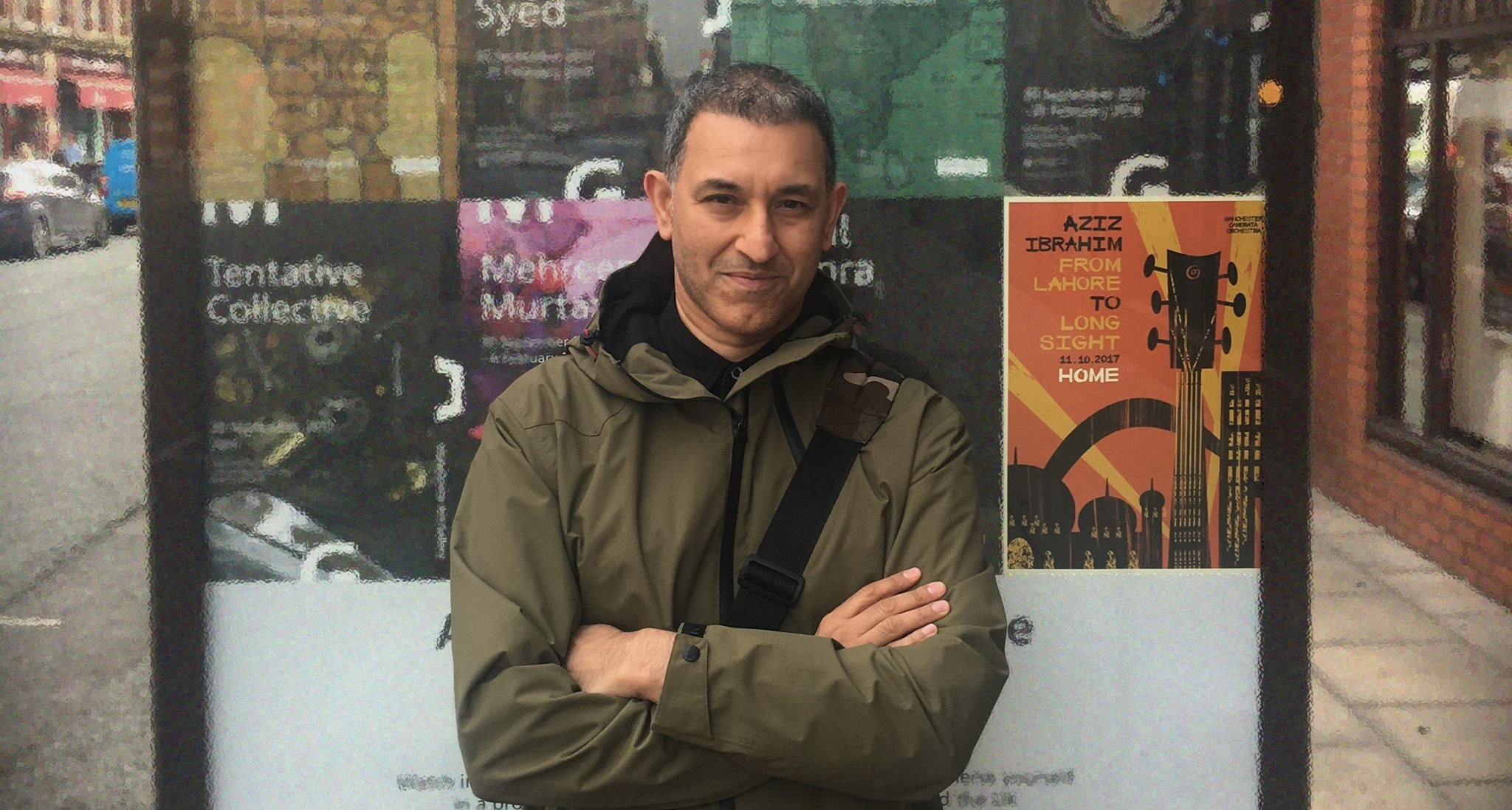
Interview with Aziz Ibrahim

HOME in partnership with Manchester Camerata present Lahore to Longsight as part of the Upclose series. This will be a multi-media realisation of the cult album by Aziz Ibrahim about his father’s journey to Britain after Partition; and will also feature Dalbir Singh Rattan (tabla).

Sitting in the bar at HOME with Aziz Ibrahim, we start off chatting about the famous C18th Scottish map maker Colin MacKenzie who had one of the largest Indian artefact collections in the world. This leads to conversation about the impact of The East India Company on the history of the British Empire and Aziz’s involvement with his old friend Dalbir Singh Rattan on an Arts Council project in Stornaway about 70 years of Partition. Several hours and a parking ticket later I know a lot more about a Pakistani Muslim from Longsight who has toured the world with artists such as The Stone Roses and Simply Red, collaborated with artists like Paul Weller and Mike Joyce (The Smiths) but who is equally happy playing guitar in a prison or a hospice. A guy who may love basketball more than music and who once played The Star Spangled Banner during a boxing match between The Staffordshire police and the N.Y.P.D. despite having been refused a visa to enter the U.S.A.

Was history always a big interest?

I was interested in history at school but I didn’t feel a connection as it was a very one sided history from an English perspective; later on I realised the history of this “wonderful” Empire was filled with blood, trauma and slavery.

The whole principle of identity and how we identify ourselves as being that culture, this religion, that city was actually brought about by The East India Company and The British Empire. Divide and Rule has segregated communities for centuries, made us feel a certain way about culture, religion and gender. Prior to colonialism people had fuzzy borders. Indians lived next to Muslims, next to Sufi. We are still perpetuating principles that were used to kept us apart. It happened to South Asians, Africans, Chinese, The Irish and Celtic communities. I’m looking at music as in how does music bring people together.  

Growing up in Northern Ireland there was a lot of segregation. In school we were taught different histories, cultures and music depending on religion. Being asked your name could define how you were treated.

I’ve been refused visas because of my name.

You missed out on a big world tour because of that, didn’t you?

Yes. My whole life changed. The knock on  effect- so many things happened after that like a domino effect- many things fell apart. 

Do you think being refused a visa shook your sense of your own identity?

It shook something!!! It made me question what is identity. Why are people identified in this way? Being perceived in a different way made me ask more questions. Why do I think in this way? I have dual heritage in that my parents came over here and I’m a Mancunian born Muslim who lived in an inner city council estate. I like to draw on all the strengths of different cultures and communities. Music is the key through which I communicate with people. 

Maybe with a curious mind comes openness to different things…outlooks?

Oh yeah, I’m definitely curious. I’m intrigued how I get ideas from different cultures, personalities, instruments – like  how they’re played then trying to mimic them on guitar to create a new voice. I’ve always thought about individual voices, our uniqueness. How do you express that in any art form? My way was incorporating other voices into the guitar. Then I became a lyricist inspired by my father and the stories he told me about India, Pakistan and Britain. Train journeys, the jungle, his army training…..hence how Lahore to Longsight came about.

What age were your parents when they left Lahore?

I dunno, they don’t know. There was no formal record keeping in the villages. My father estimated his age when he applied for the army. He was about 86 when he passed away in 2006. 

So he had a long history in India before he left after Partition?

He had a long life in India. That begs the question – Am I actually Indian, am I Pakistani, what am I?

So how did this collaboration with Manchester Camerata come about?

I was introduced to them my mate Mike Joyce from The Smiths. Mike and I have a group together which we started just playing for fun- it involves spoken word, narrative, visual art – called Azmik. 

I told them about my philosophy of music and what I’m doing. They were thinking about a Reimagining India project for the 70 years of Independence and asked if I was interested in collaboration. It came out of the blue.

Ah, so the Universe provides. Right place, right time.

Absolutely. I suggested the concept behind the album which is a partition story. A personal story about my father, a simple person from Indian roots, the story of how we lost family during Partition and resettling in Pakistan. It reflects how life was for a generation of people who went through such a traumatic experience and didn’t speak of it, who didn’t have a platform or a voice to be able to tell their story. It is not about finger pointing- my Mother always said, ” When you point a finger, there are three more pointing back at you.”

What’s it like working with the Camerata?

They are a contemporary, forward thinking orchestra. I like working and arranging with Tim Crooks (Arranger and Conductor) – he is very quick, efficient, creative. I’m aiming towards involving the orchestra in my music, exploring how we interact- not just telling them which parts to play. I’m testing them and they are testing me so it’s a sharing process. I don’t want them to be confined to the notes on a score sheet. I want them to feel they can improvise.

So you basically want to create a jamming session with an orchestra?

When two very different perspectives come together how do they work together? Like a marriage- you don’t want to be exactly alike and like the same things. That’s boring. I like the difference of opinion and perspective. Different contributions bring about new things.

The Camerata and you seem like a very natural fit. They work on projects based around mental health and dementia, and you are involved in a wide range of community projects.

Image: Mudkiss Photography. 

It’s that relationship with music and other arts. The government can withdraw funding from the Arts like it is less important than other areas of investment. I think when times are tough people rely upon the Arts to lift their spirits. It’s about engaging with people not preaching at them, and giving opportunities on an equal footing. For instance allowing a hurt child to express in music what they can’t in words. Giving young third and fourth generation South Asians respect- engaging in what interests them, asking what do they want?

Working in prisons, hospices, special needs schools and with Crisis, has made me think music is key in mental health. It is more important for people to engage and express themselves than have the correct notes. That beautiful freedom of expression and positivity even when it has maybe started from a negative place.

What do you want people to take away from this event at HOME?

That anything is possible. I’m a British Pakistani Muslim from Longsight, from a really poor family yet my journey has been so exciting. If it can happen for me it can happen for anyone. As long as you try there is always the possibility of change. The only way humanity succeeds is through perseverance. I think if HOME and Camerata can continue to develop projects like this more young people from the inner city will come through the doors of HOME etc.

Will you have family at the gig?

For the first time since 1987 my Mum is coming – she came to GMex for Simply Red and never came again! 

My brothers Ejaz and Abdul are performing with me as special guests. Its nice to have them participate as they are part of this story.

Which instruments do they play?

They play guitar and Abdul, my older brother plays all sorts of instruments – he’s on Ian Brown’s My Star – not many people even know that! 

My parents came from poor villages and worked hard their whole lives. They motivated us all to achieve academically. I wanted to be a doctor but music chose me and Simply Red offered me a career.

What do think  your Mum will be thinking?

Get a proper job!!

Still?

Yeah absolutely 100%!

This will be the first time she hears something that relates to a husband she lost in 2006. It’s honouring him. I also wanted to do this concert so she feels happy about my father’s contribution. How much we cared about him. What he did for me when I could easily have been running with gangs. Their guidance and nurturing – it’s honouring someone’s love and commitment.

That’s a life well lived, isn’t it? You have to create that. It didn’t just happen.

Absolutely. 

So what is next for you?

I hope this leads to further work with orchestras. I like the idea of creating film scores like South Asian composers like A.R. Rahman and Adi Burman. I’ve got an Arts Council grant to explore music and identity and the use of digital orientated projects  called PROJECT 70 ASIAN BLUES. It is about accessing new audiences using new tools and my mentors NAE (New Art Exchange) and people like Dave Moutray from HOME have been very supportive.

I wanted to do projects like this just so I might widen that door, so maybe others follow what I’m doing and see there are opportunities for them too. They can be younger, more talented, better looking. I want them to see they could achieve more than I could. If HOME and Camerata  are listening then others will follow.

HOME OCT 11.

PALMYRA

HOME ORBIT2017

Written and Performed by Bernard Lasca and Nasi Voutsas

Bert and Nasi performed their 2016 show Eurohouse about an hour ago so it feels like I already know these two charming pals or clowns or maybe I’m just beginning to have a sense of what they could be capable off. 

The stage is set as simply as before with two chairs set far apart. What enfolds is on a larger scale than EUROHOUSE and adds a ladder, boards on wheels and china plates, in fact boxes and boxes of broken china plates. Oh and there is a hammer too.

Hauntingly beautiful music inspires a dance where Bert and Nasi literally glide to the music. There is scuffling, destruction and bargaining. This is bigger than the hopeful formation of the European Union and its subsequent splintering as seen in EUROHOUSE. Instead  Palmyra is a painful look at the making and breaking of an ancient civilisation. The piece looks at how complicit we all are in the preservation or devastation of a community, a society or a culture. 

Bert and Nasi flit in and out of civility, acts of  intimidation and literally trying to brush the ugliness and damage out of sight. What started out in EUROHOUSE as disturbingly dark clowning is rapidly becoming more violent and unpredictable in this piece. When one of them threatens the other with a hammer it is then offered to an audience member for safe keeping. Choices become central. Who do you choose to entrust it with? I was contemplated and duly rejected. The keeper of the hammer is faced with what to do next or who to give it back to. 

These two are lovely guys or they might just be Tom & Jerry in human form. Their work together is exciting and provocative creating much needed dialogue about the world we live in.

Palmyra will never be glued back together like a broken plate, nor can those lost lives be revived. Yet we can still react and respond. We can defy expectation and we can try to be better. Perhaps there is still hope for us all if we can still hand some stranger a hammer and anticipate empathy and goodwill rather than large scale carnage.

EUROHOUSE

HOME, ORBIT2017

Created and performed by Bertrand Lesca and Nasi Voutsas

Co-produced by FellSwoop Theatre

From the moment they step on stage it is clear that Bert is a just a little bigger, more confident and sophisticated in every way than the delightfully sweet Nasi. The audience is swiftly engaged in greeting them and each other, before we all hold hands. The jovial assumption being that this will be good for all of us. Tellingly I happily hold hands with the lovely Nasi but soon my arm starts to ache held up at an unfamiliar angle. He smiles. I smile. I show no sign of discomfort. It is a lovely concept that is ultimately unsustainable.

This is EUROHOUSE. The clowning, running and dancing together is joyous and mainly harmonious until a darker edge starts to appear. Competitive elements in our personal and national psyches start to infilitrate the piece. Run fast, yes really fast but not too fast- never go faster than me and I will reward you.

Bert happily shares his sweets with Nasi encouraging and delighting in greedy pleasure. Later almost menacing he asks where the sweets are and clearly wishes them returned. It starts to feel claustrophobic in the space as Nasi has less and less options. There remains the bare vestiges of civility while food is literally taken from his mouth and the clothes from his back. The bonhomie of this functional friendship is cracking and Nasi starts to assert his individuality.

The show had opened with Bert confiding that he will be controlling the sound and lighting for the evening as if to give the nice staff at HOME a break. It is now apparent that the agenda here is control not support.

This is cleverly illustrated by the music choices played ad finitum by Bert who insists on a cloying diet of Sardou’s classic Comme d’habitude (My Way) and Kraftwerks Europe Endless. As an audience we are invited to also choose a song, as is Nasi, though neither get played by the charming Bert. When Nasi defiantly ramps up the volume on Fleetwood Mac’s Go Your Own Way I want to sing along- something I never do! It is a momentary small victory but it feels so good.

The spirit of EUROHOUSE is in sharing and playing and growing just like in the playground when we start to make the friends or enemies we must share a classroom with for the rest of our education. EUROHOUSE brings together performers from France and Greece who met in Scotland. They were part of two different companies FellSwoop and ANTLER. This performance is a bittersweet warning for us all in the aftermath of Brexit. We all need support and friendship but at what cost?