The Rock ‘n’ Roll Panto Rapunzel 2024

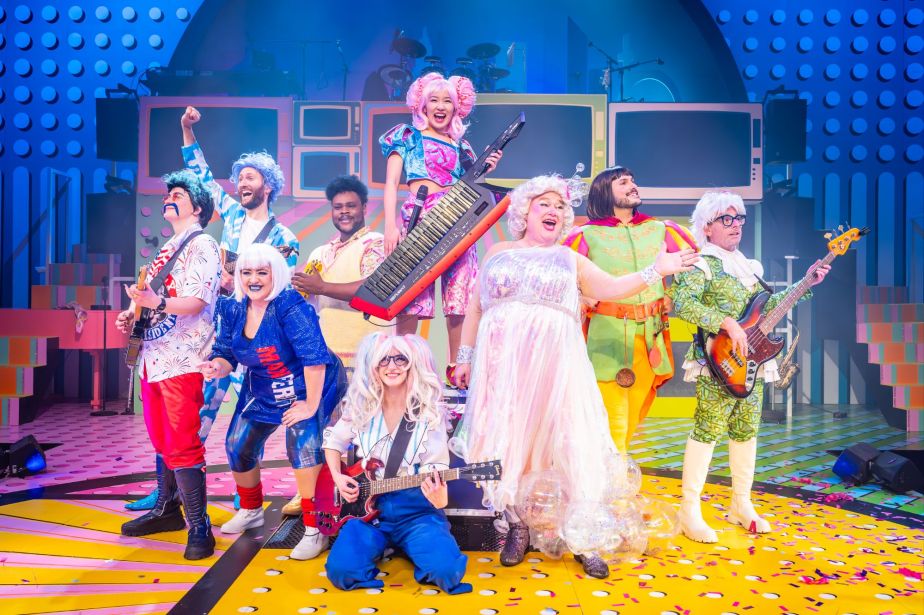
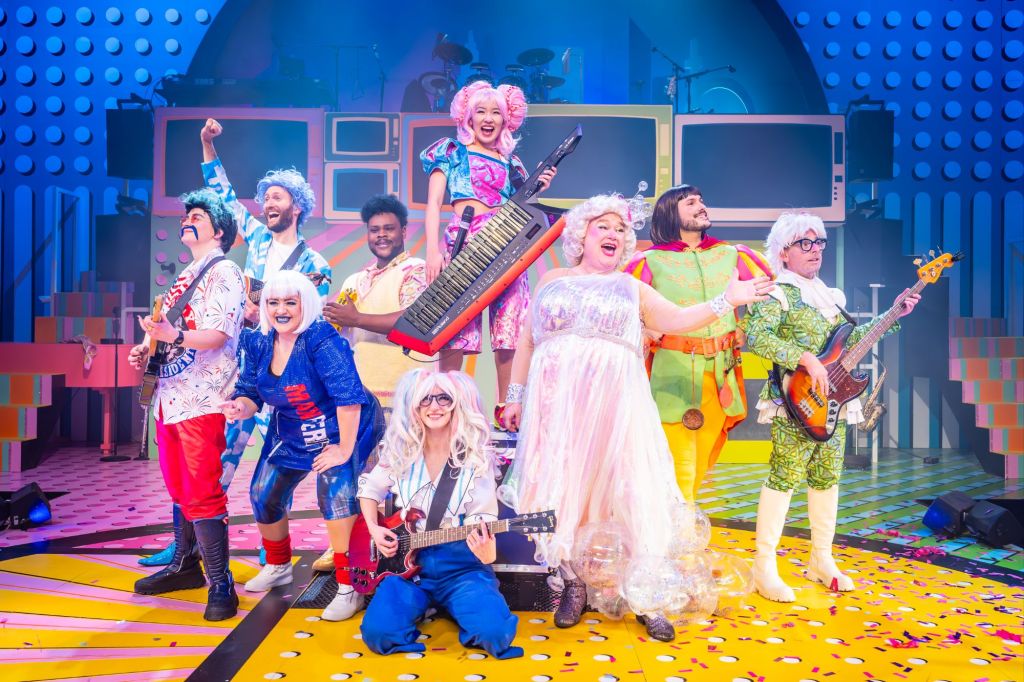
The cast of The Rock ‘n’ Roll Panto Rapunzel 2024 at Liverpool Everyman
Image credit: Marc Brenner

Written by Jude Christian

Directed by Francesca Goodridge

Liverpool Everyman

With every passing year Panto season seems to come round quicker and this year is no exception. My first this year is at Liverpool Everyman and the weather heading into the city is a sleety blizzard with high winds guaranteed to wreck any freshly coiffered mane. Thankfully there is a warm welcome inside the Everyman and a thoroughly cheery production on the stage. Jude Christian has taken this classic Panto staple and set it in Liverpool with two hairdressing salons battling it out to the final blowout while a feisty Rapunzel escapes her prison and discovers family, friendship and freedom. This rock ‘n’ Roll take is full of crowd pleasing musical numbers and a multi-talented cast perform, sing and play all the instruments on stage.

The set and costume design by Janet Bird works brilliantly. The colourful stage on two levels with a magnificent four poster bed making frequent appearances is all bright pastels and glistening with glitter. The overall effect is a fun blend of a Barbie house merging with an Andy Warhol exhibition. The costumes are equally vivid and are further elevated with elaborate hair styles that look straight out of a Manga comic book. The Dame’s costumes are wittily designed to illustrate her ownership of the now fading salon The Blonde Bombshell. Decked out as an iconic Marilyn Monroe, a Scouse take on Lady Gaga’s infamous meat dress or as Madonna in a Gaultier conical corset while heavily pregnant; the designs all guarantee laughs for an on form  Michael Starke as Debbie UpDo.

Ai Kumar as Rapunzel at Liverpool Everyman Image credit: Marc Brenner

The multi-talented cast seem to relish in Francesca Goodridge’s lively fast paced production and the audience interaction is skillfully done and very effective. Adam Keast is a delight as Fairy Fixer-Upper and his blend of fey charm, mischievous asides and double entendres land well and make for good entertainment for all ages. Zoe West makes an excellent baddie as Mancunion rival Danny Ruff posturing like an overcharged quiff of testosterone as he tries to ruin his old Boss. Ai Kumar as Rapunzel and Rebecca Levy have great chemistry as the sweet duo seeking to escape the salon and find both independence and love. They are both vocally strong and provide a number of beautiful duets. Tomi Ogbaro and Emma Bispham are the salon assistants Trevor and Goop. The former is a hapless sweetheart while Goop is clearly modelled on the implacable Nessa from Gavin and Stacy. Ben Boskovic as Prince Timotei brings a nice silliness to the proceedings as the medieval Prince who seems a dead ringer for Lord Farquaad complete with his trusty steed Ed SheerRam.

Zoe West as Danny Ruff and Michael Starke as Debbie UpDo at Liverpool Everyman
Image credit: Marc Brenner

The musical numbers include Daytripper by The Beatles, a Blondie medley, numbers from Shania Twain, Lady Gaga and Queen. They all flow neatly within the script and involve a wide range of instruments played by all the cast. A genuinely fun night out for families that is colourful and entertaining with lots of surprises and laughs guaranteed. This is definitely a trip to the theatre where everyone is guaranteed to let their hair down and have fun.

Liverpool Everyman 16th November 2024 – 18th January 2025

The Legend Of Ned Ludd


Menyee Lai, Reuben Johnson and Shaun Mason in The Legend Of Ned Ludd at Liverpool Everyman. Image credit: Marc Brenner

Written by Joe Ward Munrow

Directed by Jude Christian

LIVERPOOL EVERYMAN

The Legend Of Ned Ludd is the first of three homegrown productions celebrating sixty years of the Liverpool Everyman. Joe Ward Munrow, as a graduate of the theatre’s playwright programme, delivers a confident, \ exhilarating piece of theatre. This is a play about people, the work they do and the impact of automation. The story pivots around Nottingham in 1816 and The Luddites who sought to destroy the first machines of the industrial revolution as they witnessed the decimation of their working lifestyle as they had known it. In this production the workers/actors are at the mercy of a machine which randomly selects most of the scenes from a possible 256 permutations. The three actors on stage have to respond to whatever is thrown at them, necessitating quick fire moves through the centuries and across the globe.

The staging by Hazel Low has a suitably stark, industrial feel with the central structure containing the tubes through which flow the balls that determine scenes…a bit like the old National Lottery show. The bright blue and yellow is suggestive of IKEA and  the brown cardboard boxes of props and costumes relative to each scene roll down conveyor belts allude to an Amazon warehouse. Larger props rise up through the floor aided by the invisible unheralded workers in the pit of the theatre. As the scenes evolve through the production the numbers of balls in the perspex boxes silently grow and by the end of the play’s run may well overflow.

Menyee Lai and Reuben Johnson in The Legend Of Ned Ludd at Liverpool Everyman
Image credit: Marc Brenner

Tonight’s show opens in Detroit in 2016 where a multinational is slashing wages and staff are holding yard sales and fearing bad weather will render them unable to get to work as they don’t earn enough to repair their car. Next up is Liverpool 1985 where a painter and decorator tries to embue his apprentice with a sense of pride in a job well done. Paris 1844 shows Karl Marx and Fredrich Engels discussing the politics of labour and the human condition. Other vignettes include a prison in China where one inmate who is a writer has mysteriously disappeared, another alludes to a possible trans identity and his poignant desire to just be pretty. The enforced work is relentless and includes gaming to earn gold coins for the Prison Overseer…automation means these prisoners do mind breaking work unlike the old chain gangs who endured backbreaking labour. A school in Lagos 2018 has school children reflecting on a shift in history from BC to AD that is now about BI to AI that is After Internet rather that artificial intelligence.

Some  vignettes are more substantial than others but together they build a sense of the worldwide human experience. The THEN/NOW piece is very powerful where the rhetoric becomes robustly poetic and Reuben Johnson delivers this piece with real passion and an innate sense of beat and rhythm. The production is interspersed with pieces about The Luddite movement in Nottingham 1816 where the machine breaking is gathering pace and the risk to life for the protesters is becoming ever more real. The closing scenes are beautifully evoked and the final moments are perfectly pitched and incredibly moving. Each actor like a good team of workers bring their individual skills to the production and complement each other. The three actors play multiple characters that include Menyee Lai as an exhausted, keening prisoner to Shaun Mason as a despondent worker with limited options struggling to make ends meet and Reuben Johnson as an articulate working class man at the heart of the Luddite movement driven to suicide by cop.

Emerging from this production, work is suddenly everywhere from the words of the playwright whether composed with pad and pen or by fingers flickering across a laptop to the choreography on stage, the actor’s sweat and passion, to the staff at the Everyman lighting the stage or pouring the interval drinks, to the Uber driver  picking up theatre goers after the show, to the reviewer noting down their thoughts. Some work is poorly paid or unpaid, some is fair and some may well be obscenely overpaid. Work can bring satisfaction and a sense of achievement or simply be a means to an end or be enforced drudgery but by its very nature it can hopefully also help bring structure and give us an identity and autonomy. As the play gathers momentum one corner of the back of the stage slowly starts to fill with the detritus of used and discarded props from past scenes giving a subtle sense of our growing landfill problem from our throwaway culture caused by an increasingly mechanised world and a growing surplus of sweatshop workers desperate for and reliant on a pittance wage. If the eponymous Ned Ludd was here today and could access Google translate he would probably say Plus ça change, plus c’est la même chose.

Liverpool Everyman 20th April – 11th May 2024

othellomacbeth

HOME

A HOME/Lyric Hammersmith presentation

Written by William Shakespeare

Directed by Jude Christian

The plays of Shakespeare continue to fascinate and inspire and there is always an ongoing artistic quest to tweak his original recipes. For director Jude Christian inspiration appears to arise from a folk song by Anjana Vasan. Oh Sister asks, Oh Sister when you gonna learn. Ain’t it always about the man….a kind hearted woman to his evil hearted ways. This mash up of Othello and Macbeth turns the spotlight on the women and explores what we are capable off when hope is replaced by despair.

This pared down production opens with a narrow stage that boldly states the intention that this Othello is a series of succinct snapshots of the original. Scene changes are signified by the discordant menace of clamouring gossip on the wind. Focusing on key elements of the plot to move the narrative along swiftly it often loses the beauty of poetry and the development of key relationships; however it sharpens the focus unto male machismo and the perils of innocence in a world of brutal ambition.

The real moment of drama that makes you inhale sharply and sit up is the sinfully clever shift towards Macbeth at the end of the first act. Lady Macbeth enters clutching empty swaddling and offers her milk as gall to Desdemona, Bianca and Emilia. As these three mistreated and/or murdered women don camouflage jackets over their bloody clothes the scene is set for the weird sisters or witches to wreak havoc.

The set design by Basia Bińkowska is startling and while it initially seems restrictive and one dimensional, it is potent in its sharp simplicity. A wall of riveted steel and a metal caged walkway evoke the confines of a hi-tech prison symbolizing the narrow constrictions of being a woman in Shakespearean times and in certain societies today. For the domestic violence in Othello it brutally resounds with the visceral crackle of bone on steel. The second act lifts the steel wall and reveals a more open space for the actors to move around. What now dominates is the perspex sink crystal clear before becoming increasingly bloody as events unfold. The metal walkway overhead gets more use in the second act as the weird sisters watch over their machinations like puppeteers pulling at the heartstrings of Macbeth and the other men.

The focus on the women in this production is a powerful reminder of the perils of love and the struggle for fairness and equality. Desdemona is a young bride who naively assumes that love conquers all. Married to a powerful man she expects to be heard without resorting to shrewishness yet conforms to the message running through Shakespeare and the song used in this production….You love like a martyr… wear your heart like a suicide vest. Lady Macbeth in vivid Tory blue is a seasoned and more experienced wife who asserts her own power within her marriage. Emilia and Bianca are also more pragmatic and less naive of the ways of men, yet all are disappointed and wounded women. These are all women who love not wisely but too well surrounded by men who are equally capable of powerful emotions.

I’m not sure how many questions are answered by this production by Jude Christian who also provoked debate with Parliament Square, however OthelloMacbeth certainly evokes lively conversation about the women Shakespeare created. This nine strong cast do a good job of keeping up momentum with notable performances by Sandy Grierson and Kirsten Foster. Most of the performances here are impressive and pushing the female characters to the forefront is an interesting dynamic. The key element is the bleeding through of such influential dramatic creations through both plays and how they still resonate with audiences today. As Desdemona says Love that endures from Life that disappears.

HOME 14th Sept – 29th Sept

Lyric Hammersmith 3th Oct – 3th Nov

Images by Helen Murray

Parliament Square 

A Royal Exchange Theatre and Bush Theatre Co-production 

Written by James Fritz

Directed by Jude Christian

This is the world première of Parliament Square which received a Judges Award in The Bruntwood Prize for Playwriting in 2015. It explores whether political protests can change the world, and if a violent act of conscience could really make a profound difference or simply be deemed an act of madness. 

This production is sparsely staged so it relies on the strength of the writing and the central performances. For a play which centres on a single act of high octane drama and covers a significant period of years in its aftermath, there is very little action. This is a play which may work better in a more intimate space and for me it felt like it’s natural home was the Royal Exchange studio space. It is however testament to the writing by James Fritz and the direction by Jude Christian that the play is always engrossing and the running time of 100 minutes flew by. 

The opening scenes with the central character Kat and the starkly named Voice create an initial sense of confusion. Is this a discussion/argument between friends/family/lovers or is this an internal battle of conscience or possibly even a manifestation of a women with D.I.D (Dissociative Indentity Disorder)? The use of disembodied voice overs to convey a sense of family cleverly creates a growing awareness of what is about to happen to all those involved if Kat is successful in her plan

The internal struggle for Kat is beautifully played out by Esther Smith and the raw confusion around what to do is peppered by little gems of exquisite ordinariness. The mundane shock at the cost of a single peak time train fare to London or the poignancy of regret at no more sex or lasagne or the brutal finality of the last thing to see being “a fucking Tesco”. There is a definite sense of  this women preparing to give up a real life full of love and laughter. It is less evident what is actually driving her toward this extreme act of defiance. It is both intriguing and frustrating that there is no obvious causal factor other than “things are getting worse”. There appears to be nothing remarkable about Kat and no signs of psychological dysfunction yet she is getting on a train with the sole purpose of auto-cremating in a public space. 

Fire is the probably the most feared of all forms of death. The sociologist Emile Durkheim separated suicides into four types: the egoistic, the altruistic, the anomic (moral confusion), and the fatalistic. Perhaps self-immolation captivates so thoroughly because it wins on all counts. It is the ultimate act of both despair and defiance, a symbol at once of resignation and heroic self-sacrifice.

The simple act of counting is horrifyingly chilling. 15 seconds are all that must be endured and it is over. The objective achieved and the pain ceased. As the seconds are counted out in real time it is simply unbearable and the sudden rupture at 8 seconds is agonising relief. 

The second half deals with the aftermath. It plays out in hospital and rehabilitation as Kat and her family are reunited and have to find their individual ways to come to terms with what has happened. Society is untouched and largely unaware of Kat’s sacrifice, it is her and her family who are irrevocably impacted by this single act of political defiance. In the end it is whether or not the politics of family life can remain the same or not.

The dramatic use of light/dark/light in the hospital scenes is extremely effective at creating Kats slow and agonising reawakening and recuperation. This device is further developed as we see flashes of life carrying on over the years. Hospital appointments, job promotions, family barbecues  and a child’s birthdays convey the passing years as society becomes more fractured and threatening. The stop/start flashes of life are reminiscent of the flickers of a cigarette lighter in reluctant or wary  hands. The allusion to fire is also poignantly captured in a passing remark about “hundreds suffocating and no one surviving above the 13th floor”. The comparisons to austerity measures, broken Britain and Grenfall Towers were clear.

The relationship with her mother is the most interesting and Joanne Howarth is excellent as another strong woman who despairs of what has happened but is pragmatic in what needs to happen next for Kat to have a viable future. She articulates her frustration, “What’s wrong with a fucking petition?” and protects her child with a blanket of silence in the belief that rather than be viewed as a hero she would be seen as a lunatic. 

The interplay between Kat and Tommy her husband and with her rescuer Catherine work less well. Their characters all need more development to be more believable. The extreme nature of the core of this play is such that it does not feel authentic that a marriage would not have been severely impacted by Kats actions. The reappearance of her rescuer seems more of a plot device than an authentic action. I cannot believe that the character would not have feared a similar failed outcome as that of Kat. It is a very moving final scene but I can’t help seeing the closing scene as either Kat revisiting Parliament Square after years of unremitting pain and finishing what she started, or with her and her rescuer Catherine standing together in a final unified act of protest.

Royal Exchange Theatre 18 – 28th October 

Bush Theatre 30th November – 6th January