OTHELLO

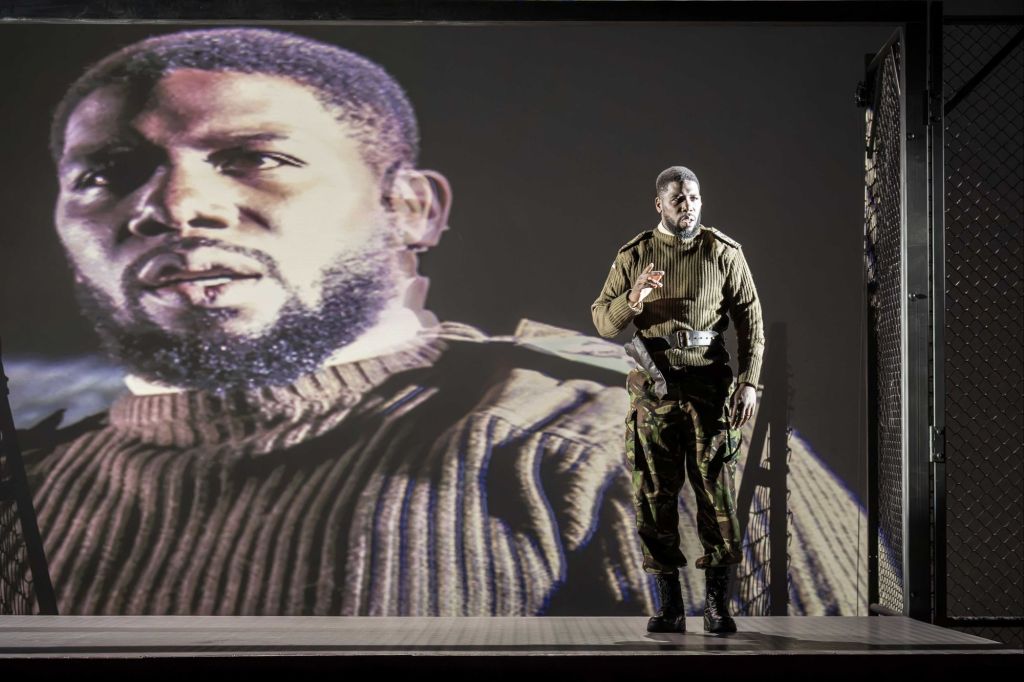
Duane Walcott as Othello in Othello at HOME
Image credit: Marc Brenner

Written by William Shakespeare

Directed by Anthony Almeida

HOME

★★★☆☆


Shakespeare’s Othello is a tragedy fuelled by jealousy, manipulation and the corrosive power of mistrust. Northern Stage’s new production at HOME takes on this familiar tale of love and betrayal with commendable ambition and style. Director Anthony Almeida offers up some moments of real dramatic intensity, even if the overall impact is somewhat uneven and confused.

At the heart of the play is Othello, a celebrated general whose confidence and authority are gradually dismantled by the poisonous machinations of Iago. Dwane Walcott is a strong and charismatic Othello who seems to have it all yet when the mask slips, this is a man who can’t perhaps fully believe his luck and is therefore susceptible to the drip,drip,drip of poison from Iago.

It is a story that remains disturbingly relevant, exposing the fragility of trust and the ease with which prejudice and insecurity can be exploited. Director Anthony Almeida embraces these themes while bringing a contemporary sensibility to Shakespeare’s exploration of power, race and toxic masculinity. This feels like a deep dive into the world of gaslighting and a world where the ever present immediacy of news coverage means we are continuously bombarded with how to choose between facts and false news.

Almeida sets his version on a military base in Cyprus against the backdrop of The Falklands War but this idea feels underdeveloped. Apart from some old news footage on a TV screen this device feels somewhat superfluous as the text remains firmly linked to Venice. Costumes sometimes feel more Nineties and Depeche Mode’s Everybody Wants to Rule The World is sung by Desdemona yet it was only released 3 years after the Conflict ended. Despite these confusing elements, the military base set by Natasha Jenkins is excellent. Stark and  oppressive with mesh and barbed wire and with a raised platform that lowers like the loading deck of a warship, this is a steely triumph. It acts as a catalyst for the impending tragedy as the walls literally start to close in on the doomed lovers.

The production has an appealing immediacy, with a stripped-back approach that places the emphasis firmly on the actors and the shifting dynamics between them. There is at times a admirable muscularity to the storytelling, and the tension does build as Iago’s calculated deceptions begin to take hold. Yet, despite the dramatic potential, the production occasionally struggles to sustain the psychological complexity that makes this tragedy so compelling. The pacing can seem out of sync with the action and dialogue, and lines vital lines of dialogue are occasionally muffled or don’t land with the necessary beat. This is a clearly talented and committed group of actors but possibly not all particularly comfortable and familiar with Shakespearean dialogue.

Iago, Shakespeare’s master manipulator, is the engine of the drama with his ability to turn seemingly innocent observations into instruments of destruction. There are flashes of deliciously dark humour in his duplicity, although the character could benefit from a more chilling subtlety. Maanuv Thiara plays Iago with the shallow bonhomie of a disgruntled squaddie resulting in the emotional trajectory not always achieving the devastating force required.
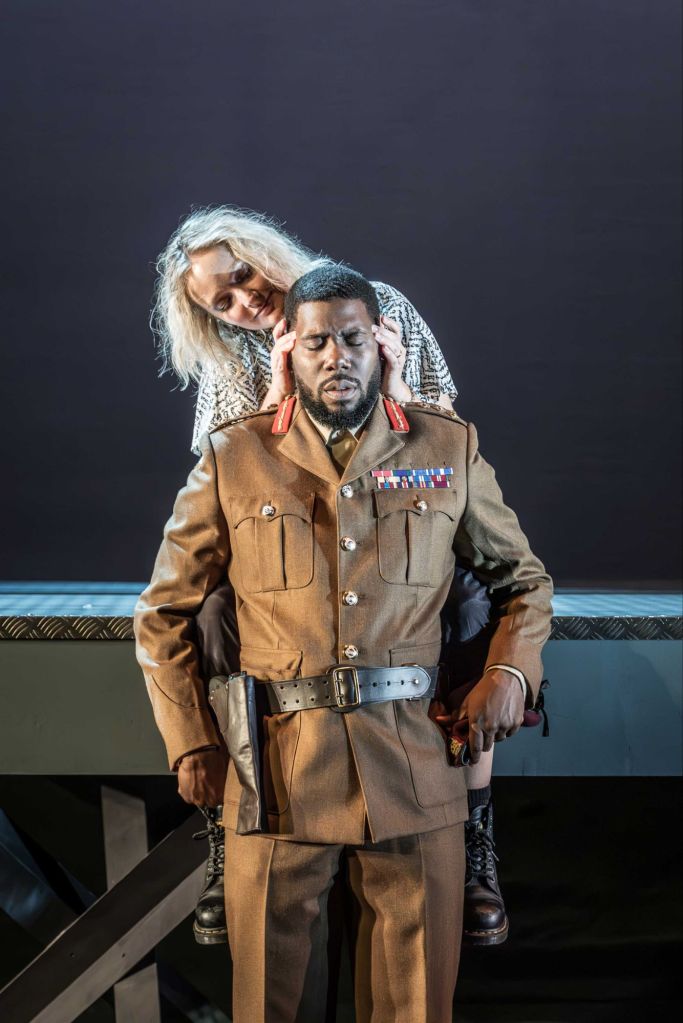
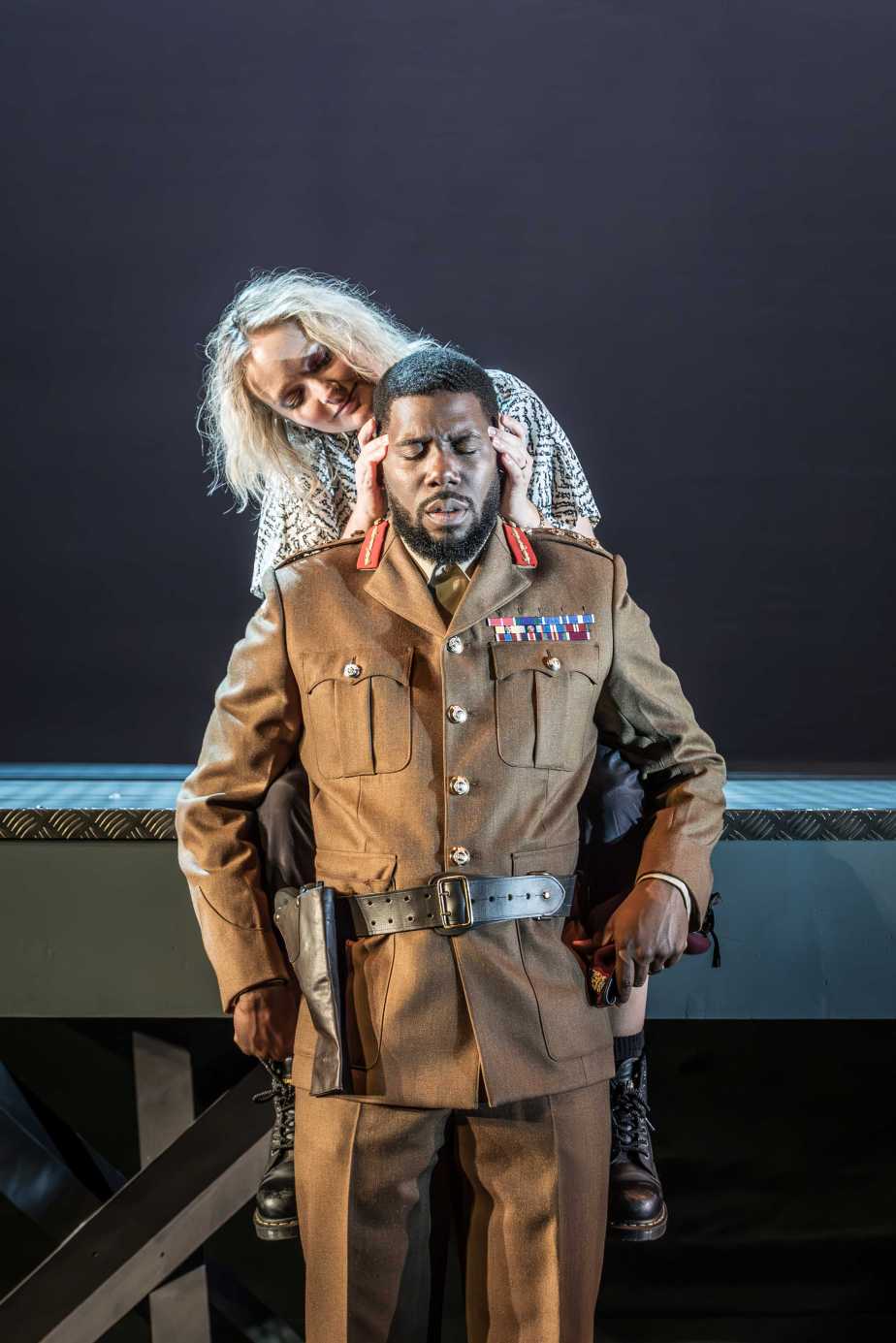
Phoebe Smyth as Desdemona and Dwane Walcott as Othello in Othello at HOME
Image credit: Marc Brenner

Desdemona is a much more intriguing figure than often portrayed as the young bride caught between devotion and the increasingly dangerous consequences of her husband’s growing mistrust. Newcomer Phoebe Smyth makes her professional stage debut and its a highly memorable one for all the right reasons. She ensures that Desdemona’s vulnerability is palpable while allowing her to be much more than a mere victim of the men around her. This pale young woman is not remotely pallid as she beguiles Othello with her feisty and joyful nature and positive approach to life. It’s therefore all the more terrifying and heartbreaking that her shining presence is still not enough to pierce Othello’s growing paranoia and to alter the ensuing tragic outcome. Another excellent professional theatrical debut comes from fellow RAMDA graduate, Will Stanton. His Cassio is a beautifully measured and assured performance that feels authentic and engaging.

Ultimately, this Othello offers a spirited but not entirely satisfying interpretation of one of Shakespeare’s most psychologically intricate tragedies. Its themes of manipulation, misogyny and racial prejudice retain their unsettling potency, but the production never quite unlocks the full emotional devastation of the text. There is much to engage the audience, even if the final tragedy feels more solidly delivered than genuinely shattering.
This is, at times a very compelling Othello but when it loses pace, the characters feel as adrift as a ship full of conscientious objectors heading towards The Falklands for a war no one fully understands.

HOME 30th – 10th October 2026

Touring til 20th November 2026

othellomacbeth

HOME

A HOME/Lyric Hammersmith presentation

Written by William Shakespeare

Directed by Jude Christian

The plays of Shakespeare continue to fascinate and inspire and there is always an ongoing artistic quest to tweak his original recipes. For director Jude Christian inspiration appears to arise from a folk song by Anjana Vasan. Oh Sister asks, Oh Sister when you gonna learn. Ain’t it always about the man….a kind hearted woman to his evil hearted ways. This mash up of Othello and Macbeth turns the spotlight on the women and explores what we are capable off when hope is replaced by despair.

This pared down production opens with a narrow stage that boldly states the intention that this Othello is a series of succinct snapshots of the original. Scene changes are signified by the discordant menace of clamouring gossip on the wind. Focusing on key elements of the plot to move the narrative along swiftly it often loses the beauty of poetry and the development of key relationships; however it sharpens the focus unto male machismo and the perils of innocence in a world of brutal ambition.

The real moment of drama that makes you inhale sharply and sit up is the sinfully clever shift towards Macbeth at the end of the first act. Lady Macbeth enters clutching empty swaddling and offers her milk as gall to Desdemona, Bianca and Emilia. As these three mistreated and/or murdered women don camouflage jackets over their bloody clothes the scene is set for the weird sisters or witches to wreak havoc.

The set design by Basia Bińkowska is startling and while it initially seems restrictive and one dimensional, it is potent in its sharp simplicity. A wall of riveted steel and a metal caged walkway evoke the confines of a hi-tech prison symbolizing the narrow constrictions of being a woman in Shakespearean times and in certain societies today. For the domestic violence in Othello it brutally resounds with the visceral crackle of bone on steel. The second act lifts the steel wall and reveals a more open space for the actors to move around. What now dominates is the perspex sink crystal clear before becoming increasingly bloody as events unfold. The metal walkway overhead gets more use in the second act as the weird sisters watch over their machinations like puppeteers pulling at the heartstrings of Macbeth and the other men.

The focus on the women in this production is a powerful reminder of the perils of love and the struggle for fairness and equality. Desdemona is a young bride who naively assumes that love conquers all. Married to a powerful man she expects to be heard without resorting to shrewishness yet conforms to the message running through Shakespeare and the song used in this production….You love like a martyr… wear your heart like a suicide vest. Lady Macbeth in vivid Tory blue is a seasoned and more experienced wife who asserts her own power within her marriage. Emilia and Bianca are also more pragmatic and less naive of the ways of men, yet all are disappointed and wounded women. These are all women who love not wisely but too well surrounded by men who are equally capable of powerful emotions.

I’m not sure how many questions are answered by this production by Jude Christian who also provoked debate with Parliament Square, however OthelloMacbeth certainly evokes lively conversation about the women Shakespeare created. This nine strong cast do a good job of keeping up momentum with notable performances by Sandy Grierson and Kirsten Foster. Most of the performances here are impressive and pushing the female characters to the forefront is an interesting dynamic. The key element is the bleeding through of such influential dramatic creations through both plays and how they still resonate with audiences today. As Desdemona says Love that endures from Life that disappears.

HOME 14th Sept – 29th Sept

Lyric Hammersmith 3th Oct – 3th Nov

Images by Helen Murray

Othello

Everyman, Liverpool

Written by William Shakespeare

Directed by Gemma Bodinetz

In this new production of Othello the past and present collide. A hand-embroidered hankerchief and a smartphone symbolise our human need to love and be loved, to accept and be accepted; and the destructive power of betrayal and fake news. Director Gemma Bodinetz and the repertory company at the Everyman have produced an Othello that is absolutely fresh and timeless. There is no sense of the frustration of a 400 year old play being shoehorned to appease or entice a modern audience. It just works from start to finish. The much heralded casting of Golda Rosheuvel as a female Othello is both exciting and intriguing. However this becomes at times almost irrevelant as it is the emotional depth and intensity of her performance that stand out as the most pertinert aspects of this casting choice.

Golda Rosheuvel is Othello as an army General that is female, black and gay. She is successful, respected and courageous. It could have been so obvious to play her Othello as a butch lesbian with a crew cut and and a jutting jaw. Instead we see a strong, intelligent woman who has the quiet certainty of being in love and feeling loved. She is not large in physical stature and is womanly whether in battle fatigues or a simple flowing gown. She is measured and reflective in all areas of her life until confronted by Iago whose thwarted ambition and jealous vilification of others conspire to destroy her faith in love and honour.

Patrick Brennan is undeniably effective as the charming manipulator dripping his poison with all the reasonableness and solicitation of a corrupt politician at a General Election. His Iago is odious as he reveals his plans to the audience and truly terrifying in his own certainty regarding his actions. He is the epitome of the reasonable white man hellbent on obliterating anyone who is “other”, as he moves around the stage spitting honeyed venom like Trump on Twitter.

Cerith Flinn plays Cassio as a taut, muscled squaddie with a heart of gold whether fighting honourably on the battlefied, carousing with a bottle in hand or wooing the winsome Bianca – a delightfully comedic Leah Gould. His Cassio is a fitting replacement for Othello as a young soldier with a pure heart and good intentions.

Emily Hughes performance is fresh and vivid. She combines girlish delicacy and youth with gritty determination to seek out fairness and equality for others. She is fair and beautiful but her character is what really defines why Othello loves her. She loved me for the dangers I had passed, And I loved her that she did pity them.

The swift unravelling of Othello’s calm reason into jealous, vengeful rage might seem at odds with this professional soldier and loving wife. Iago has broken the implicit trust essential between comrades on the battlefield and partners in a happy marriage. The result is a tortured woman stricken with epilepsy and deep emotional trauma. A modern take on this might well be an Othello suffering from PTSD (post-traumatic stress disorder) who is battle scarred and reacting to new trauma with paranoia, dissociative seizures and the hyperarousal of murderous rage.

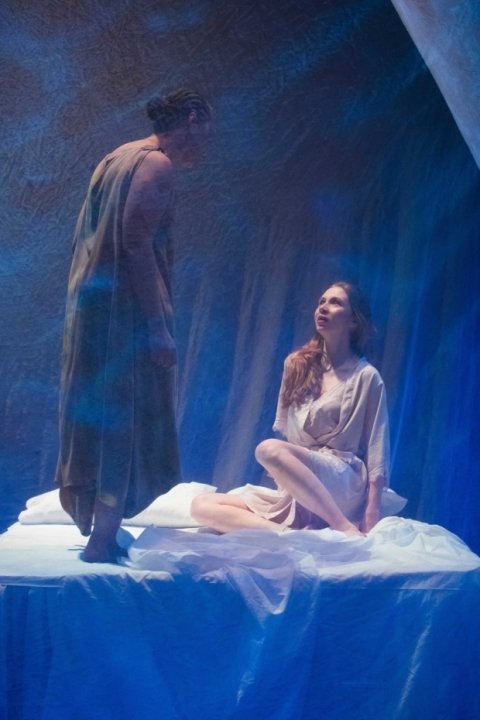
The final scenes played out in a floaty, white gauze bedchamber are gut wrenchingly poignant. This gossamer veil highlights the ephemeral nature of life and gives a dreamlike softness to both the brutality and the tenderness of the murder scene. Such betrayal and heartbreak plays out and the emotional struggle for Othello is palpable. Even knowing the end of this 400 year old play, expectations feel suspended as if on a heartbeat the outcome might still go either way.

At pivotal points the audience are spotlit by powerful searchlights or the beam of a single torch. On reflection it feels like an invitation by Shakespeare and also by Bodinetz to look at ourselves and those around us and reflect on what we see. Perhaps there is an invitation to start accepting ourselves- regardless of gender or ethnicity as all being capable of strong and powerful emotions. That does not have to be dangerous when we recognise they can make us protective, nurturing parents, successful and happy in our relationships and productive in our work. It is only when we use labels to divide and diminish that we lessen ourselves and our humanity. Like Othello – male, female or gender neutral we are perfectly imperfect. No more and never any less.

OTHELLO Sat 28 April to Tues 10th July

Images by Jonathon Keenan