Hot Brown Honey

HOME

Briefs Factory presents Hot Brown Honey 

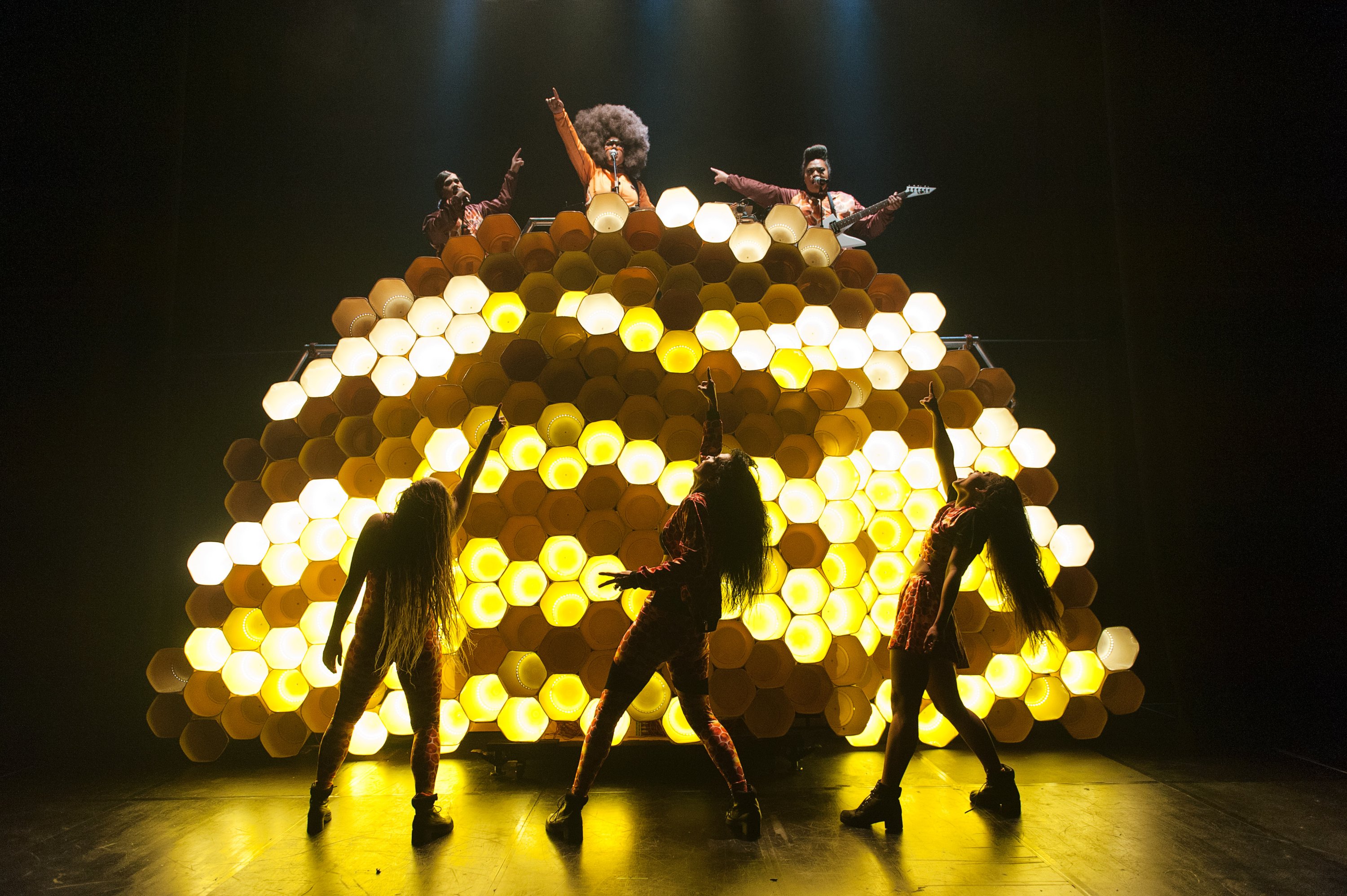
Six vibrant First Nation women wearing identical shellsuits on a stage dominated by a huge gleaming, pulsating honeycomb hub. Our MC is Busty Beatz  (Kim Bowers) a co-founder of Hot Brown Honey and she is loud and  proud and magnificent towering above everyone astride the honey dome. Below is the other founder, Director and Choreographer Lisa Fa’alafi who I met briefly as I took my seat in the theatre. These women are chatty and welcoming as they stroll  around the aisles before the show. They are upfront and direct, almost immediately the audience is told a collection toward their childcare will be passing through the aisles because as Lisa says The Revolution can not happen without  childcare. 

Suddenly the performance ramps up the energy. I can’t fully hear everything. I’m blinking as the lights flash powerfully on the honeycomb dome. The performers are hi octane and nothing is going to stop them. It’s too loud!! It’s too bright!!! It’s too……DO NOT ADJUST YOUR SET. WAKE UP. GET ON BOARD. ROCK THE BOAT. THIS MAY JUST BE THE TRIP OF YOUR LIFE.

There is zero tolerance of stereotyping as MC Beatz quotes from the 2009 TEDTalk by Chimamanda Ngozi Adichie The Danger of a Single Story. There are no single stories here and this is reinforced by a show that defies any genre. This is burlesque, cabaret, song, beatboxing, hip hop, poetry, hula hooping, aerial silks, sermon and comedy. This is an EVENT and like its orchestrators it cannot be pigeonholed.

This is an intelligent, passionate celebration of womankind in all its colours, shapes and creeds of politics, religion and sexuality. There is a strong burlesque influence running through all aspects of this show. This is burlesque as gender politics defying any attempts at body shaming. Women standing proud and celebrating perfect boobs, giant inflatable  boulder boobs, pussies that may or may not have  seen childbirth, giant padded feline pussies, bodies curvy or lean, skin that gleams or has cellulite or skin blemishes. Women using burlesque to own their own bodies using the frequent vivid costume changes to drive the stories. Fa’alafi describes the experience as the decolonisation of our thoughts and inhibitions. The poet and playwright Maya Angelou was also a burlesque dancer in her early years; and it a very powerful tool of expression and liberation.

There are group sequences ramming home the message We Are Not Maids. Shellsuits are shed to reveal cheeky Princess Megan t-shirts then shed again to reveal maid costumes. MC Beatz dons a massive Afro for the anthem Don’t Touch My Hair.  Fa’alafi delights with a reverse striptease parodying the fantasies of bare breasted Polynesian maidens in grass skirts. This is no coy blushing maiden or unskilled island girl. Our Lisa is surrounded by leaves but deftly fashions shoes and bags like a fashion forward icon. The glorious voice of ‘Ofa Fotu rips apart the James Brown anthem It’s a Man’s Man’s Man’s World while she wears a stifling costume that clearly alludes to a golliwog doll. Elena Wangurra battles the confines of the Australian flag and triumphantly emerges as a superhero in the vivid colours of the Aboriginal flag. The beat box skills of Hope One pound through the speakers while Crystal Stacey spins hoola hoops with the dexterity that most women multi task. Domestic violence is portrayed in a way that is gut wrenchingly shocking. Crystal Stacey performance was my personal highlight as she escaped violent assault by using aerial silks. Her performance was exquisite and horrifying and incredibly poignant. Literally hanging by a thread this was a truly visceral evocation of desperation, determination and resilience. We do this for the Women who cannot speak. We are taught that silence will save us. But we will make noise.

The Speaker of this Hive asks Will you stay the same or rock the boat? The Hot Brown Honey mantra throughout this amazing show is DECOLONISE AND MOISTURISE or as Faalafi  says We want to decolonize the World , one stage at a time. The audience are on their feet dancing. The atmosphere is electric. The Party Manifesto is clear and this is one party you won’t want to miss.

HOME until Saturday 23rd Dec
REAL MAGIC

HOME

Director Tim Etchells

Devised with and Performed by Jerry Killick, Richard Lowdon and Claire Marshall

Forced Entertainment bring their latest show Real Magic to real theatres and real audiences and so the endless loop of absurdity continues. Attempting to critique this show is probably as ridiculously hopeless and pointless as trying to guess the word on this gameshow/mind reading show. Real Magic is like musical chairs for demented amnesiacs.

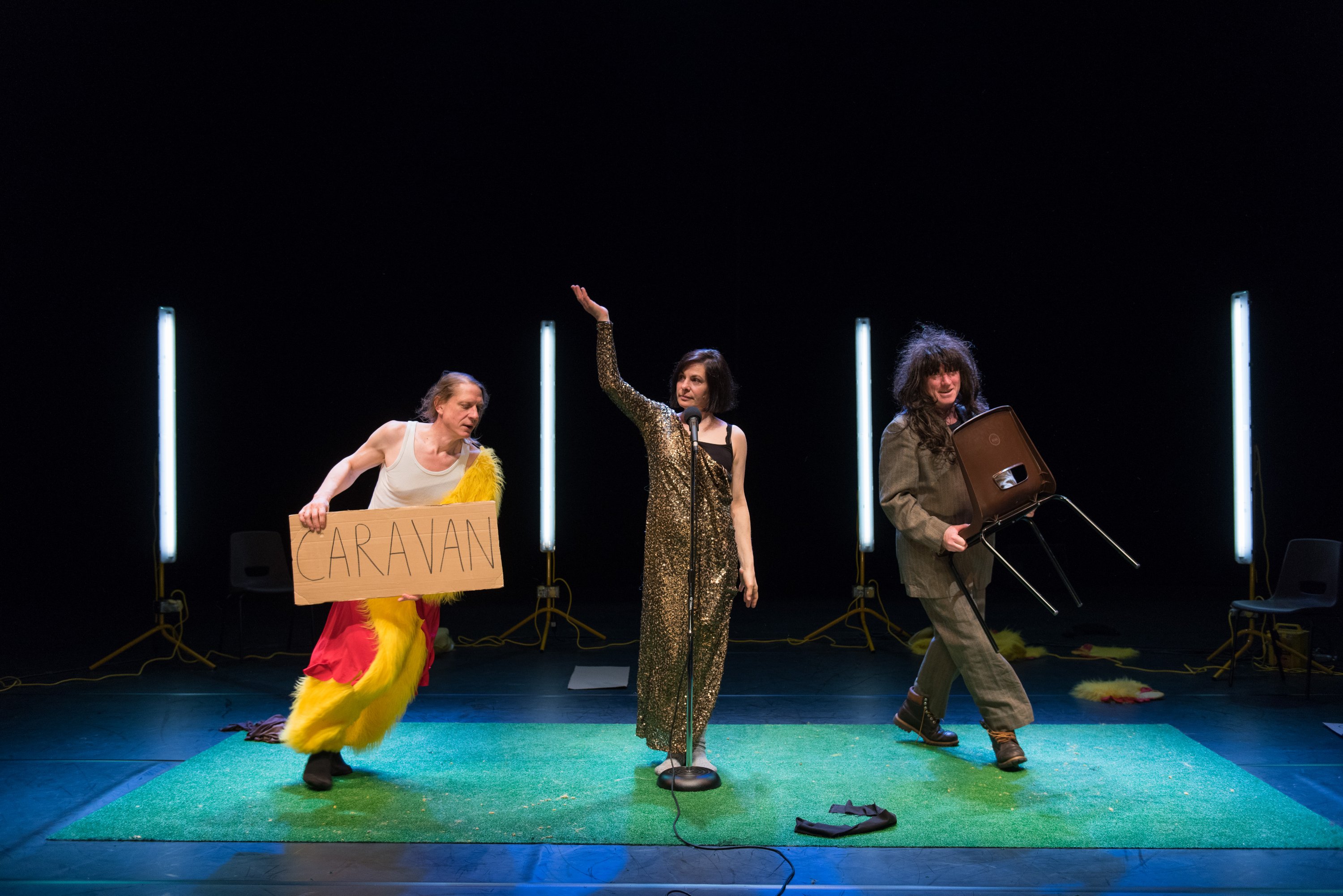
Three people on stage. Three roles to adopt. Three possible words to guess. Three answers given regardless of who asks who the question. Three chicken suits. The magic perhaps lies in the myriad of ways this short, basic scenario plays out. The three actors gift this absurd, apparently mediocre scene with a wide range of emotional pitch and timing that shifts through upbeat fun to encouragement to intimidation to sheer desperation.

From early on it is apparent that this fruitless task is looping just like the canned applause. The internal dilemma for the watcher is when is this going to end?…..Will it magically resolve?…. Do I care?…..How many more times can they do this?…..Can they really keep this going for 85 minutes?

At certain points Jerry asks the would-be mindreader Are you feeling good? Are you feeling safe? Are you feeling confident? The same might be asked of the audience as the show progresses. Ultimately I guess this show is challenging our consumption of mediocre television shows and our sometimes tunnel vision around our perceptions about our world. If nothing else Real Magic is a masterclass in the art of cognitive dissonance and the risks of stubbornly resisting change.

The overly long performance does hit home the sense of time wasting watching banal television. There are lots of allusions to crappy gameshows parodying hosts such as Chris Tarrant. The word CARAVAN in this pointless show within a show is a cheeky reminder of 70/80s shows where people won caravans but didn’t own driving licences or cars. 

I found myself drifting at times but perhaps that was exactly the intention. Did the chicken suits remind me of the jumpsuits worn in Guantanamo Bay? How many people were relentlessly interrogated when they could never knowingly answer certain questions in the way the interrogator desired? Was this absurd and bizarre scene a cut from the impenetrable Red Room in Twin Peaks? I keep seeing Jerry on the floor, sweaty and wild eyed like Killer Bob, with Claire in her evening dress as Laura Palmer and affable Richard in the suit as Agent Cooper. Perhaps I just watch too much television and need to go to the theatre more. 

If I took anything useful from the show it was questioning How do we elicit change?  Is it by encouragement, co-operation, education, by example or by intimidation? Or perhaps more worrying is the fear that we never change and just like the characters in Real Magic we are trapped in a nightmarish loop repeating our mistakes over and over and always failing to learn from them.

 At HOME until Dec1

Uncle Vanya

HOME 

Written by Anton Chekhov

Adapted by Andrew Lipton 

Directed by Walter Meierjohann

Uncle Vanya was written 20 years before The Russian Revolution of 1917 and may depict a long gone era, however the themes of depression, regrets and obsessional love are timeless. The uncertainties and frailties of human emotion are all on display and are beautifully depicted in this adaptation.

The set by Steffi Wurster is vast so the home setting dwarves the characters. The walls extend up to encompass everything and everyone, effectively creating a sense of claustrophobia. The raised piano ensures that the comfort of music remains out of reach for Yelena. The sense of decay and gloom seeps out of the walls. Even a garden scene plays out within the gloom of the house. There is literally no escape for Vanya and Sonya. The estate dominates everything as both prison, and home and hearth. 

The key human emotions of Anger, Fear, Joy and Sadness are all evoked in subtle ways. The layers of each performance ensure that each character is defined and memorable. There is always a sense of fatalism here and human curiosity about how each character chooses to respond. The emotion connection with the audience becomes truly intimate when characters  address us as though personally sharing with us one to one. 

The Professor is a man whose success and potency is fast waning and the only new challenges he faces are illness and death. Nick Hodder’s Vanya brilliantly evokes a man who has given up in body and spirit. He is only 47 but feels his life is not only over but has never really started. The tragicomedic outcome of his brief reach for love and hope is  perfectly pitched. In contrast Jason Merrells gives Astrov vitality and curiosity which lifts the gloomy house. He imbues new thinking and change yet is born too soon to really make a difference for himself. Despite their differences neither man is likely to get the future they crave and will continue to exist rather than thrive.

The older women seem stoic and content in their roles within the house. The younger female characters are similarly trapped by the social norms. Hana Yannas is perfect cast as a beautiful and brittle trophy wife full of longing and repressed energy. She is mystified at the possibility of breaking free and having love and passion rather than wifely duty and social position. Katie West is luminous on stage, her Sonya is an innocent and it is her sense of hope in an weary old world that holds everyone together. Her physical plainness is viewed as an obstacle to love and passion so she is as equally thwarted as Yelena. She remains unseen by Vaskov despite being a good match for the middle aged doctor. The tragic irony that both her and Vaskov would rather have nothing if not a great love, and therefore both are likely to get nothing. She is at peace in a spiritual way, resigned to a life of duty and tending to the needs of others rather than fulfilling her own desires in her earthly life.

The ephemeral nature of love and hope seem to dictate that emotional survival comes from taking solace in solid things like food, vodka, work or nature. In Uncle Vanya we see all too painfully what may be the outcome from missed opportunities or possibilities not acted upon. If only Vanya had seized his moment with Yelena 10 years earlier or if Astrov was more of a pragmatist than a dreamer then Sonya would have a very different life. The  invitation in this production is Seize the Day for each day is a once in a lifetime opportunity. 

Fri 3Sat 25 Nov at HOME 

SOMETHING DARK

HOME 

LEMN SISSAY

Dark, In Darkness always comes the question,Where is the light?”

Lemn  Sissay literally bounces unto the stage as though about to launch into a stand up routine. The first twenty minutes are indeed a stand up routine in the sense that this is a connection process. Who are we, how do we respond, are we accepting or rejecting? This is the quicksilver poet, the actor, performer, public speaker and private man and inner child. In giving the audience an extra bonus introduction before the play there is an unspoken understanding that this connection is about boundaries and safety.  In therapy we talk about the three Ps- Protection, Permission and Potency. In this instance they seem vital to this piece.

During the performance he remarks, that  “You shouldn’t tell your story in the way that I’ve told mine if you’ve not come to terms with it. Your well-being has got to be in mind.” On stage he exudes strength, confidence and a wickedly playful sense of humour. He creates a safe space for himself and for the audience in how he performs his own life experience. I sincerely hope that when he steps away from the stage those carefully constructed and honed inner strengths remain robust.
Something Dark is Lemn Sissays one man play telling the extraordinary and shocking story of his childhood in foster care from birth and in four  state childrens homes from age eleven to eighteen. It seems impossible to believe that Wigan Social Services countenanced such appalling disregard for a Mothers wishes for her child’s well being and safety. The second half of the play follows his journey to seek out his birth mother living in The Gambia and find a sense of family both there and in his parents homeland, Ethiopia. 

Any sense of family however dysfunctional is a gift for a man who at twenty had no one in his life that had known him more than two years. “I was the only proof of my own existence,” As he reminds us family gives us reference points, family provides  a set of disputed memories over a lifetime which inform how we see ourselves in Society. As someone who once stood pregnant for the first time at a parents graveside I can connect with that acute sense of being adrift and unknown without parents or siblings  to validate my stories and memories. 

The performance is rich and full of life, full of resilience and persistence. This work embodies our need in Society to embrace acceptance and tolerance. It eloquently screams out our need to address how we view young people in care and ensure that every aspect of their well-being is paramount while they are being parented by the State.

The performance is both uplifting and painful to watch as this clever, engaging and quite beautiful man reads his story and leads us on a journey so very dark and yet so brilliantly light. Light- because standing on that stage telling his story so poetically and advocating so passionately for young people in the care system, he radiates a light much brighter than the spotlight upon him.

For a human being born into such a dark place he epitomises nothing but light and has certainly fought long and hard “for the right to light.”

Journeys Festival International/ Orbit Festival

13th October 2017

PALMYRA

HOME ORBIT2017

Written and Performed by Bernard Lasca and Nasi Voutsas

Bert and Nasi performed their 2016 show Eurohouse about an hour ago so it feels like I already know these two charming pals or clowns or maybe I’m just beginning to have a sense of what they could be capable off. 

The stage is set as simply as before with two chairs set far apart. What enfolds is on a larger scale than EUROHOUSE and adds a ladder, boards on wheels and china plates, in fact boxes and boxes of broken china plates. Oh and there is a hammer too.

Hauntingly beautiful music inspires a dance where Bert and Nasi literally glide to the music. There is scuffling, destruction and bargaining. This is bigger than the hopeful formation of the European Union and its subsequent splintering as seen in EUROHOUSE. Instead  Palmyra is a painful look at the making and breaking of an ancient civilisation. The piece looks at how complicit we all are in the preservation or devastation of a community, a society or a culture. 

Bert and Nasi flit in and out of civility, acts of  intimidation and literally trying to brush the ugliness and damage out of sight. What started out in EUROHOUSE as disturbingly dark clowning is rapidly becoming more violent and unpredictable in this piece. When one of them threatens the other with a hammer it is then offered to an audience member for safe keeping. Choices become central. Who do you choose to entrust it with? I was contemplated and duly rejected. The keeper of the hammer is faced with what to do next or who to give it back to. 

These two are lovely guys or they might just be Tom & Jerry in human form. Their work together is exciting and provocative creating much needed dialogue about the world we live in.

Palmyra will never be glued back together like a broken plate, nor can those lost lives be revived. Yet we can still react and respond. We can defy expectation and we can try to be better. Perhaps there is still hope for us all if we can still hand some stranger a hammer and anticipate empathy and goodwill rather than large scale carnage.

BRAVADO

HOME

Part of Orbit 2017

Written and Directed by Scottee

Entering The Briton’s Protection pub on a busy Saturday night felt intimidating. It was heaving with men out for the night, men on stag do’s, men in football scarves and men already pissed. A perfect setting for performance artist Scottee to stage Bravado as part of Orbit 2017.

Upstairs in the pub a room is set up with 3 flickering and crackling analog screens, a mike and a teleprompter. Tension builds in the room as we wait for someone, anyone, to break the stalemate awkwardness and embarrassment filling the space. We need a volunteer from the audience to stand up and deliver the text, to man up and speak up about Blood, Spit, Tears and Cum. We need a perpetrator or a victim, a male presence to speak the words that Scottee has lived. A different voice each night for a story that remains unchanged and timeless.

This is a visceral and vicious account of working class men at their most brutal and brutalized. It is set against a backdrop of blokish telly of the Nineties like WWE wrestling, The Mitchell brothers in Eastenders and Bullseye. Each segment is broken up with an Oasis song which could be sung by tonight’s bloke. Ours honours the text with real tenderness and compassion but baulks at singing. Yet another insight into the complexity of the male psyche as he reads out such painful experiences but cannot sing the familiar lines of Look Back in Anger.

The content of the text is not easy to hear but the writing is a delight. The emotional pacing and the delicate attention to such brutal details are incredible. Bravado is a lesson in both how not to be a man and a testament to the potential beauty in every man.

PEOPLE, PLACES & THINGS

HOME

Written by Duncan Macmillan

Directed by Jeremy Herron                          with Holly Race Roughan

Almost 2 years after it’s world premiere at the National Theatre’s Dorfman Theatre Headlong open the first UK tour of People, Places  & Things at HOME. The play retains the original set, but has a new cast and is updated to include reflect recent major political events.

The stark white set is like a tabula rasa before the sudden ear splitting plunge into period drama with Emma as the fragile Nina from Chekhov’s The Seagull. Seconds later and time fractures again like a skipping cd and the seamless shift to the reception area of a rehab unit reveals a second audience facing us with traverse like staging. This device toys with the layers we may all sometimes hide behind. It also  manages to convey that sense in therapy that someone literally  has your back.  In many respects the seating of the audience serves as a second circle of trust in this therapeutic space.

If there is a huge amount of pressure on Lisa Dwyer Hogg to follow the award winning performance of Denise Gough it is not apparent. She delivers a wonderfully brittle, fractured addict trying to survive her many demons. The frequent use of gallows humour sits well with her Northern Irish accent and places her securely in a family of distant fathers and relentlessly harsh mothers.

Her Nina/Emma/Sarah is “excellent at being other people and totally useless being myself.” Like so many addicts she displays a toxic combination of low self esteem and grandiosity, doubting herself as an actress while challenging her doctor to “be cleverer than this. I need you to match me.”

Bunny Christie’s set facilitates the craziness of withdrawal. Aspects of the walls and floor move and shift like prisms and open up to reveal floating images, and alternate Emmas fragment and appear through walls and furniture like ants crawling on skin during withdrawal. 

The therapy space reveals the raw vulnerabilities of those in recovery seeking to deal with pain, make amends in the 12 step programme and ‘practice’ ways to avoid the triggers of people, places and things. As a therapist I can vouch for the authenticity of these characters, the fragility of their sobriety and the beauty of those ‘lightbulb moments’ when new truths are revealed.

The closing scenes are brutal and harrowing as a family explores honesty and their separate truths. Therein lies the painful reality that sometimes the people, places and things we most yearn for are truly the most dangerous. The final moment on stage sees a fragile survivor seeking acceptance from us the audience. 

Booking details

22nd Sept- 7th Oct.

TANK

HOME

DIRECTED BY Billy Barrett and Ellice Stevens

WRITTEN BY Billy Barrett, Joe Boylan, Craig Hamilton, Ellice Stevens and Victoria Watson

This is the kind of theatre experience that might leave an audience dumbstruck at times but is guaranteed to generate conversation in the bar afterwards. BREACH have produced a piece of partly verbatim theatre that can shock and provoke but is also a sensitive and moving portrayal of how inhumane humanity can be.

In the midst of Sixties Cold War paranoia NASA funded a ridulously indulgent experiment into animal neuroscience. John Lilley headed up a laboratory on St Thomas experimenting with 3 dolphins in captivity. The main protagonists of this true story are Margaret Howe Lovatt and Peter a young male dolphin. There seemed to be little emphasis on hard science as Margaret had no qualifications as a researcher other than she was curious and liked dolphins. Lilley was also curious, mainly about what effect LSD might have on a huge brain- it might be useful to mention his best mate directed all the Flipper movies! The aim was to teach the dolphins to speak English and so improve Mankinds chance of communicating with extra terrestials should we ever meet any.

The high or low point of five years of research was a 10 week period in which Margaret and Peter cohabited in a watery home. Peter did not learn to speak English but Margaret did learn how to masturbate a dolphin so maybe not an entire waste of time!

TANK uses dried out tapes of some surviving recordings of this research to illustrate this fishy tale and lo fi microphones to reproduce Peters attempts at language. The large video screen is used to show the underwater film of Peter and Margaret while the four actors on stage work to create a prism like take on what really occurred in the lab.

The actors bicker on stage as to the detail of the actual events. Margaret was “ruggedly feminine” and wore heels or boots or ….. Pam the dolphin had dried out traumatised skin or was covered in concealed blood. This is an odd couple love story or it’s a girl wanking off a gigantic dolphin cock. At the centre of this piece is the many facets of the story. Love, science, philosophy- how do we each perceive an event and how does experience colour our viewpoint? Here the women are wearily sensible  and frustrated by the men who sexualise  events like smutty schoolboys.

Joe Boylan is superb as Peter. He physically evokes the power and curiosity of the young dolphin. His is a totally believable performance and as he dances with the others the vibrancy and naughtiness bubbling through is totally infectious. Sophie Steer as Margaret vibrates with passion and despair as she attempts to communicate with Peter. There is an innocence and a whimsy to her that makes her masturbation of this dolphin seem sensuous and natural rather than sexualised which is exactly how the research assistant described her actions years later.

There are some delicious moments as they all sensuously dance together with blank faces or as they strip down and  Boylan puts on his dolphin mask. The air of menace is never far way as they fantasize about Margarets ruination and death at the fins of a dolphin army.

This is raw and edgy and joyous, it is dark theatre. It reminds us just how crazy humans can be but there can sometimes be a little magic in the crazy. TANK is good crazy.

POSTSCRIPT:

Twenty years after these experiments I spent a summer in Windsor researching parenting and attachment behaviours in dolphins. Two mother and their babies and I got to observe and play with them. It was heaven on earth.