Image credit: Victoria Wai
Written by Paul Herzberg
Directed by Jake Murray
Aldridge Studio, The Lowry Theatre
On paper The Moth is ticking all the right boxes as an exciting piece of drama that examines some highly pertinent issues around racism, fascism and the legacy of Apartheid. South African writer Paul Herzberg has crafted a full length play from his award winning 12 minute piece for The Covid-19 Monologues The Moth. Elysium Theatre Company and Director Jake Murray have a strong track record in delivering high quality productions such as Jesus Hopped The A Train, and this tour is their biggest yet taking in 25 venues. This is an ambitious production with a lot to say about how our history haunts and informs our present and whether forgiveness is always possible or even appropriate.
You think you know me. You don’t. So its time to talk.”
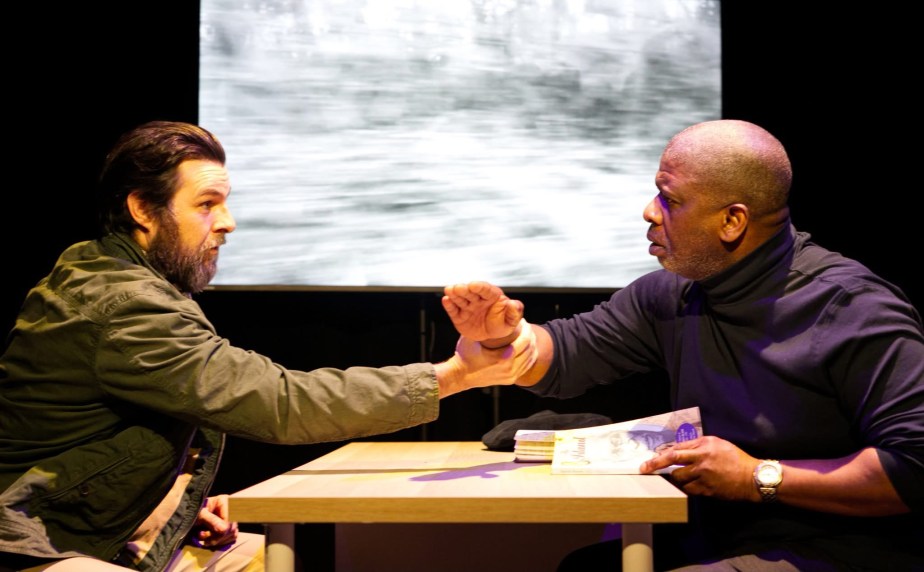
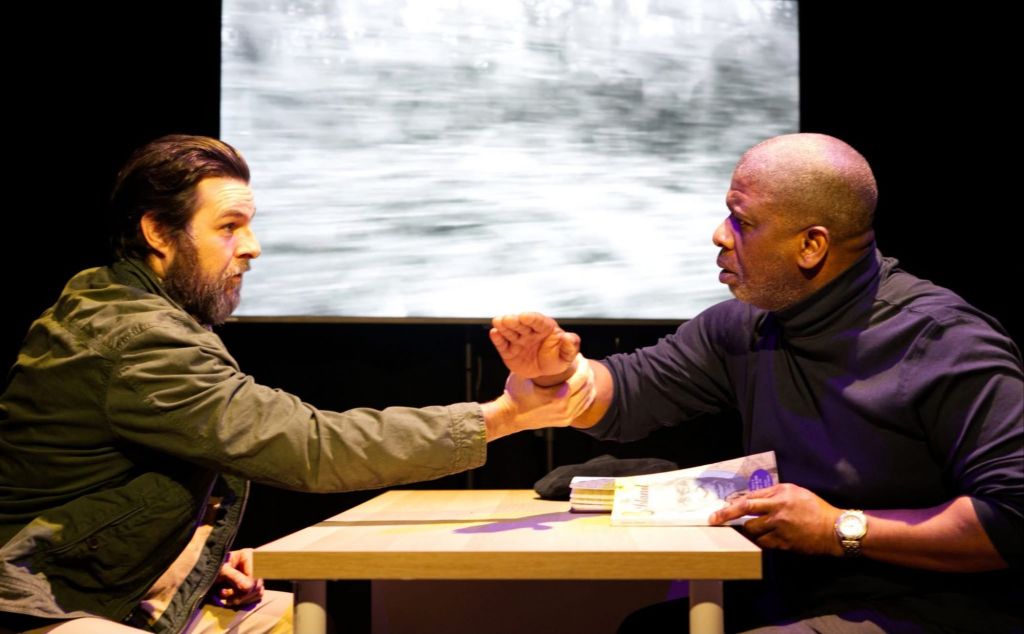
In 1997 two men meet by chance on a train from Scotland to King’s Cross. Sat opposite each other on this long journey these very different men are connected through their origin stories. John Jordana played by Faz Singhateh is a successful black British journalist who was born in a prison in South Africa and came to Britain via East Berlin where he fled with his father, an established political activist. He has great pride in his father but no relationship with his mother who stayed in South Africa. Marius Muller (Micky Cochrane) is a white South African who was conscripted into the Army and fought in the horrific Angolan Border War. Brutalised by a violent pro Nazi father and traumatised by his war experiences, he was also abandoned by his mother. These men share an uneasy conversation which leads to a shocking revelation that John writes about and the resulting fallout over the subsequent years leads to further meetings. This finally sees them face each other in a television studio as they come together to share their stories with us as the studio audience.
This is an interesting premise and is actually based on some true experiences. Writer Paul Herzberg was also a conscripted soldier in the War and has written an number of plays about the South African military experience. Here the focus is on what happens when the son of a freedom fighter comes face to face with a one time soldier responsible for war atrocities. The simple staging is effective and allows for a sense of a television studio while also serving as seats on a train or John’s home office. The use of a large monitor serves to create the illusion of scenery flying by on the train journeys, while also allowing Adjoa Andoh to pop up on Skype as John’s mother or images of family photos for both men that give a further sense of their background. stories.
Both actors give powerful performances in this lengthy and intense production. Micky Cochrane is particularly impressive maintaining a strong South African accent throughout. They both play complex and damaged men who seem frustratingly unable to connect yet appear to have an invisible thread pulling them together over decades.
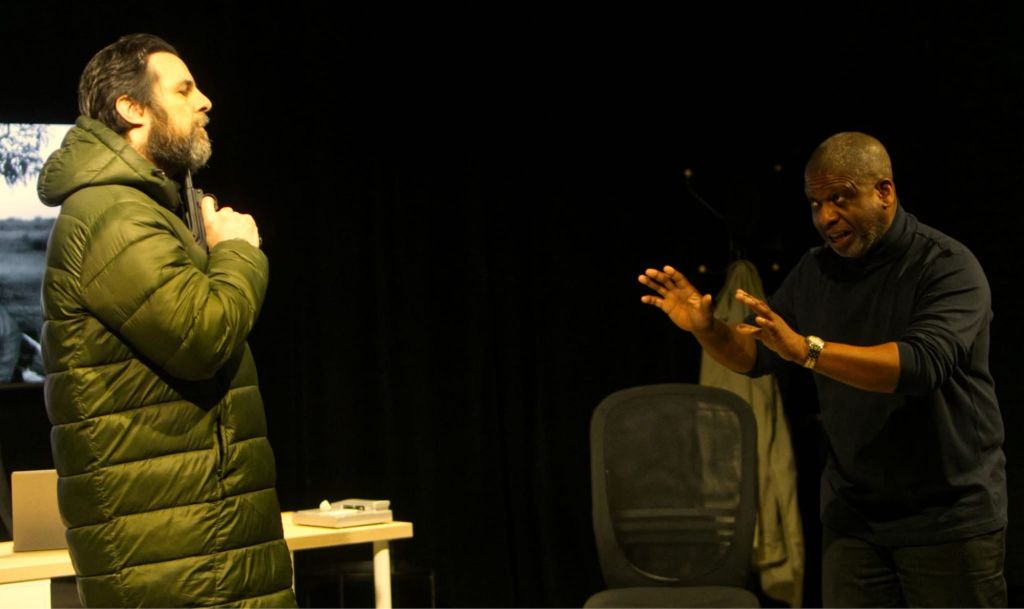
There is a real need right now for theatre that explores difficult political and ethical issues in new ways that help us make sense of a troubled world. The Moth does impart a real sense of the horror and brutality of war but it veers toward repeating its narrative in order to emphasis the story and instead this dense repetition loses the Director and his actors an opportunity to real breathe life into this production. Including the interval the play runs at about two hours that is heavy on dialogue but seems to fail to truly capture a sense of either protagonist. Scenes like the one in John’s upstairs office just don’t feel authentic. His loving wife would be highly unlikely to let a man she had never met but knew to have been the perpetrator of violent war crimes upstairs in her home to surprise her husband while their children were in the house. This feels like a missed opportunity to use that time to flesh out these complex men or to make a decision to run at 70 mins and tell an important war story succinctly and powerfully.

 Live Art Alive