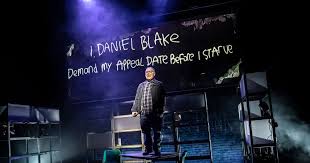

I, Daniel Blake

David Nellist as Dan in I, Daniel Blake
Image credit: Pamela Raith

Adapted by Dave Johns from the film directed by Ken Loach, written by Paul Laverty, and produced by Rebecca O’Brien for Sixteen Films.

Directed by  Mark Calvert

Written and Adapted by Dave Johns

HOME THEATRE

⭐️⭐️⭐️⭐️


This production of I, Daniel Blake is not a period piece thoughtfully adapted from the Ken Loach film. Director Dave Johns ensures that it remains an open, angry wound that has never properly healed and continues to fester. Ken Loach’s landmark film, adapted for the stage, remains a devastating portrait of bureaucratic cruelty, yet this production understands that indignation alone is not enough. It must also find the humanity flickering beneath the paperwork, the humour surviving in the queue, the tenderness that institutions so often ignore.
The story follows Daniel Blake, a joiner recovering from a heart attack who is declared unfit for work by his doctor but not by the job centre, and Katie, a young mother relocated far from home and struggling to keep her family afloat. Their uneasy friendship, born of shared hardship, becomes the emotional spine of the evening. What could feel schematic instead breathes with the lived truth of genuine poverty in Broken Britain.


This production resists any grandstanding or preaching. It does not need to. Its power lies in the detail… the humiliating jargon of assessments, the tinny hold music of endless on phone call queues, the exhausted body language of people forever asked to prove their own desperation and the bleak mono. The direction keeps sentimentality on a tight leash, allowing anger to emerge naturally rather than by theatrical decree.
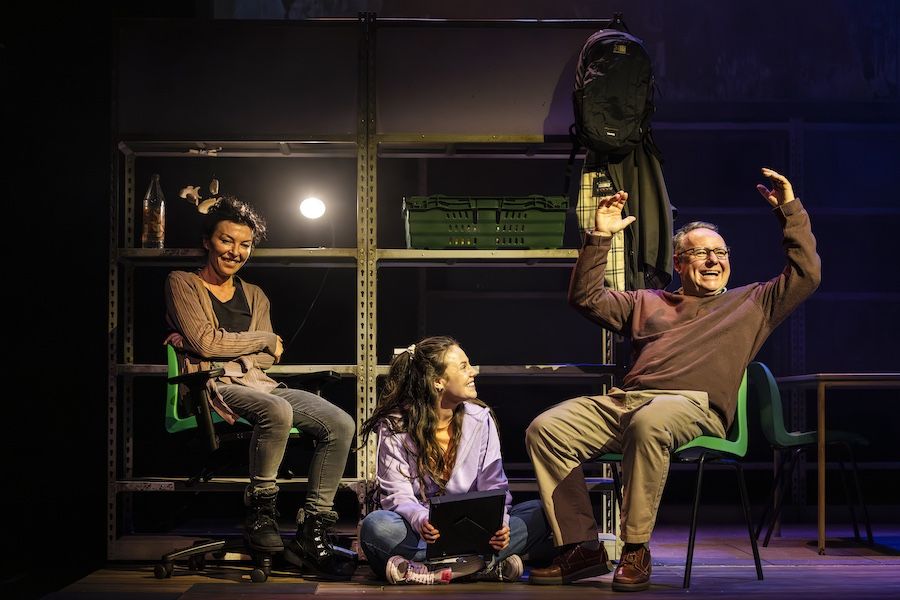
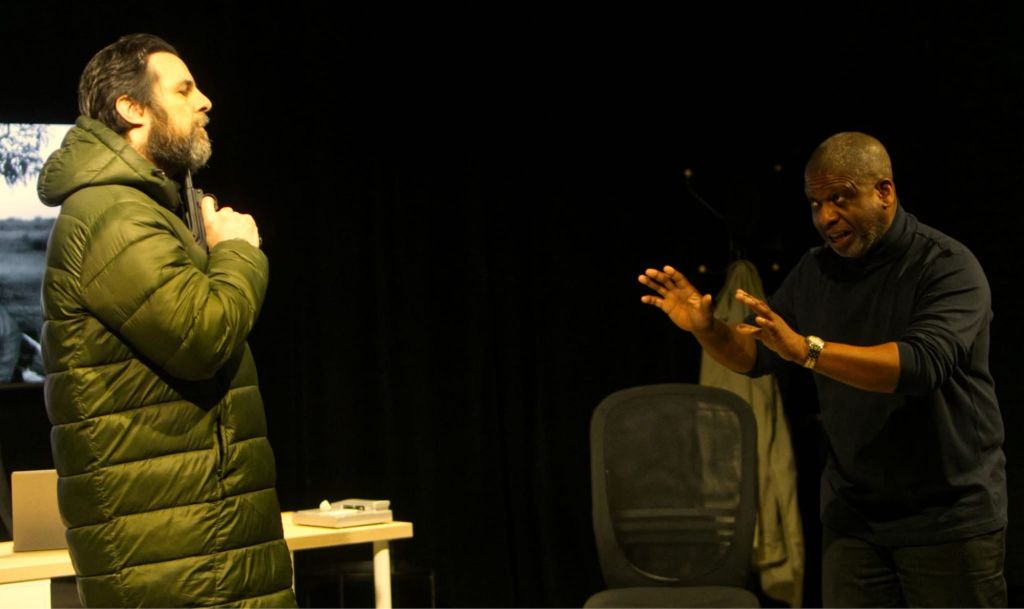
Jessica Johnson, Jodie Wild and David Nellist in I,Daniel Blake
Image credit: Pamela Raith

The ensemble work is particularly strong, creating a city of strangers who are by turns indifferent, overwhelmed, compassionate and complicit. Kema Sikazwe brings warmth,humour and hope as the young entrepreneur and Jodie Wild is the sweet but never naive beacon of hope for Dan and Katie. Micky Cochrane is electrifying as the angry man applauding Dan’s eventual retaliative outburst. No one is rendered a cartoon villain. Even the agents of the system seem trapped inside machinery too large and too cold to stop. That nuance matters. It reminds us that injustice often wears an ID badge and follows procedure.

At the centre, Daniel is played beautifully by David Nellist with a quiet dignity rather a than a saintly glow. His frustration grows by inches, not explosions, making his eventual acts of defiance all the more moving. Katie, meanwhile, avoids becoming a symbol of noble suffering. Instead Jessica Johnson is funny, proud, sharp, and at times frighteningly close to collapse but always utterly believable in the role. Their scenes together carry the warmth of two people building a tenuous shelter from weather they did not create and certainly cannot control.

Visually, the production is spare but eloquent. Functional sets slide and reshape like official forms endlessly refiled. Public spaces feel exposed; private pain has nowhere to hide. When moments of darkness arrive, they land like stones in water, such as the infamous food bank scene in which the wretched tears fall in darkness and are rendered all the more powerful.

Years after its first appearance, I, Daniel Blake remains a necessary howl against systems that confuse efficiency with morality. This compassionate, clear-eyed production does not simply ask for sympathy. It asks for memory, responsibility, and change. In an age still fluent in cruelty, that feels urgently current.
If there is a limitation, it is that the film’s intimate realism can sometimes sit awkwardly on stage, with certain transitions moving around the stage feeling more dutiful than fluid. Yet the emotional truth survives intact, and often hits harder in a room where collective witnessing becomes part of the drama. The use of the background screen is a powerful tool, used thoughtfully to show the messages and platitudes are still the same regardless of which political party chooses to tweet or advertise their latest slogan on the side of a bus.

Years after its first appearance, I, Daniel Blake remains a necessary howl against systems that confuse efficiency with morality. This compassionate, clear-eyed production does not simply ask for sympathy. It asks for memory, responsibility, and change. In an age still fluent in cruelty, that feels urgently current.
HOME MCR 21st – 25th April 2026

Tour Dates

The Moth

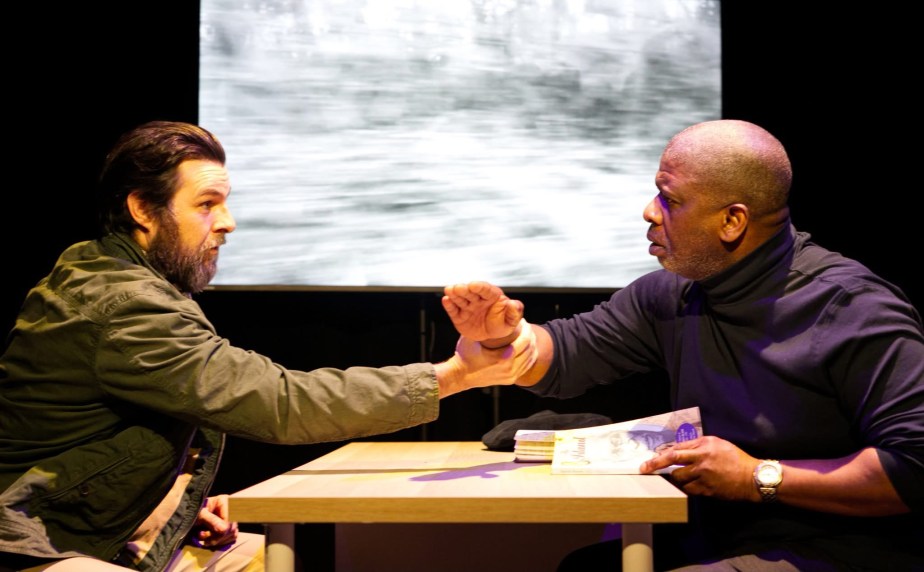
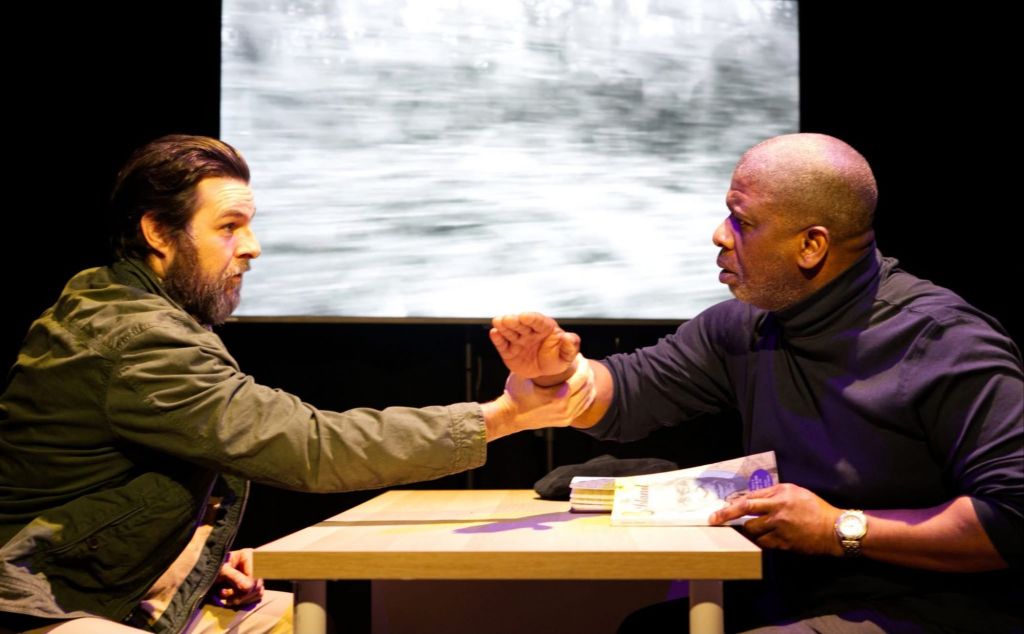
Micky Cochrane as Marius and Faz Singhateh as John in The Moth
Image credit: Victoria Wai

Written by Paul Herzberg

Directed by Jake Murray

Aldridge Studio, The Lowry Theatre

On paper The Moth is ticking all the right boxes as an exciting piece of drama that examines some highly pertinent issues around racism, fascism and the legacy of Apartheid. South African writer Paul Herzberg has crafted a full length play from his award winning 12 minute piece for The Covid-19 Monologues The Moth. Elysium Theatre Company and Director Jake Murray have a strong track record in delivering high quality productions such as Jesus Hopped The A Train, and this tour is their biggest yet taking in 25 venues. This is an ambitious production with a lot to say about how our history haunts and informs our present and whether forgiveness is always possible or even appropriate.

You think you know me. You don’t. So its time to talk.”

In 1997 two men meet by chance on a train from Scotland to King’s Cross. Sat opposite each other on this long journey these very different men are connected through their origin stories. John Jordana played by Faz Singhateh is a successful black British journalist who was born in a prison in South Africa and came to Britain via East Berlin where he fled with his father, an established political activist. He has great pride in his father but no relationship with his mother who stayed in South Africa. Marius Muller (Micky Cochrane) is a white South African who was conscripted into the Army and fought in the horrific Angolan Border War. Brutalised by a violent pro Nazi father and traumatised by his war experiences, he was also abandoned by his mother. These men share an uneasy conversation which leads to a shocking revelation that John writes about and the resulting fallout over the subsequent years leads to further meetings. This finally sees them face each other in a television studio as they come together to share their stories with us as the studio audience.

This is an interesting premise and is actually based on some true experiences. Writer Paul Herzberg was also a conscripted soldier in the War and has written an number of plays about the South African military experience. Here the focus is on what happens when the son of a freedom fighter comes face to face with a one time soldier responsible for war atrocities. The simple staging is effective and allows for a sense of a television studio while also serving as seats on a train or John’s home office. The use of a large monitor serves to create the illusion of scenery flying by on the train journeys, while also allowing Adjoa Andoh to pop up on Skype as John’s mother or images of family photos for both men that give a further sense of their background. stories.

Both actors give powerful performances in this lengthy and intense production. Micky Cochrane is particularly impressive maintaining a strong South African accent throughout. They both play complex and damaged men who seem frustratingly unable to connect yet appear to have an invisible thread pulling them together over decades.

Image credit: Victoria Wai

There is a real need right now for theatre that explores difficult political and ethical issues in new ways that help us make sense of a troubled world. The Moth does impart a real sense of the horror and brutality of war but it veers toward repeating its narrative in order to emphasis the story and instead this dense repetition loses the Director and his actors an opportunity to real breathe life into this production. Including the interval the play runs at about two hours that is heavy on dialogue but seems to fail to truly capture a sense of either protagonist. Scenes like the one in John’s upstairs office just don’t feel authentic. His loving wife would be highly unlikely to let a man she had never met but knew to have been the perpetrator of violent war crimes upstairs in her home to surprise her husband while their children were in the house. This feels like a missed opportunity to use that time to flesh out these complex men or to make a decision to run at 70 mins and tell an important war story succinctly and powerfully.

Aldridge Studio 10th-12th April 2025

Tour dates