The Moth

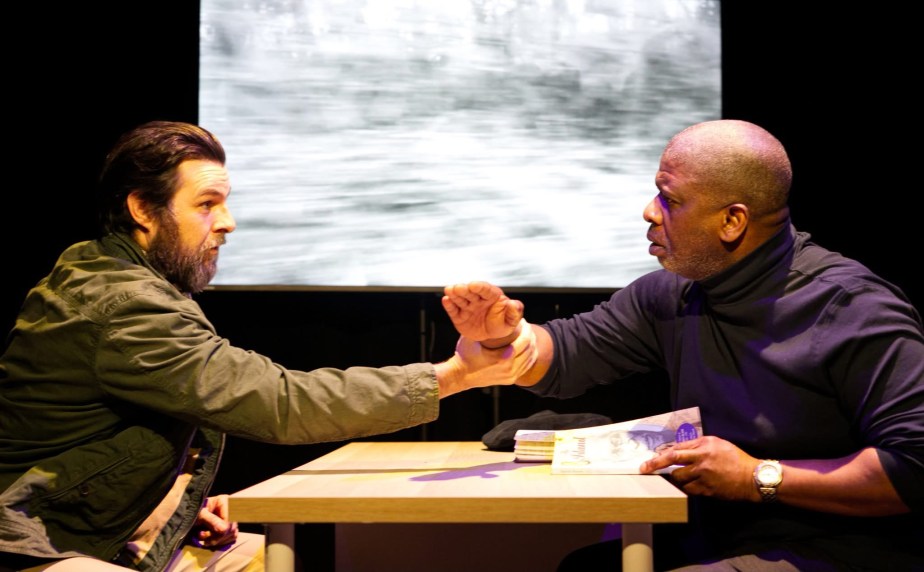
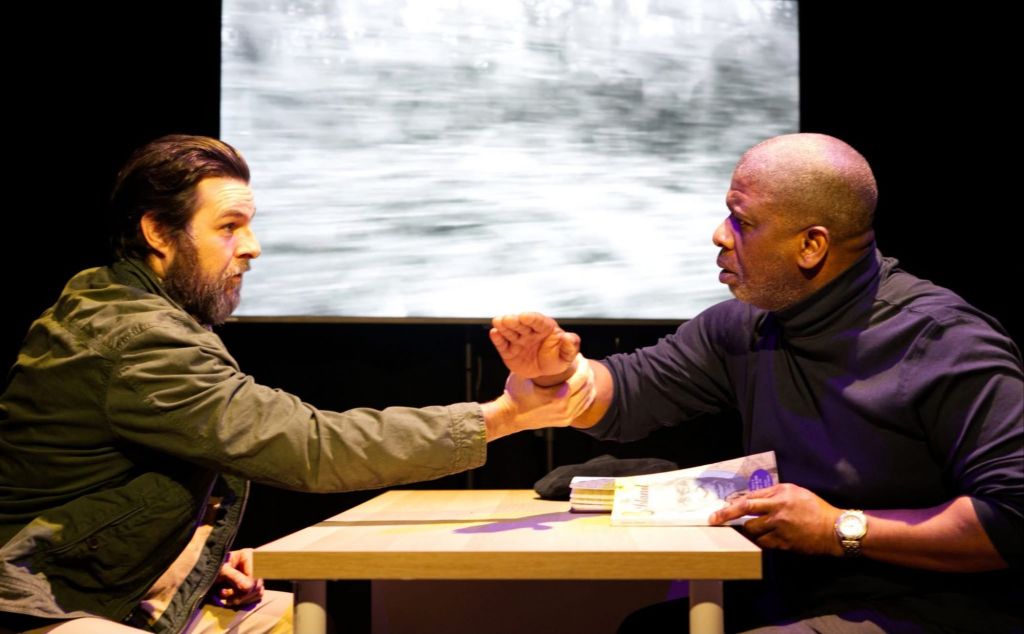
Micky Cochrane as Marius and Faz Singhateh as John in The Moth
Image credit: Victoria Wai

Written by Paul Herzberg

Directed by Jake Murray

Aldridge Studio, The Lowry Theatre

On paper The Moth is ticking all the right boxes as an exciting piece of drama that examines some highly pertinent issues around racism, fascism and the legacy of Apartheid. South African writer Paul Herzberg has crafted a full length play from his award winning 12 minute piece for The Covid-19 Monologues The Moth. Elysium Theatre Company and Director Jake Murray have a strong track record in delivering high quality productions such as Jesus Hopped The A Train, and this tour is their biggest yet taking in 25 venues. This is an ambitious production with a lot to say about how our history haunts and informs our present and whether forgiveness is always possible or even appropriate.

You think you know me. You don’t. So its time to talk.”

In 1997 two men meet by chance on a train from Scotland to King’s Cross. Sat opposite each other on this long journey these very different men are connected through their origin stories. John Jordana played by Faz Singhateh is a successful black British journalist who was born in a prison in South Africa and came to Britain via East Berlin where he fled with his father, an established political activist. He has great pride in his father but no relationship with his mother who stayed in South Africa. Marius Muller (Micky Cochrane) is a white South African who was conscripted into the Army and fought in the horrific Angolan Border War. Brutalised by a violent pro Nazi father and traumatised by his war experiences, he was also abandoned by his mother. These men share an uneasy conversation which leads to a shocking revelation that John writes about and the resulting fallout over the subsequent years leads to further meetings. This finally sees them face each other in a television studio as they come together to share their stories with us as the studio audience.

This is an interesting premise and is actually based on some true experiences. Writer Paul Herzberg was also a conscripted soldier in the War and has written an number of plays about the South African military experience. Here the focus is on what happens when the son of a freedom fighter comes face to face with a one time soldier responsible for war atrocities. The simple staging is effective and allows for a sense of a television studio while also serving as seats on a train or John’s home office. The use of a large monitor serves to create the illusion of scenery flying by on the train journeys, while also allowing Adjoa Andoh to pop up on Skype as John’s mother or images of family photos for both men that give a further sense of their background. stories.

Both actors give powerful performances in this lengthy and intense production. Micky Cochrane is particularly impressive maintaining a strong South African accent throughout. They both play complex and damaged men who seem frustratingly unable to connect yet appear to have an invisible thread pulling them together over decades.
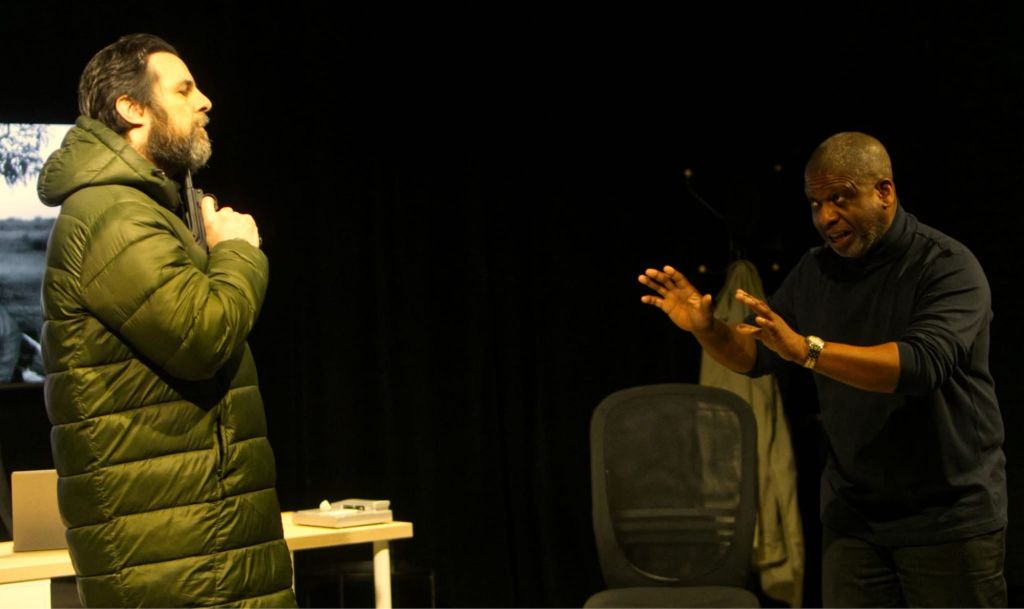
Image credit: Victoria Wai

There is a real need right now for theatre that explores difficult political and ethical issues in new ways that help us make sense of a troubled world. The Moth does impart a real sense of the horror and brutality of war but it veers toward repeating its narrative in order to emphasis the story and instead this dense repetition loses the Director and his actors an opportunity to real breathe life into this production. Including the interval the play runs at about two hours that is heavy on dialogue but seems to fail to truly capture a sense of either protagonist. Scenes like the one in John’s upstairs office just don’t feel authentic. His loving wife would be highly unlikely to let a man she had never met but knew to have been the perpetrator of violent war crimes upstairs in her home to surprise her husband while their children were in the house. This feels like a missed opportunity to use that time to flesh out these complex men or to make a decision to run at 70 mins and tell an important war story succinctly and powerfully.

Aldridge Studio 10th-12th April 2025

Tour dates

Warhorse

The Lowry Theatre

Written by Michael Morpurgo

Adapted for Stage by Nick Stafford

Directed by Marianne Elliot and Tom Morris

A National Theatre production

Warhorse had it’s regional première at The Lowry in 2013 and returns for the third time, fittingly as the centenary of the end of WW1 approaches. The book by Michael Morpurgo was adapted at The National Theatre in 2007 and has been hugely successful ever since with worldwide audiences of over 7 million. It is a extraordinary show in terms of scale and ambition with a use of puppetry by South Africa’s Handspring Puppet Company that is breathtakingly effective. It takes the audience on a journey from sleepy pre-war Devon countryside to the horrors and brutality of the battlefields of France. It is a poignant tribute not only to all that wasted youth and unfulfilled potential but to the animals who suffered and were slaughtered in appalling numbers.

This is a huge production relying on the puppetry effects merging with a large cast in a believable way. There are moments with the birds early on that don’t seem as effective as perhaps intended but otherwise it all works incredibly well. Moments like the puppeteers reverently stepping away from Topthorn perfectly convey the loss of the heart and soul of this proud animal. Similarly the sudden breaking of the colt to make way for the fully fledged Joey is spectacular. This is clearly a team effort with the whole cast giving their all to a very special theatrical experience.

The design work on Warhorse is astounding in its apparent simplicity. Rae Smith’s set is a bare stage using occasional props but to stunning effect. Doors appear in the dark backdrop or poles create market day or become paddock fences. Barbed wire draped at the front of the stage creates a visceral horror that is unforgettable. The brilliance of the vast overhead projection screen is incredibly special. As the performance opens it looks like a slash of white cloud across the Devon countryside but is of course a torn fragment of parchment from a soldiers sketchbook. The backdrop of images of country villages, callow youths on horseback and soldiers’ arrival in France and the battlefields of The Somme are sketched out across the screen in black and white drawings. The only splash of colour is when the screen bleeds red for a lost comrade and poignantly becomes the blossoms of poppies on The Somme.

The lighting by Paule Constable is beautifully done creating golden summer days and crisp winters before shifting into the bleak battlefields where soldiers emerge from the gloom or are blinded by the white flashes of explosions or the yellowing haze of gas attacks. The lighting has the effect of breaking the fourth wall by making the audience experience the battlefield horrors as though they are there too. The impact of the sound and visuals have created a powerfully immersive experience that lingers after the show has ended.

My grandfather was a country boy like Alfred and fought throughout the war. He was to be the sole survivor of his platoon at The Somme and initially was listed as dead. He was seriously injured, placed on a cart of dead bodies dragged back through the mud and debris by a horse such as Joey. He started to regain consciousness as the bodies of his friends were lifted off for burial. He was one of the lucky ones who came home.

This is an incredibly moving experience especially as the young soldiers go over the top and are cut down so brutally. The horrors of horses ridden into barbed wire with no escape or dragging ambulance carts or tanks through the treacherous mud. Warhorse is a potent reminder of why WW1 is rightly still remembered as a testament to the senseless cruelty of war.

The Lyric Theatre, The Lowry

13th – 30th June

Images by Brinkhoff & M Âgenburg

Cyrano

QUAY THEATRE, THE LOWRY 

NORTHERN BROADSIDES/ NEW VIC THEATRE

Adaptation of  Edmund Rostand’s Cyrano de Bergerac by Deborah McAndrew

Saturday afternoon in a box right by the stage. Great view of audience and cast. It is a piece of period French drama. It is pantomime but with an audience of old people and a 12 week old baby. It is a musical. It has the ghost of Geraldine McEwan on a balcony in a crinoline. Please let me face the Spanish forces with a wooden sword and let the equally wooden young Christian stay to listen to Roxanne instead of me.

In this production Cyrano is much younger than how he is usually portrayed. This works on some levels and Christian Edwards portrays him with energy and conviction. Amongst the poets and soldiers he convinces, however the casting of Roxanne makes it harder for him to seem as passionate in the love scenes. Northern Broadsides have built a sound reputation casting using regional accents and staging in unusual locations. It can be a winning combination but not in this instance. The set is very pedestrian and uninspiring and the Northern accents are fine though become uneasily frenchified when discussing patisserie. The big problem is the strident cut glass Edinburgh voice of Roxanne. Closed eyes and  Cyrano and Christian are wooing Miss Jean Brodie in her prime. It creates a dissonance and ruptures belief in Roxanne (Sharon Singh) as a credible love interest for the clever and complex Cyrano.

The addition of lots of singing and dancing and men in women’s clothes with tiers of pastries under their skirts and baps hidden in their bras distract from the original play and create the farce of pantomime instead. There is even an pickpocket/nun of small stature to add to this bewildering spectacle.

The cast bring lots of energy and enthusiasm to this production. However the staging and direction makes it feel more am/dram than this cast deserve.

The closing scene of the death of Cyrano is a blessed release for all concerned bar the wretched Roxanne who will no longer have the local gossip told to her  in an engaging way. Where in Deborah McAndrews  script is the quick wit of Roxanne that so beguiled Cyrano?  Four autumn leaves fall from the sky to herald the passing of poor lovelorn Cyrano – a props misfunction or no budget left for leaves after buying in so much pastry? 

It is ironic that Cyrano should speak so eloquently for Northern Broadsides ethos 

Shall I hide my roots, and change my voice. Modulate my vowels to fit in?

Sadly in the case of a Scottish Roxanne it would have been welcome.