WRESTLELADSWRESTLE

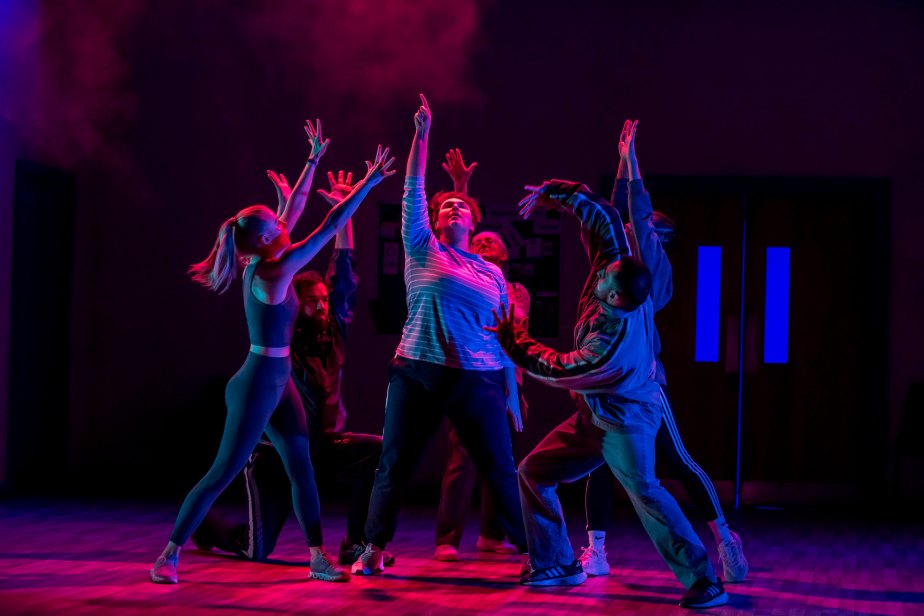
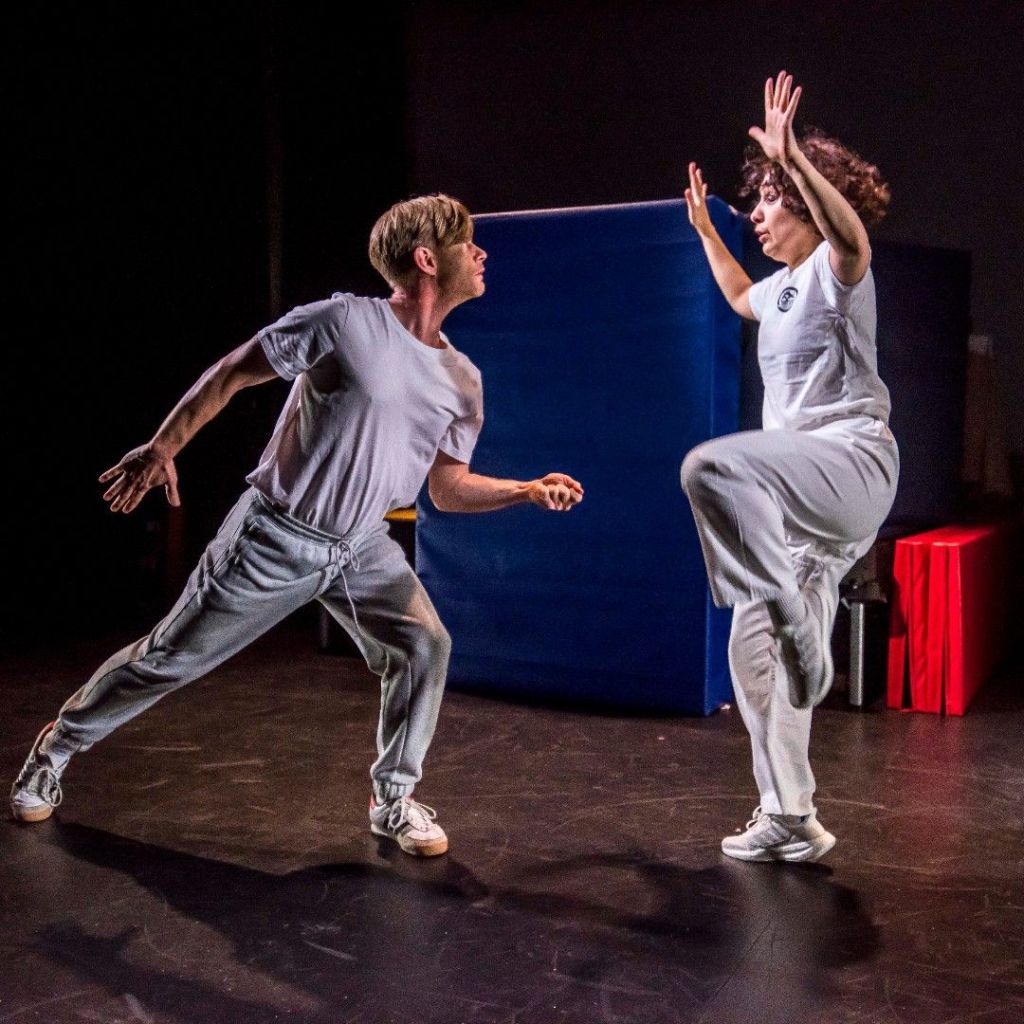
Simon Carroll Jones and Jennifer Jackson in Wrestleladswrestle at HOME

Created and Performed by Jennifer Jackson

Outside Eye Sarah Frankcom

HOME

Theatre 2 in HOME is pulsing with energy during this new production devised by Jennifer Jackson with the assistance of fellow performer Simon Carroll Jones (Head of Movement at The Arden). The stage is piled up with thick wrestling mats which are later moved to reveal a full drum kit on which Isobel Odelola punches out a mean beat. Jackson was the under 50kg British Judo Champion at age 15 and seems to have lost little of her energy and prowess. Mixing dance movements and judo moves, the narrative weaves strands of storytelling from Jackson’s childhood involving a racist event and a scenario involving a drunken incident at a taxi rank with segments of teaching self defence Judo moves to an actual girl gang. The result packs a punch as the production explores racism and oppression while asking why women continue to be so unsafe on the streets and in their homes that they still need self defense classes to protect themselves.

Jackson is a gifted storyteller who vividly evokes 1980s Coventry and transports the audience to the sales queue in C&A as she and  her petite Bolivian mother wait their turn. Loops of this scenario repeat sometimes featuring a red-faced angry man and eventually an angry white woman with the young Jackson witnessing her Mother being subjected to a racist attack. At times the scenario involves the performer challenging this unprovoked oppressive behaviour with a samurai sword or verbally making the aggressor see the error of their ways and apologise or sees the child get away with some ribald swearing in defence of her mother. The more prosaic actual truth of standing in silence and shame in the store queue has clearly shaped Jackson as a person and was also the catalyst to having judo training as a young girl. The other incident is also told from a range of perspectives. At times it is a funny story of fighting off a drunken woman trying to jump the queue at a late night taxi rank. In one instance she is celebrated as a feisty woman who pours a pint over the other woman and taunts her that she is a judo champion but when the tale loops again it has a darker edge suggesting the other woman’s vulnerability and desperation to get in a cab just to get home safely.

There are some lovely pieces of movement involving Jackson and Carroll Jones that see judo moves blend with elements of traditional Bolivian dance and Old Holywood dance routines which at times shift into an insidious violence of choke holds. The petite Anglo-Bolivian theatre-maker spars with her rather Aryan looking partner and  teaches judo moves with clear instructions to her girl gang and the audience. The energy and pace of the piece is propelled by the drum beat and hi energy moments such as when Jackson wrestles a sex doll and pummels every inch of air out of it so it resembles a ragdoll. It presents as entertainment with the girl gang braying encouragement but as with so many implied undercurrents in this production there is something deeply unsettling about the casually discarded limp body lying on the stage.

WRESTLELADSWRESTLE at HOME

By the end of the production the stage is filled with women all capable of felling the hapless judo assistant Simon. This is clearly celebrating safety in numbers and pure girl power as Jackson is surrounded by their communal embrace. There is a lot to like in this production and WRESTLELADSWRESTLE also benefits from some punchy captioning by Sarah Readman and live action video design from idontloveyouanymore that add a cartoon element to the work with all the BEEPS and GONGS flashing up onscreen.  There are however some staging issues such as although the drum kit is raised up and highly visible, the piece also features a lot of floor work which is not always easy to see unless sat in the very front rows. Overall Jackson delivers a message of self defense training as empowerment and a worthy alternative to standing silently in a queue if no one comes to your aid.
HOME 3rd – 12th October 2024

ROBIN/RED/BREAST

Maxine Peake in ROBIN/RED/BREAST at AVIVA STUDIOS. Photo credit: Tristram Kenton

Adapted from Robin Redbreast by John Griffith Bowen

Writer Daisy Johnson

Co-Creators Maxine Peake, Sarah Frankcom and Imogen Knight

Director Sarah Frankcom

NORTH WAREHOUSE, AVIVA STUDIOS

ROBIN/RED/BREAST continues the highly successful collaboration between Factory International and Maxine Peake, Sarah Frankcom and Imogen Knight which began in 2013 with The Masque Of Anarchy. Last year’s Manchester International Festival saw Peake in a reading of the dystopian 70’s novel They which  further cemented her artistic reputation as an accomplished actress and a beguilingly natural storyteller. This time the artistic team behind the new production company MAAT (Music, Art, Activism and Theatre) re-examine Robin Redbreast which first featured on the BBC in 1970 as part of the iconic Play For Today series. This piece of folk horror is uncomfortably pertinent as women are once again having to fight for their bodily autonomy and the right to make our own reproductive choices.

For any of us who grew up in a rural community there is an absolute normal in the strangeness of folklore and ritual. Cures handed down by the seventh son of a seventh son and sneaked into hospitals by desperate relatives or teenagers spat on and then blessed by a total stranger living in a remote house up the mountain as a cure for chickenpox were not at all unusual…or perhaps my upbringing was not as mundane as I have presumed. The Seventies produced a plethora of folk horror stories focusing on rural rituals especially around fertility and sacrifice which coincided with huge social revolutions for women around contraception and abortion. In this production Norah played by Maxine Peake is an independent woman who feels confident about her own choices regarding relationships, family and career. Choosing to opt out of city life after a relationship breakdown she finds herself alone in a cottage seeped in history where the rustling of mice and the whirr of wasps seem to open up crevices in time through the ancient walls. As we listen on headphones to Norah’s thoughts it is clear her sense of her own identity may be being threatened by sinister elements in the community around her.

Maxine Peake and Tyler Cameron in ROBIN/RED/BREAST at AVIVA STUDIOS.
Photo credit: Tristram Kenton

The staging by Lizzie Clachan is stunning in its simplicity. Walking into the cool dimness of the North Warehouse with its huge ceiling, the wooden frame of the cottage nestled on a rich earth floor feels like magically coming across a forest cathedral. All pathways leads toward it and staged in the round with audience on benches it exudes the feeling of a natural amphitheatre. The audience don headphones and are immersed in the sound of birdsong, scuttling mice and the thoughts that come racing through Norah’s mind as loneliness, lust and looming fears begin to creep in like the bindweed that invades the sanctity and safety of her cottage walls. When the febrile dancing abates and the cottage is suddenly ripped away there is nothing left but the dank, rich earth of Mother Nature merging with the prone form of Norah asleep on the forest floor.

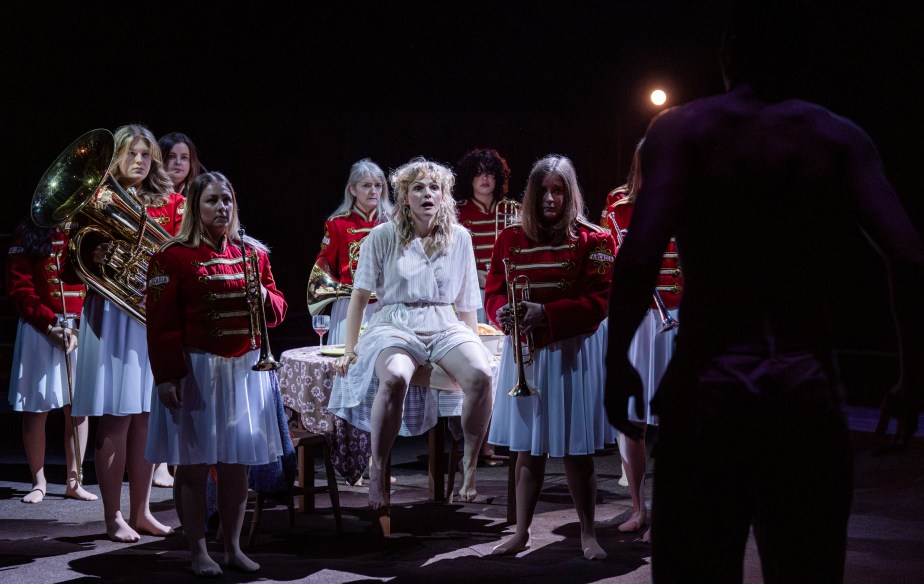
The music by Gazelle Twin blends beautifully with the dreamy poetry of writer Daisy Johnson who has also worked on Viola’s Room, the latest immersive production by Punchdrunk. There is a very surreal feel to this production further enhanced by elements such as a female brass band who silently observe Norah and are clad in vivid red and white band uniforms that may evoke a group of Robin Redbreasts yet also a female army who may or may not protect Norah from impending threat. The langorous choreography by Imogen Knight adds to the atmosphere as we observe Norah like a character from a fairytale awaking in this cottage, going about her chores and coupling in the woods with a handsome forester.

Maxine Peake draws in the audience as she moves around her cottage home, suitably vexed as she scrubs menstrual blood from her bedsheets and later perplexed as her contraceptive cup has seemingly vanished. Listening to her flurry of thoughts through headphones makes for a potent connection to the character so when she finally speaks aloud to the audience it feels like we might really know Norah or indeed perhaps Maxine. This could be any woman and that is where the true fear lies…rising like the torrent of water that threatens to wash away homes, hopes and security like a deluge of miscarriage blood or the tumultuous waters that may drown a mother or her child in a flimsy refugee boat.

Peake is at her very best when speaking directly with an urgent softness that evokes inclusion and intimacy. Huddled in a circle on blankets the  young women silently listen as she speaks of abortion choices, miscarriage traumas and the brutality of the lottery that occurs everyday in a maternity unit. Women bleed whether they abort,  miscarry or give birth. They do not know if they will love unconditionally or struggle to feel anything or  veer between fierce love and the overwhelming desire to put him down…whatever that may mean at any one time. In such a lottery of joy and despair it is terrifying enough to be a woman without additionally fearing others may try to enforce their choices and beliefs on us.

AVIVA STUDIOS 15th – 26th May 2024

Work It Out

The cast of Work It Out at HOME
Photo credit:Chris Payne

Written by Eve Steele

Directed by Sarah Frankcom

HOME

Work It Out shines a light on the week to week experience of a disparate group of vulnerable individuals as they start to form bonds within a dance fitness class they have been prescribed at their local Community Centre. The naturalistic setting and the format of weekly sessions allows writer Eve Steele to deftly explore the journeys that each of her characters experience as they attempt to change their lives. It also gives Steele a perfect platform for an unashamedly polemic rant about a broken Britain where the most vulnerable in the population are increasingly isolated and unsupported. This could be a hard hitting, grim litany of despair but instead Steele imbues her characters with sufficient warmth and humour to ensure there is also a sense of hope as her characters re-engage with a love of life and all its possibilities.

Eve Steele as Siobhan in Work It Out at HOME Photo credit: Chris Payne

The motley crew are all dealing with their own demons. Pensioner and Grandma Marie is both feisty and vulnerable with her anxieties masked by brusqueness and antipathy. Eithne Brown embodies this elderly hoarder with compassion and humour as she gradually opens up to the group and starts to regain some confidence. Raffie Julien plays her deaf granddaughter who having fallen out of love with music and dance has retreated to a world where her primary social engagement is with her phone. This is a beautiful performance and Julien shines as the prickly young woman who starts to regain joy and freedom in dance as she also makes new friends. The use of BSL throughout the production is seamlessly blended and works especially well within the fluid choreography of the whole production. Compulsive eater Colette initially tries to blend into the nondescript walls but Eva Scott blossoms on the dance floor as she connects with her repressed emotions. Writer Eve Steele is Siobhan, a heroin addict attempting to beat the drugs and  the System while trying to get her daughter out of Care. Her character is  both frustratingly disruptive in the class yet also acts as a catalyst for change in others that tragically she can sustain for herself. As always Steele is utterly believable as this chaotic and desperate woman who has suffered multiple traumas since childhood.

Dominic Coffey as Shaq and Raffie Julien as Rebecca in Work It Out at HOME
Photo credit: Chris Payne

The men here are interesting characters who despite their issues seem readily at ease amongst the predominantly female class. Aaron McCusker as Rab is a recovering alcoholic finding solace in acerbic one-liners and reiki. There is a bleak stoicism in his determination to live despite his own child wishing him dead. Dominic Coffey as Shaq has been through the care system and his burgeoning dance skills compete with his tics and stimming. The seemingly perfect class teacher played by Elizabeth Twells unites these characters but is woefully unprepared for the issues that erupt and she soon reveals herself as equally vulnerable and just as in need of a support group.

There is much to like in this production. Jennifer Jackson has done a brilliant job with the movement and choreography which is very impactful especially in scenes such as Coffey’s solo dance to a great version Creep by Radiohead. Katie Scott has created a set that embodies every detail of a down at heel community space. For Eve Steele and Director Sarah Frankcom this has clearly been a labour of love and the naturalistic direction feels like a homage to the wonderful Annie Baker. There are however issues with the overall length of the play and the pacing. The first half feels too long and risks losing its momentum on several occasions and there are occasions where the dialogue is hard to hear during some dance sequences. Overall Work It Out is a well written piece with a big heart. It celebrates the redemptive quality of kindness and the vital importance of community in our increasingly fractured world. It also highlights the hidden tragedy of those who are often better at helping others than knowing how to truly help themselves.

HOME 1st – 16th March 2024

Light Falls

Written by Simon Stephens

Directed by Sarah Frankcom

Original music by Jarvis Cocker

ROYAL EXCHANGE THEATRE

Light Falls marks the end of Sarah Frankcom’s tenure as Artistic Director at the Royal Exchange Theatre. It seems only fitting that she bows out with a play about loss and endings. In the same week as iconic Northern soap Coronation Street is opening up a frank conversation about death, grief and kindness comes this new play by Simon Stephens. He has written a delicate and beautiful play about death that is also a eulogy to kindness and a testament to fortitude.

Christine (a very moving and understated performance by Rebecca Manley) is nine months sober after a life of alcoholism when she walks into a Stockport supermarket. Married to Bernard and a mother to Jess, Steven and Ashe, and a grandmother to baby Layton, she hovers at the shelf of vodka before dying suddenly from a sub-arachnoid haemorrhage. It is 12 minutes to 5pm. It is a Monday in February 2017. What happens next moves from the mundane to the sublime as Christine hovers around her family watching the defining moments in their lives as they hear of her death. What this quiet play does so well is capture how time can suddenly stand still yet life moves on around us and so inevitably must we, even when our world has irrevocably changed.

The cast of ten explore the intertwined relationships of a family and those around them as Christine dies. There are standout performances from Lloyd Hutchinson and Carla Henry as Bernard and his mistress as they navigate through a fumbling attempt at a threesome in a Doncaster hotel. There is a terrible poignancy and dark humour to this blustering, overweight man striving for new experiences yet ultimately lusting more for a double cone icecream than two young women in his hotel four poster bed.

All three children are emotionally damaged by their upbringing with an alcoholic mother who took wine to McDonalds and was drunk in the school playground. Defensive and wary in their emotional relationships they struggle with attachments having known a parent who at times favoured vodka over them. The play touches on each of their partnerships and through interactions and fragments of dialogue gives a sense of ongoing internal struggles.

Katie West is simply wonderful as Ashe, a desperate, exhausted young mother who has attempted suicide only months before her mother’s death. She exudes vulnerability and raw emotion in all her scenes and it is her presence that lingers after leaving the theatre. This is a portrayal of grief, fortitude and love that makes this play soar.

The stark, bare elegance of the set by Naomi Dawson ensures this is always about the actors. The stairs and tiered steps open out the staging and also feel like a gentle hint of stairs to heaven and steps in the grieving process. The cascading downpour that drenches has the catharsis of an outpouring of grief and emotion. The much heralded music by Jarvis Cocker is also understated in a less is more way. A recurring melody and a single Hymn of the North feel like the familiar comfort of a lullaby.

This is a low key production that favours subtle touches, gritty humour and beautiful writing to colour and shade an ordinary family dealing with the stark pain of loss. I’ll be watching from the shoreline epitomizes what many of us hope for when we have to survive loss. We yearn for that sense of being watched over and still cared for, as Christine does with her children. Much has been made of Light Falls as a Northern play by a Northern writer with a hymn by a Northern songwriter. Personally I’m not sure it matters where they are from, North or South. We are shaped by our roots, our heritage and whether we embrace or reject that, or run from it or back to it, our shoreline is simply our core, our gut, our safe place. We all need a haven when our world is rocked by loss regardless of who we are or where we live.

Royal Exchange Theatre 24th October – 16th November 2019

Images by Manuel Harlan

West Side Story

ROYAL EXCHANGE THEATRE

Directed by Sarah Frankcom

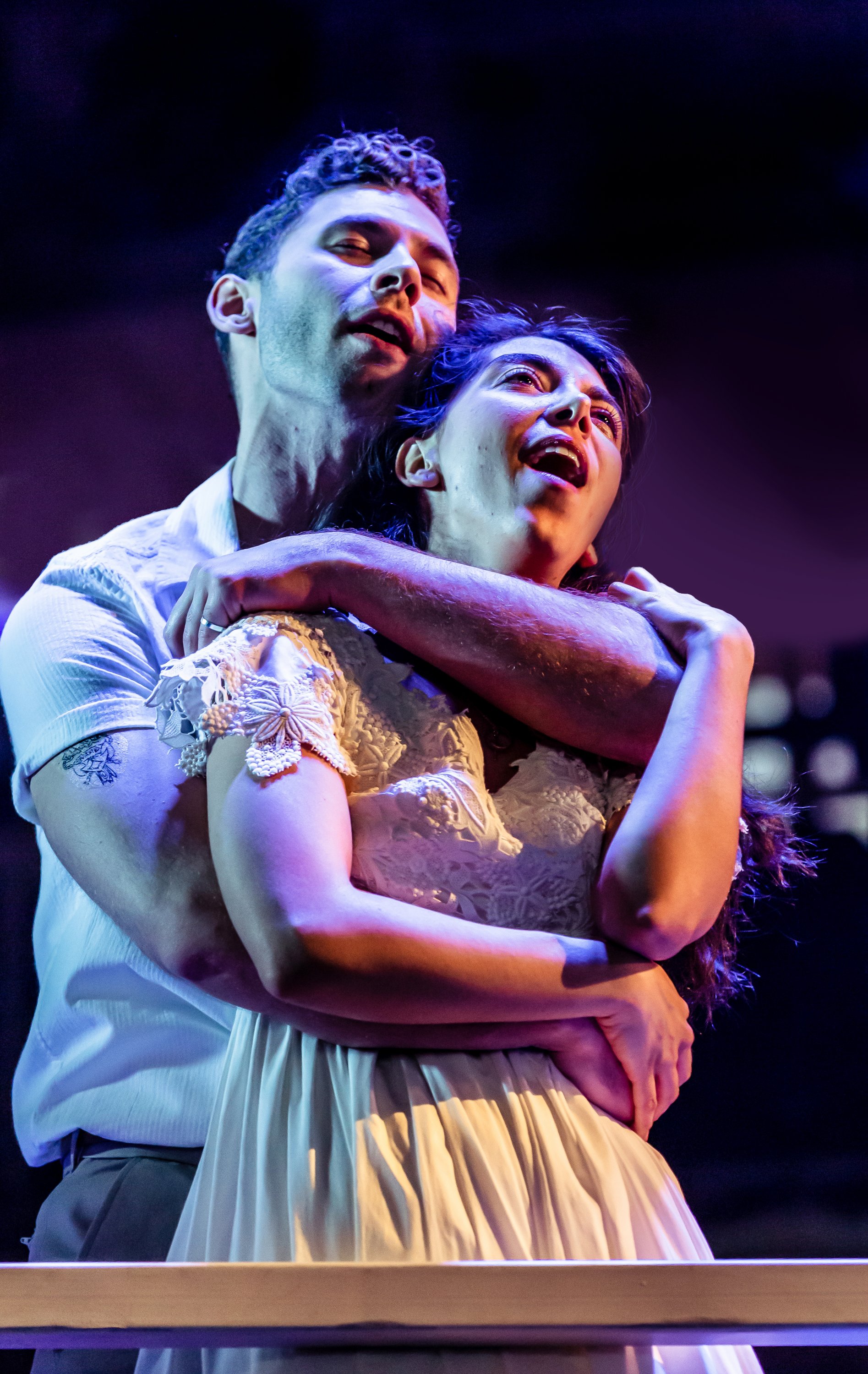
Initially conceived by Jerome Robbins in 1949, WEST SIDE STORY finally arrived on Broadway in 1957. A resounding hit, it was made into a movie in 1961 and has remained an iconic and groundbreaking musical ever since. New versions are in production for Broadway and cinema, but the first big production to makes changes to the choreography and score is this Sarah Frankcom version.

Based on star-crossed lovers Romeo and Juliet, this tale of thwarted love amidst gangland violence and knife crime is as horribly relevant in modern British cities as it was in 1950s Manhattan. It speaks so vividly of young people adapting to their burgeoning independence in a world where they may struggle for acceptance. This tale of gangs is evergreen in that it perfectly depicts the human quest for social identity. We all seek a sense of belonging and to affirm this we adhere to an in group which might be family, social class, a gang or a football team. To increase self esteem we discriminate against the out group, the more prejudice and seperateness then the greater enhancement of self image. The beauty and the tragedy of this has resonated throughout the ages and in every culture. In my teenage years it was Catholics and Protestants in Northern Ireland where boys were knee capped and girls tarred and feathered if they dared to fall in love with someone outside their religion.

The set design by Anna Fleischle is all clean stark lines of white steel and glass, like possible staging for A Clockwork Orange. Although beautiful in a minimalist manner it initially seemed too cold for this tale of passion. There is no context or sense of location which is disconcerting yet highly effective as a potent reminder that this story is ongoing – here in the theatre and outside in every town and city.

This set also works brilliantly with the new choreography by Aletta Collins. She has kept the beauty of the original but adapted it for the round stage and added a fresh athletic element that sees the performers really use the multi levels of the set with cat like grace and agility so there is almost an element of Parkour in the choreography.

Jason Carr has ensured that the music really is the star of this production with an orchestra concealed outside the theatre itself delivering a glorious version of Bernstein’s score. Every note seems flawless and crystal clear as though the orchestra was actually centre stage.

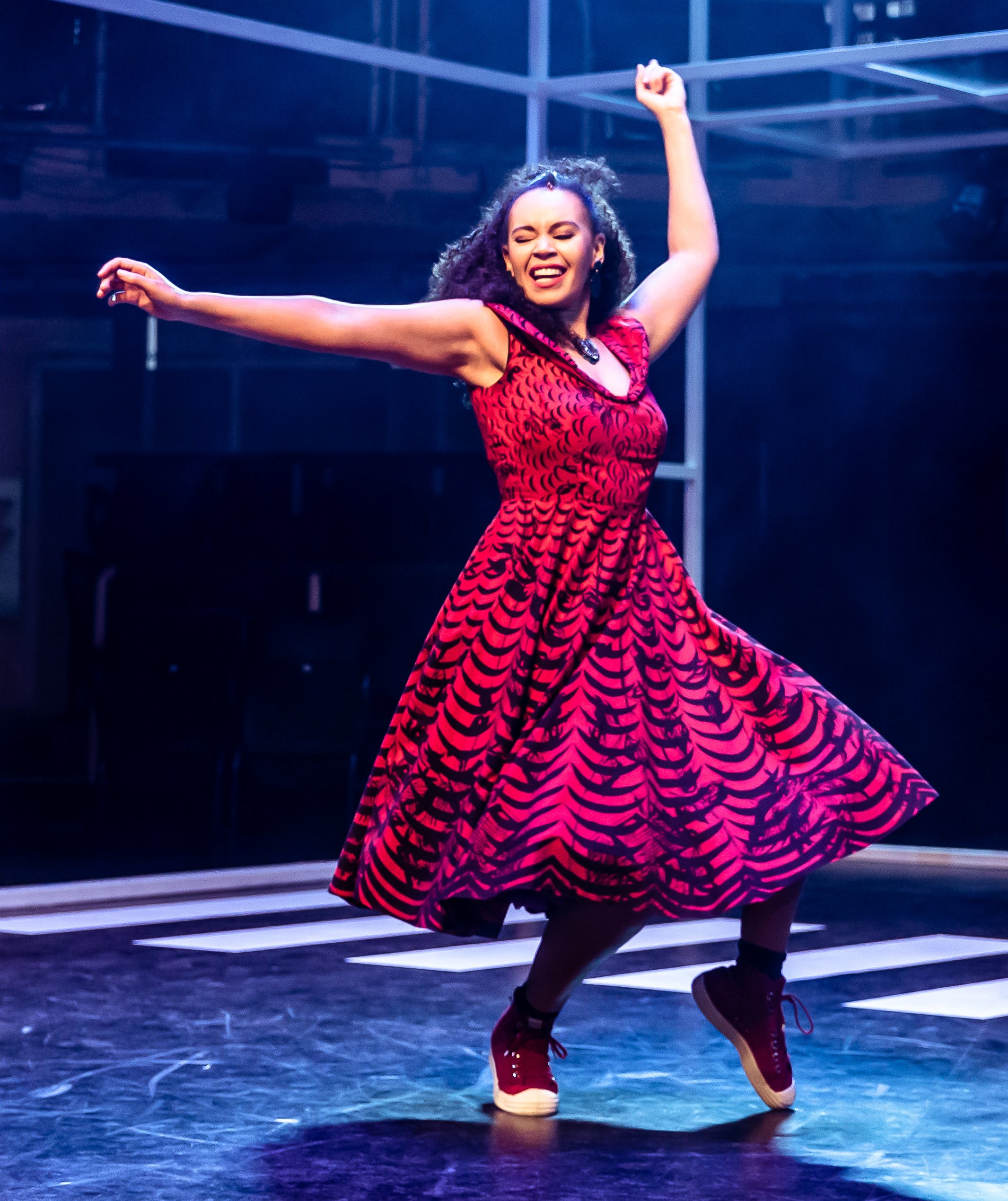
The cast exude the confidence and youthful exuberance of teenagers with a lust for life and a casual disregard for the brutal reality of death until tragedy actually strikes. There are some great vocal performances. Gabriela García as Maria has a pure soaring operatic vocal while Andy Coxon as Tony has a rich warm voice which grows in confidence throughout the show. Gang leader Riff Michael Duke is a powerful dancer but it is his lover Anita, Jocasta Almgill who steals the show. A brilliant singer and dancer, it is also her stage presence which ensures she exudes both passion and compassion.

The central protagonists Coxon and García have do have great chemistry as the lovers torn between two worlds. The love scenes are full of tenderness and the reckless passion of teenage hormones. The rumble scenes and resulting deaths are impactful and exude horror and regret at the wasted young lives. The overall feel of this production is that it is a beautiful and lovingly crafted yet I left feeling curiously flat. Perhaps as Maria says It’s not Us, its everything around us, the knowledge that our young people appear destined to keep repeating the same mistakes in an unyielding world.

Royal Exchange Theatre 6 April – 25 May 2019

Images by Richard Davenport: The other Richard

Death Of A Salesman

ROYAL EXCHANGE THEATRE

Written by Arthur Miller

Directed by Sarah Frankcom

Sarah Frankcom directs this post-war classic as a sensitive and cerebral study of a family glued together and cracked wide open by the fragility of the veneer of success they cling to. This is an epic study of human beings driven by the human urge for survival, respect and love and with the desire for financial success. Writing in 1949, Miller had a living memory of the Great Depression and was observing the post war escalation of consumerism and greed for success. This is the tragedy of one man and his family in an ultimately fruitless, blind pursuit of the American Dream.

The set design by Leslie Travers creates a sense of normality which also manages to feel quite dreamlike. It’s apparent simplicity effectively allows the focus to be centred on a simple table which represents the centre of the home, the desk of the business world and the dining table of public success. The surrounding edge seating allows other actors to be the chorus of memories in Willy’s mind. Overhead the dense green foliage is perhaps suggestive of the theme of blind ambition, in that we literally cannot see the wood for the trees. The gradual change of leaf colour in Act 2 is poignant as dreams start to fade and crumble.

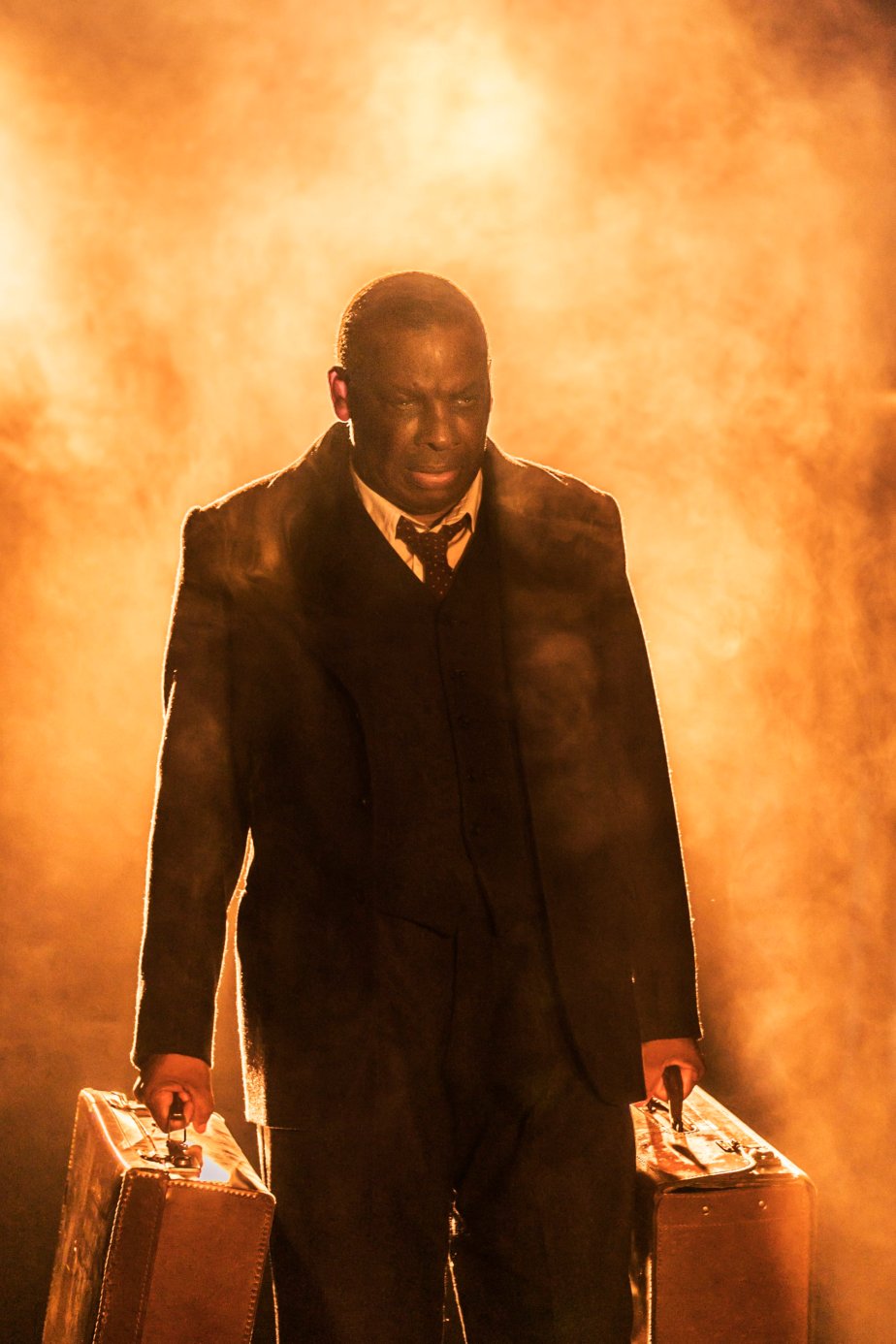
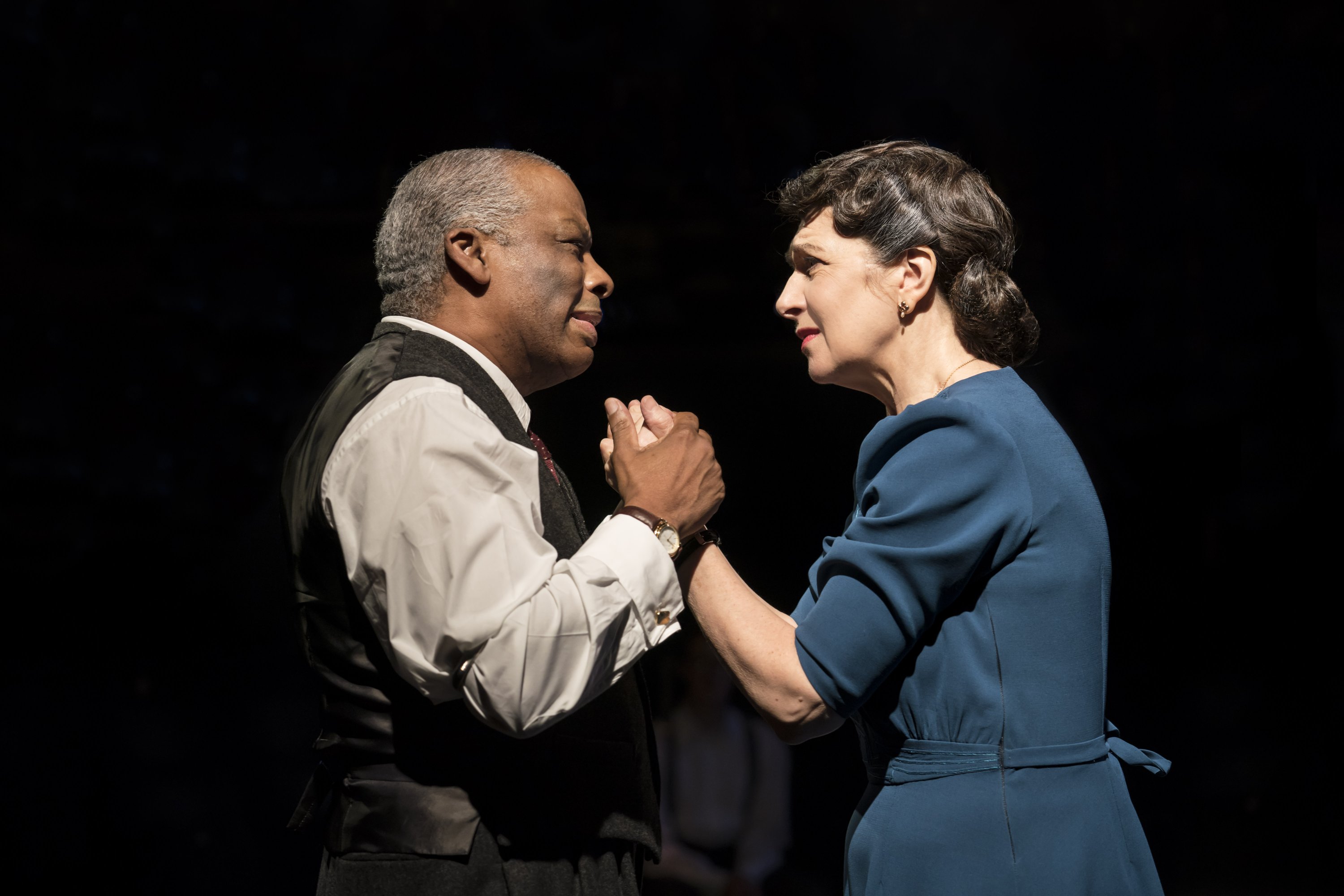
Frankcom draws stellar performances from a strong cast. Don Warrington absolutely embodies Willy Loman with his weary stoop, worn down by despair and the weight of his salesman’s sample cases. This is a man full of bluster and desperation whose only strategy to cope with fear and disappointment is stubborn denial of his reality. Warrington moves with ease between bravado and rage in erratic mood shifts that can bleed into the warm charm of the consummate salesman. This is a slow burn performance which by the second act is blistering and visceral as lies are challenged and truths are finally spoken. This is a narcissistic man descending into madness or possibly dementia who has been thrown on the scrap heap and whose thwarted ambitions now shift toward the possible validation of a well attended funeral.

Maureen Beattie as Linda gives a powerful performance. She is every inch the supportive, devoted wife propping up her husband’s ego and encouraging her sons to do the same. A paragon of virtue and a loving wife terrified of Willie’s suicidal tendencies she appears to exude everything that makes him declare her “my foundation and my support”. However as her character is further revealed her steely resolve is apparent and it becomes clear that she enables Willy in his quest for success like a partner supporting an addict. She chills and terrifies as she eviscerates her sons when they challenge their father’s perspective.

Biff (Ashley Zhangazha) and Happy (Buom Tihngang) are both strong as the Loman boys. Zhangazha is especially powerful as the older son who is the only one willing to confront his own failings having painfully witnessed the truth about his father. The moment when he speaks of his father and reflects “He had the wrong dreams” is electrifying. Tihngang brings energy and enthusiasm to his role as the younger boy seeking approval from his parents. Spiritually bankrupt and full of selfish entitlement and largesse he is truly his father’s son and a product of a consumerist society.

This is a play that truly stands the test of time. The memory bleed which Willy experiences and it’s impact on his family will resonate with many families living with mental health issues and/or dementia. It also serves to remind us of how the past informs the present when we try to understand our family relationships and patterns of behaviour. This play addresses our very human fear of being a Nobody and how essential it is for human well-being to have validation. Timely reminder for today’s audience as we inhabit a celebrity obsessed world where success is defined by the numbers of followers on social media. Just like Willy Loman many of us struggle with the cognitive dissonance of not living the lives we expected to and revert to various coping strategies to stay in denial. Perhaps like Biff, we all need to pause sometimes, look up at the sky and remember who we really are.

Royal Exchange Theatre 11 Oct – 17 Nov

Production images by Johan Persson

Happy Days

ROYAL EXCHANGE

Written by Samuel Beckett

Directed by Sarah Frankcom

In the opening minutes of Happy Days there is a strangely surreal sense of reassuring normality as Winnie methodically cleans her teeth and applies her lipstick. Yet this women is inexplicably trapped from the waist down in a mound of barren earth like the Queen of a floating island which is brilliantly evoked by Designer Naomi Dawson. Director Sarah Frankcom and Associate Artist Maxine Peake have joined forces on Samuel Beckett’s Happy Days. It is a stunningly evoked vision of some kind of absurdist prison or hellish afterlife or perhaps, simply an allegory of a marriage gone stale.

Maxine Peake draws on all her acting skills and delivers a Winnie who shimmers in the harsh sunlight and gleams as the light finally fades. She is girlish and gay or plaintive and rueful. There is quite simply nowhere to hide in this production, nor are there cues from other actors as Willie is always out of her sight even when he is near her. Peake is just sublime throughout, brittlely blithe and gay in Act 1 and pitifully sunken eyed and unkempt in Act 2. With a camera zoomed in on just her face and every tiny expression projected on monitors above her, she never wavers. Her Winnie is runny nosed with an aged voice, seemingly forgotten like an O.A.P in a sub-standard carehome.

She is the quintessential upper middle class British woman who was probably a pre-war débutante brought up to be pretty, charming and cheerful but also brave and stoic in the face of adversity. She reminded me of the Stephanie Beacham’s Rose in Tenko years ago. A delicate beauty who could still ooze pure class and glamour in rags, and who had cut glass vowels and cheekbones with a backbone seemingly formed of pure steel. Certainly Winnie keeps returning to the past to speak in the old style or recall past moments when she was young, foolish, beautiful while holding unto the classics to not forget familiar anchors. She is terrified of losing those anchors to sanity yet can also blithely ask Willie What is that unforgettable line?

It is the vulnerability of the human condition that pains Winnie more than the actual paralysis. What is most important is to be heard as a way of validating sanity and existence. She prattles away to Willie pastiming through the horror of her predicament as a coping mechanism. The maintenance of small routines and the comfort of Willie and the bag are her anchors to ensure she holds unto sanity and to gravity. Even as a husk of her former self in the second act unable to utilise these comforts she wills herself to focus on them as tangible memories, seeing Willie again and singing her song from the now out of reach music box.

This play is a study in mindfulness reminding us all how to harness our senses and focus back in on the little things. In a world where we are often surrounded by the incessant noise of people, media, memes and madness, Winnie’s plight is terrifying yet also an invitation to slow down and stay in the moment.

Royal Exchange 25 May – 23 June

Images by Johan Persson

The Last Testament of Lillian Bilocca

Written by Maxine Peake

Directed by Sarah Frankcom and Imogen Knight

Created by Maxine Peake for Hull Truck Theatre and Uk City of Culture this is an unforgettable march through the corridors of power walking in the shabby down at heel shoes of the leader of the Headscarf revolutionaries Lillian Bilocca.

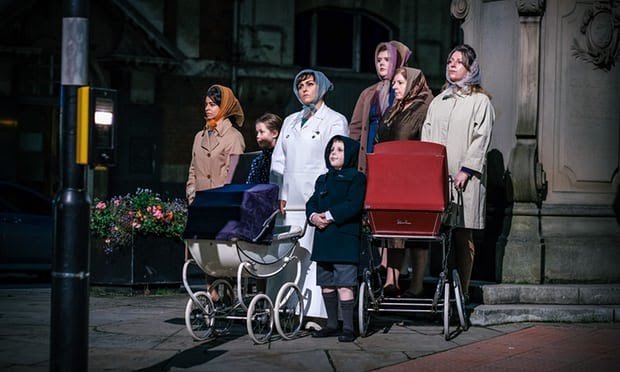
It celebrates the determination and fortitude of a group of working class woman who nearly 40 years ago “achieved more in six weeks than the politicians and trade unions have in years” The tightknit community around Hessle Road were all connected to the fishing industry. In early 1968 three trawlers were lost at sea with a loss of 58 men over 26 days. It was the woman as wives, mothers, sisters, lovers who rose up and said “enough is enough.” Led by Lillian they gathered 10,000 signatures and stormed the offices of the trawler owners and went to parliament to meet the then Prime Minister Harold Wilson. The result changed the shipping laws and The Fisherman‘s Charter saved countless lives in the fishing industry.

Sarah Frankcom and Imogen have done a wonderful job in the The Guild Hall to bring realise this ambitious promenade performance. A live folk band courtesy of the wonderful Adrian McNally and The Unthanks are in full swing at The Silver Cod Ball. The stuffy ornately dressed couples move stiffly round the dance floor as we watch them celebrate the spoils of the trawler industry.

The arrival of Helen Carter as Lillian is the first sign of real life in this grand reception room. Clad in shabby shoes with a neat buttoned up blue coat and a matching chiffon headscarf she reminds me of early memories of my own mother. She too campaigned on a social issue and refused to be silenced and also met a government minister to have a statute changed. It is a very powerful emotional moment making that sudden connection with my own strong, bolshy mother. As more strong women from The Hessle Road Womens Committee appear the energy continues to build.
The arrival of The Three Day Millionaires brings testosterone, Brylcreem and Old Spice. The dance floor becomes the local pub and suddenly there is lust and life and love and fisticuffs as the booze flows. This is a vivid snapshot of men home for three days who have been spared an icy drowning and are reunited with their womenfolk. A temporary relief from knawing fear of death and a fistfull of cash is a heady cocktail.

The promenade takes us through the corridors of power where endless portraits of men of power stare down at us. We pass women thanking us for our support and enter a Council boardroom with Yvonne Blenkinsop played by Katherine Pearce holding the hand of her young son. Standing on the table she summons up the experience of waiting, worrying and grieving. As each woman steps forward to tell their story it reinforces the sense of what drove these ordinary woman to step up and do something extraordinary.

Subsequent scenes evoke the dead and dying men swathed in icy fog. Pleading, wild eyed and clammy with desperation they are a ghostly tableau. The main council chamber is dimly lit by tealights burning in mismatched teacups – possibly a light to represent each of the 58 men lost? At the centre is a haunting set comprised of a simple kitchen sink unit and a formica table. As we listen with headphones to a soundtrack of a storm and its aftermath we watch a snapshot of acute loss. A woman seeks the smell of her dead husband in his last white shirt. Later she dons the soaking wet garment and stands dripping like a lost siren of the sea.

The grand dinner at The Silver Cod Ball seats the audience at the dinner tables with the trawler owners at the top table. Stony faced, stony hearted and stony earred to the pleas of the women they look on with disdain at these earthy, passionate requests. The silver cod is like a coffin filled with blood money, and Lillian approaches me with a crumpled handful of banknotes asking “Is this what our men are worth?” Strident, rough edged and ardent these women shocked and shamed many of their own men by their actions. It was a bittersweet success as Lillian Bilocca was blacklisted and never worked in the industry again.

The final scenes of this production are stunningly effective and incredibly moving. The original music by The Unthanks for this production is sublime and gorgeous. It is a fitting end to hear the echo of exquisite voices fade away like waves on an ebbing tide. Unforgettable.

The Guild Hall, Hull 3-18 November

Hull Truck Theatre

Photographs by Andrew Billington.