TOXIC

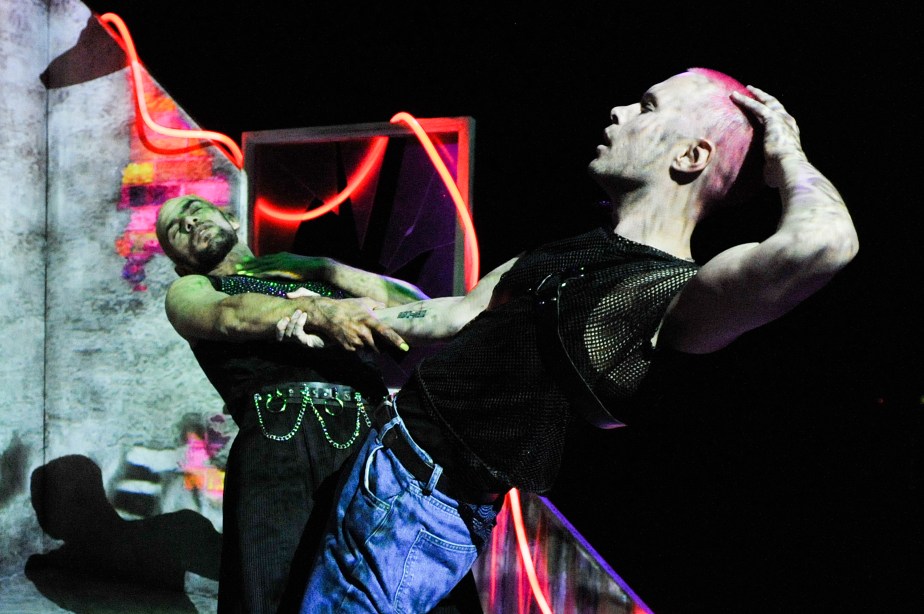
Josh-Susan Enright and Nathaniel J Hall in TOXIC at HOME. Image credit: Dawn Kilner

Written by Nathaniel J Hall

Directed by Scott Le Crass

A Dibby Theatre production commissioned by HOME

HOME

TOXIC is a semi-autobiographical piece from writer, actor and HIV activist Nathaniel J Hall. Six years on from the premiere of First Time which I saw in 2017 at Sale Waterside, at Edinburgh Fringe in 2018 and at CONTACT in 2021, its time to see what that tricky “second album” looks like. This is an exploration of how two troubled souls forged a trauma bond but sadly as Hall says This is the story of how we met, fell in love, and f*cked it up. The piece looks at how intoxicating love can disintegrate into something damaged and ultimately toxic. Woven through this love story gone wrong is a powerful look at the personal impact of his HIV diagnosis as a teenager and his partners’ experience of growing up mixed race in a sometimes violent household while both were also grappling with coming to terms with their own sexuality.

That’s a lot to pack into a 90 minute show and deal with any of the subject matter with any depth or sensitivity. In the main TOXIC does a lovely job of vividly evoking two flawed characters that have charm and real substance. Hall exudes winsome vulnerability and Josh-Susan Enright gives a warm rich depth to their performance. Watching them meet and fall in love it’s easy to root for a happy ending even as the show opens with an unabashed ending spoiler. There is something joyfully endearing about this boxfresh couple building a domestic life together with a dog and a DFS sofa. However the broken windows of a cleverly claustrophobic set by designer Lu Herbert already hints at the tragedy yet to unfold. Hall breezily blends glib humour and sly asides into his writing which counterbalances some of the more uncomfortable subject matter without sacrificing the power of the narrative. He may gleefully suggest we just call us your friendly neighbourhood red flags but when he recalls situations where he was called unfuckable because of his HIV status it is hard not to feel the pain in that recollection.

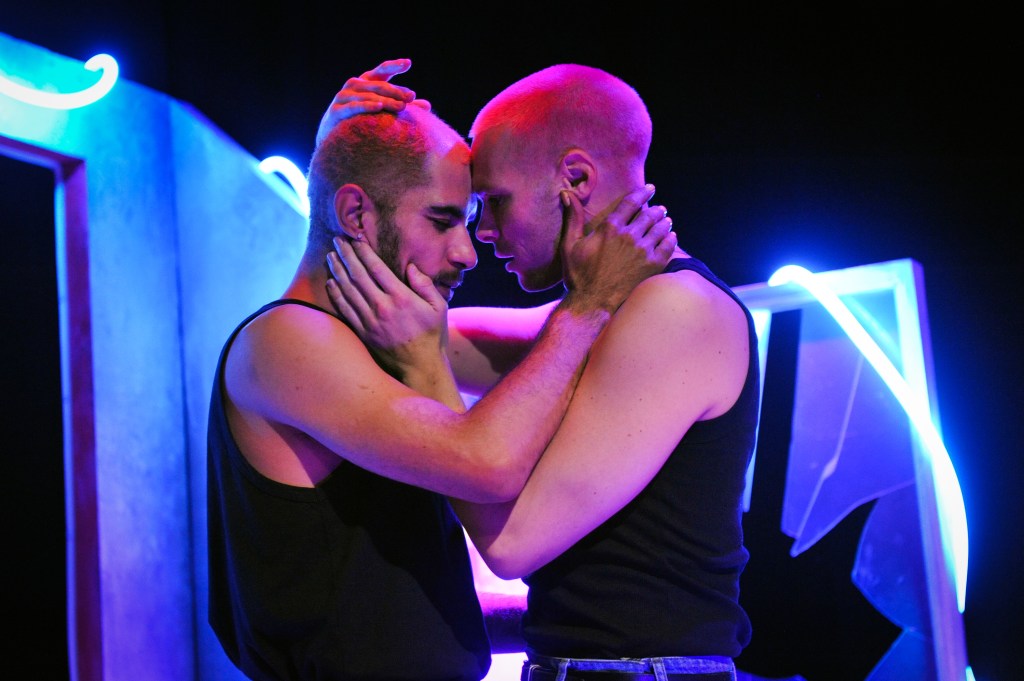
Josh-Susan Enright and Nathaniel J Hall in TOXIC at HOME. Image credit: Dawn Kilner.

The on stage chemistry between Hall and Josh-Susan Enright is palpable and the latter feels like a perfect foil as the more experienced lover. One is ready to retire their party lifestyle whereas the other is still curious and hungry for the experience denied him before the game changing introduction of PrEP. Their blend of domesticity and drug fuelled partying leads to hook up apps and threesomes that descend into paranoia and jealousies that destroy their happiness. In the main the story is well paced and highly engaging. However there are points towards the end where the show seems to flounder a little. Hall seems breathy in some of his delivery and the fight scene doesn’t quite resonate as it could. Overall this is an assured production that looks great and is cleverly lit by Tracey Gibbs especially in the moments where the visual effects seem to bathe the cast and set with an insidious splatter effect that echoes germs multiplying in a petri dish. The dividing stage is a surprising and startlingly effective way of depicting how broken this couple now are. As Hall says Hurt people hurt people. There is a lovely and reassuring sense of maturity in this insight…something to be truly proud of whatever race, gender or sexuality you may be. There is never shame in recognising our own flaws or damage when we are open to learning and healing.

HOME 18th – 28th October 2023

Dibby Theatre

Hobson’s Choice

Shalini Peiris and Esh Alladi in Hobson’s Choice. Credit Marc Brenner

Written by Harold Brighouse

Adapted by Tanika Gupta

Directed by Atri Banerjee

In this new adaptation of the 1915 classic, Tanika Gupta has moved the setting from a cobbler’s shop in Salford to a tailor’s shop that is vibrant with silk saris. Set in Eighties Ancoats, Hobson and his three daughters are Asian Ugandans who fled the regime of Idi Amin and have spent the last 15 years building a life and a business in the Britain of Ted Heath who had welcomed 30,000 refugees. Using sparkling dialogue and a clear understanding of the original Gupta honours the familial relationships established by Brighouse while ensuring that the societal themes remain fresh and current.

The set design by Rosa Maggiora blasts colour and a keen sense of detail into this production. Director Atri Banerjee brings a lightness of touch to this production insuring that the witty dialogue sparkles throughout. His experience at the Royal Exchange is evident in how he uses the space. He creates an intimacy and a sense of participation for the audience. Wedding favours are shared out during the interval creating a lovely sense that we are participants in the wedding celebration. The catwalk triumph of Asian Chic serves as a joyful finale and also as a celebratory parade of all the actors.

This is a really strong cast that brings an absolute authenticity to this production. We see young women wearing mini skirts and dancing in The Hacienda, rebelling against a father who tells them to “Live within your boundaries. It’s a Man’s World.” There is the destructive theme of racism from Enoch Powell’s Rivers of Blood speech that still resonates today. Hobson has slipped into alcoholism and his best tailor works for a pittance because he “is the lowest of the low”, staying because “Your Papa has my passport.”

Esh Alladi as Ali Mossop. Credit Marc Brenner

Esh Alladi is utterly engaging and believable as the shy downtrodden worker full of twitches and tremors. There is real delight in watching him grow in confidence from tentative bridegroom to a loving husband and a budding entrepreneur. Shalini Peiris as Durga Hobson is cooly decisive and resourceful. There is no self pity for her situation instead she ensures the best possible outcome for herself and her sisters. Peiris skillfully balances being both a funny and blunt force of nature with the delicacy and vulnerability of being a new bride on her wedding night.

Tony Jayawardena as Hobson gives a performance full of bluster, self-pity and patriarchal arrogance. He embodies a man living in complete denial who has slipped into alcoholism and is facing bankruptcy and the loss of his family. Even when Hobson is at his most outrageous Jayawardena still brings enough warmth and charm to his character that his daughter’s return involves residual affection and not just duty or ambition.

This new adaptation is a real success that brings the issues of intergenerational conflict, class snobbery, alcoholism and immigration into sharp focus while never feeling preachy or worthy. Over one hundred years since the original opening night, Hobson’s Choice remains relevant, engaging and thought provoking.

Royal Exchange 31 May – 6 July 2019

What If I Told You?

Written and Performed by PAULINE MAYERS

Directed by CHRIS  GOODE 

The Studio, The Royal Exchange 

Pauline Mayers is a Rambert Ballet trained dancer, a choreographer, a writer and a theatre maker. She is a Hackney girl who has travelled the World as a dancer. She is a women of a certain age who has lived through significant  physical injuries and the emotional pain of depression.  She is a performer and an experimenter and an explorer. She is a black woman who has had a mixed response from the dance world about having a black body  to channel ballet through. More recently she has also experienced the closed doors that often greet an older dancer.

Talking to her in interview recently and watching her perform this  evening there is an undoubted warmth and engagement with others that is striking. As she opens the show her gaze attempts to connect with each member of the audience with a white hot intensity. This will draw in many audience members but for some may prove uncomfortable to fully engage with.

What If I Told You? uses theatre, movement and dance to explore prejudice and the conscious and unconscious assumption around skin colour. The piece weaves elements of her personal history and dance experience with the story of Dr J.Marion Sims often referred to as the father of modern Gynaecology. 

Dr Sims practised medicine in the nineteenth century and made major discoveries in the field of Gynaecology. His work was and remains highly controversial as he used black slave women as his subjects and refused to use anaesthetic deeming them less able to feel pain than white women.

The piece uses audience interaction and participation throughout. It is most powerful as we recreate a montage of a painting of Sims with Anarcha (a patient he experimented on many times), and two other white doctors observing while two tramatised black women peek through a curtain to see what awaits them. This is the impact of the piece that has stayed with me. Imagining that Anarcha might have been Pauline and seeing a lovely young black woman I know who could have been waiting her turn. Sims and another doctor were portrayed by white middle class men I also knew. It was deeply unsettling to imagine whose shoes we might walk in, in another place or time. 

There are some very rich moments to observe and there are some lovely interactions and connections as the audience participate in the movement of the piece. There is however a frustration that in weaving these elements together so much there is a risk that the piece loses some of its impact. An hour limits some of the storytelling when we also are participants. Pauline is so engaging I wanted more of her and less of me!!

Koan is a Japanese word for public thought. Its the audience thinking and speaking and reflecting together. Its a radical act of self care and empowerment. 
The Koan completes the second half of the show and is led by poet Khadijah Ibrahiim. Koan is a Japanese word for public thought. This is an important part of the piece as it is an exploration of subjective experience and a continuation of sharing what is “sameness” as opposed to “otherness”. 

The genuine hope in What If I Told You? is that each of us leaves the space with a keener and more empathic perspective on our neighbours. 

“There are periods of history where skin colour is used as a means to separate and disconnect us. I really feel what hurts you, hurts me. We are all human beings. There is only one race.”
This is a very personal piece. Pauline says it is an invitation to walk in her shoes for an hour. As with any subjective experience this will be more potent for some than for others. This is undoubtedly painful and chilling at times however it is also celebratory. Having stubbornly fought to be recognised as a black dancer and struggled with the loss of that career this show is also a homecoming. Theatre has welcomed her as a performer and story teller and her joy and appreciation is evident in this piece.

SHOWING 19/20 JUNE