SHED: EXPLODED VIEW

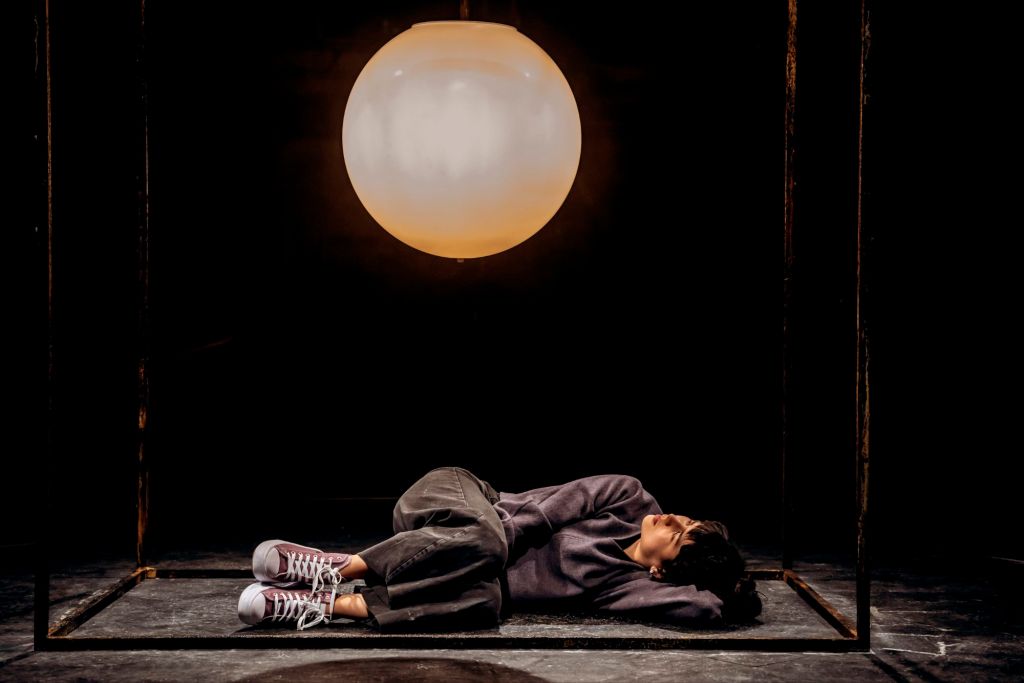
Lizzy Watts as Naomi in SHED:EXPLODED VIEW at the Royal Exchange Theatre.đź“·Johan Persson

Written by Phoebe Eclair-Powell

Directed by Atri Banerjee

ROYAL EXCHANGE THEATRE

SHED:EXPLODED VIEW by  Phoebe Eclair-Powell won The Bruntwood Prize for Playwriting in 2019. A brutal yet deeply intimate exploration of domestic violence, love and isolation inspired by the work of artist Cornelia Parker whose installation Cold Dark Matter: An Exploded View literally shines a light on the domestic debris remaining after a explosion. The global pandemic meant a delay in the staging of this production and also spiked a horrific rise in the statistics for domestic violence making this urgent play even more powerful.

Three couples interact over a thirty year period in this nonlinear play. Time shifts back and forth denoted by each year displayed on a monitor above the stage. A highly effective minimalist set by Designer  Naomi Dawson features moving concentric circles that the performers chalk scene titles onto. As they slowly move around or are smudged during the performance they subtly allude to the fragmentation and blurring of time and memory. The exposed skeleton frame of a shed is suspended over the stage and illuminated by a single huge bulb of light. Lighting Designer Bethany Gupwell uses a bank of lights to anchor each scene from home to exotic honeymoon beach or NYE fireworks and the splintered, crackling light effects on the stage are used for maximum shock effect in the scenes of violence.

The six performers have literally nowhere to hide on stage. Occasionally some sit on the sidelines on hard wooden chairs and observe scenes with the audience. On Stage sometimes they interact with the other couples, other times their words overlap as if time itself is blurring or merging past and present. The oldest couple Lil and Tony are on second and third marriages hoping to get it right this time. Naomi and Frank are newly weds who seem unsuited from the start and the seeds of disappointment and resentment are already in situ. Abi and Mark meet as students and momentarily look like they may just break the cycle and write a different story. Each couple viewed through a prism of hope could be envied and aspired to. The elderly couple holding hands…is that a lifetime of domestic bliss, love second time around or one holding the other’s hand to anchor them in this world as reality and memories splinter and disintegrate? Or the couple with their young daughter… playing happy families or desperately clinging on to the fading dream of a stable marriage and home life? The new lovers who laugh and drink together yet secretly knowing that for every time his hand tenderly holds her hair back from her face if she’s sick may also be the hand that stabbed the meat of her face with a fork.

It is the women in this piece who are drawn most vividly and drive the narrative even when they are sometimes seemingly passive. Hayley Carmicheal is quite wonderful as Lil, she initially appears to have a birdlike fragility but age and bitter experience has given her a steely core and a warrior spirit. This is a tiny woman who can tend to the vulnerable yet could potentially eviserate a hulking  abusive husband. Lizzy Watts as Naomi gives a subtle performance  that grows as her character ages and finishes with a blistering portrayal of grief and rage. She deftly moves from a young wife trying to please a sullen bridegroom, to a weary, anxious parent who learns to dance with her feisty daughter, navigate a difficult marriage and emerge from tragedy with a fierce sense of purpose and her own worth. Norah Lopez-Holden as Abi is always utterly invested in her character whether as a curious child, a testing teenager or as a young woman desperately attempting to redefine her deadly reality.
Norah Lopez-Holden as Abi in SHED: EXPLODED VIEW at the Royal Exchange Theatre đź“·Johan Persson

The two younger men feel more generic, Jason Hughes as Frank is an resentful, embittered man who seems unwilling to take responsibility for his own choices. Michael WorkĂ©yè as Tony exudes a discomforting blend of boyish charm and casual cruelty as he belittles and gaslights Abi. Wil Johnson as Tony has the most satisfying male role and gives a compelling performance as the flawed but wiser older man gifted another chance at love. His scenes are beautifully written especially as his story becomes increasingly poignant and Eclair-Powell gives a really touching insight into the strains of dementia on patients and carers at home during the pandemic.

Director Atri Banerjee deftly ensures that the many small fragmented scenes that unfold or collide come together to build a cohesive story that satisfies and intrigues just as the art installation that inspired the writing  of this production. There is something incredibly powerful about examining moments in time or splinters of objects. In my day job as a Psychotherapist I often witness how a single statement or recollection can be a light bulb moment that crystallises a vital realisation for a client. As a child growing up in Northern Ireland I witnessed bomb explosions and remember my parents taking me into the aftermath of a bombed village shop to help make it ready for business as usual. Everyday objects scattered everywhere and coloured nail polish splattered on the red tiled floor amidst shards of glass and warped metal shopping baskets. The detritus of everyday life spread out telling stories of the ordinary, the extraordinary and the fragility of life especially in the face of violence. On so many levels I love the bravery and structure of this piece. It was and remains a worthy Bruntwood prize winner. SHED: EXPLODED VIEW is a sensitively rendered howl of rage and frustration that should rally us all to call out any signs of abuse and urge loved ones, neighbours, colleagues or strangers to run at the first warning signs. RUN…and don’t look back…RUN… even if it’s over broken glass.

Royal Exchange Theatre 9th Feb – 2nd March 2024

Light Falls

Written by Simon Stephens

Directed by Sarah Frankcom

Original music by Jarvis Cocker

ROYAL EXCHANGE THEATRE

Light Falls marks the end of Sarah Frankcom’s tenure as Artistic Director at the Royal Exchange Theatre. It seems only fitting that she bows out with a play about loss and endings. In the same week as iconic Northern soap Coronation Street is opening up a frank conversation about death, grief and kindness comes this new play by Simon Stephens. He has written a delicate and beautiful play about death that is also a eulogy to kindness and a testament to fortitude.

Christine (a very moving and understated performance by Rebecca Manley) is nine months sober after a life of alcoholism when she walks into a Stockport supermarket. Married to Bernard and a mother to Jess, Steven and Ashe, and a grandmother to baby Layton, she hovers at the shelf of vodka before dying suddenly from a sub-arachnoid haemorrhage. It is 12 minutes to 5pm. It is a Monday in February 2017. What happens next moves from the mundane to the sublime as Christine hovers around her family watching the defining moments in their lives as they hear of her death. What this quiet play does so well is capture how time can suddenly stand still yet life moves on around us and so inevitably must we, even when our world has irrevocably changed.

The cast of ten explore the intertwined relationships of a family and those around them as Christine dies. There are standout performances from Lloyd Hutchinson and Carla Henry as Bernard and his mistress as they navigate through a fumbling attempt at a threesome in a Doncaster hotel. There is a terrible poignancy and dark humour to this blustering, overweight man striving for new experiences yet ultimately lusting more for a double cone icecream than two young women in his hotel four poster bed.

All three children are emotionally damaged by their upbringing with an alcoholic mother who took wine to McDonalds and was drunk in the school playground. Defensive and wary in their emotional relationships they struggle with attachments having known a parent who at times favoured vodka over them. The play touches on each of their partnerships and through interactions and fragments of dialogue gives a sense of ongoing internal struggles.

Katie West is simply wonderful as Ashe, a desperate, exhausted young mother who has attempted suicide only months before her mother’s death. She exudes vulnerability and raw emotion in all her scenes and it is her presence that lingers after leaving the theatre. This is a portrayal of grief, fortitude and love that makes this play soar.

The stark, bare elegance of the set by Naomi Dawson ensures this is always about the actors. The stairs and tiered steps open out the staging and also feel like a gentle hint of stairs to heaven and steps in the grieving process. The cascading downpour that drenches has the catharsis of an outpouring of grief and emotion. The much heralded music by Jarvis Cocker is also understated in a less is more way. A recurring melody and a single Hymn of the North feel like the familiar comfort of a lullaby.

This is a low key production that favours subtle touches, gritty humour and beautiful writing to colour and shade an ordinary family dealing with the stark pain of loss. I’ll be watching from the shoreline epitomizes what many of us hope for when we have to survive loss. We yearn for that sense of being watched over and still cared for, as Christine does with her children. Much has been made of Light Falls as a Northern play by a Northern writer with a hymn by a Northern songwriter. Personally I’m not sure it matters where they are from, North or South. We are shaped by our roots, our heritage and whether we embrace or reject that, or run from it or back to it, our shoreline is simply our core, our gut, our safe place. We all need a haven when our world is rocked by loss regardless of who we are or where we live.

Royal Exchange Theatre 24th October – 16th November 2019

Images by Manuel Harlan

Happy Days

ROYAL EXCHANGE

Written by Samuel Beckett

Directed by Sarah Frankcom

In the opening minutes of Happy Days there is a strangely surreal sense of reassuring normality as Winnie methodically cleans her teeth and applies her lipstick. Yet this women is inexplicably trapped from the waist down in a mound of barren earth like the Queen of a floating island which is brilliantly evoked by Designer Naomi Dawson. Director Sarah Frankcom and Associate Artist Maxine Peake have joined forces on Samuel Beckett’s Happy Days. It is a stunningly evoked vision of some kind of absurdist prison or hellish afterlife or perhaps, simply an allegory of a marriage gone stale.

Maxine Peake draws on all her acting skills and delivers a Winnie who shimmers in the harsh sunlight and gleams as the light finally fades. She is girlish and gay or plaintive and rueful. There is quite simply nowhere to hide in this production, nor are there cues from other actors as Willie is always out of her sight even when he is near her. Peake is just sublime throughout, brittlely blithe and gay in Act 1 and pitifully sunken eyed and unkempt in Act 2. With a camera zoomed in on just her face and every tiny expression projected on monitors above her, she never wavers. Her Winnie is runny nosed with an aged voice, seemingly forgotten like an O.A.P in a sub-standard carehome.

She is the quintessential upper middle class British woman who was probably a pre-war dĂ©butante brought up to be pretty, charming and cheerful but also brave and stoic in the face of adversity. She reminded me of the Stephanie Beacham’s Rose in Tenko years ago. A delicate beauty who could still ooze pure class and glamour in rags, and who had cut glass vowels and cheekbones with a backbone seemingly formed of pure steel. Certainly Winnie keeps returning to the past to speak in the old style or recall past moments when she was young, foolish, beautiful while holding unto the classics to not forget familiar anchors. She is terrified of losing those anchors to sanity yet can also blithely ask Willie What is that unforgettable line?

It is the vulnerability of the human condition that pains Winnie more than the actual paralysis. What is most important is to be heard as a way of validating sanity and existence. She prattles away to Willie pastiming through the horror of her predicament as a coping mechanism. The maintenance of small routines and the comfort of Willie and the bag are her anchors to ensure she holds unto sanity and to gravity. Even as a husk of her former self in the second act unable to utilise these comforts she wills herself to focus on them as tangible memories, seeing Willie again and singing her song from the now out of reach music box.

This play is a study in mindfulness reminding us all how to harness our senses and focus back in on the little things. In a world where we are often surrounded by the incessant noise of people, media, memes and madness, Winnie’s plight is terrifying yet also an invitation to slow down and stay in the moment.

Royal Exchange 25 May – 23 June

Images by Johan Persson