Paranormal Activity – A New Haunting Live on Stage

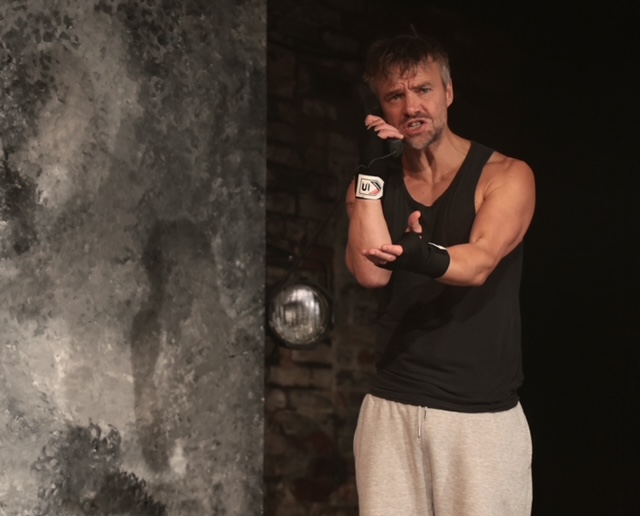
Patrick Heusinger as Jimmy in Paranormal Activity – A New Haunting Live on Stage at Leeds Playhouse. Image credit: Pamela Raith

Written by Levi Holloway

Directed by Felix Barrett

Co-produced by Leeds Playhouse and Simon Friend Entertainment

Courtyard Theatre, Leeds Playhouse

This brand new production is based on the highly successful horror film series Paranormal Activity which became a global cultural phenomenon. Paranormal Activity – A New Haunting Live on Stage is written by Levi Holloway and directed by Felix Barrett MBE, the Artistic Director of Punchdrunk. This theatre company is synonymous with the term immersive theatre with hugely successful and long running productions such as Sleep No More, The Drowned Man and most recently The Burnt City and Viola’s Room. As a production which has been marketed with a deliberate policy of giving no details about content it follows the trademark Punchdrunk secrecy which lends itself well to ensuring maximum shock factor for this horror production as there are zero spoiler alerts. It has garnered its buzz from lovers of the horror genre and those theatre goers excited to see what Barrett can create in his first venture into working in a traditional theatre setting.

Sitting in darkness, a voice invites the audience to collectively close their eyes and contemplate the German term eigengraus meaning significant grey which is what we all see when we shut our eyes. The voice suggests that this gray is not a colour but is a place where we make contact with the Dead. A voice in the darkness is a perfect medium for hypnotic induction and so even before we see the stage our senses are becoming immersed in a collective sense of fear.

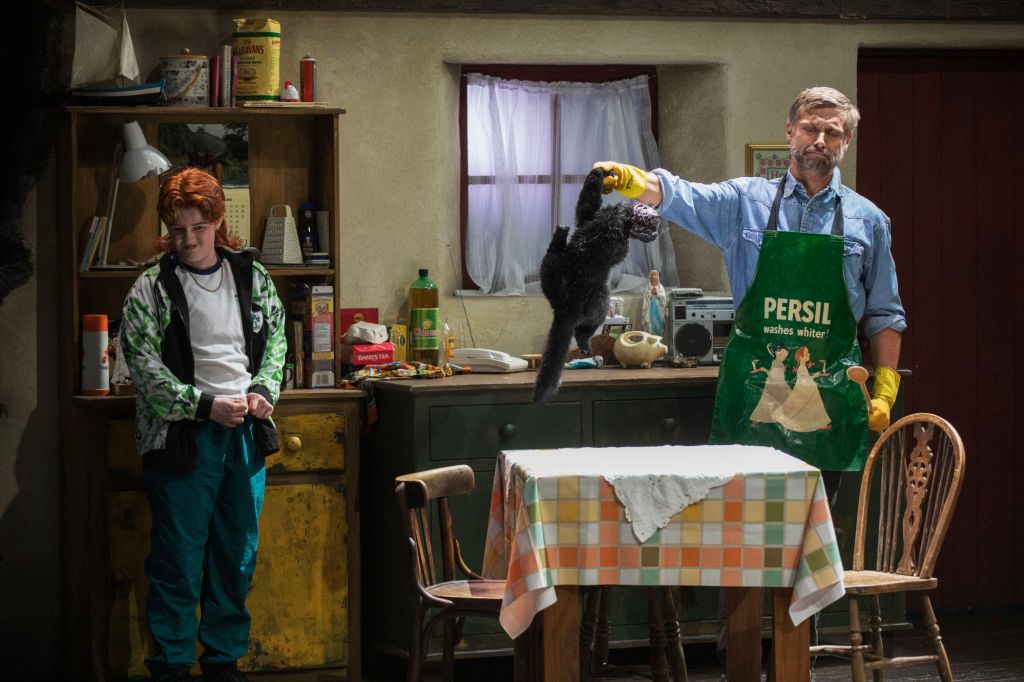
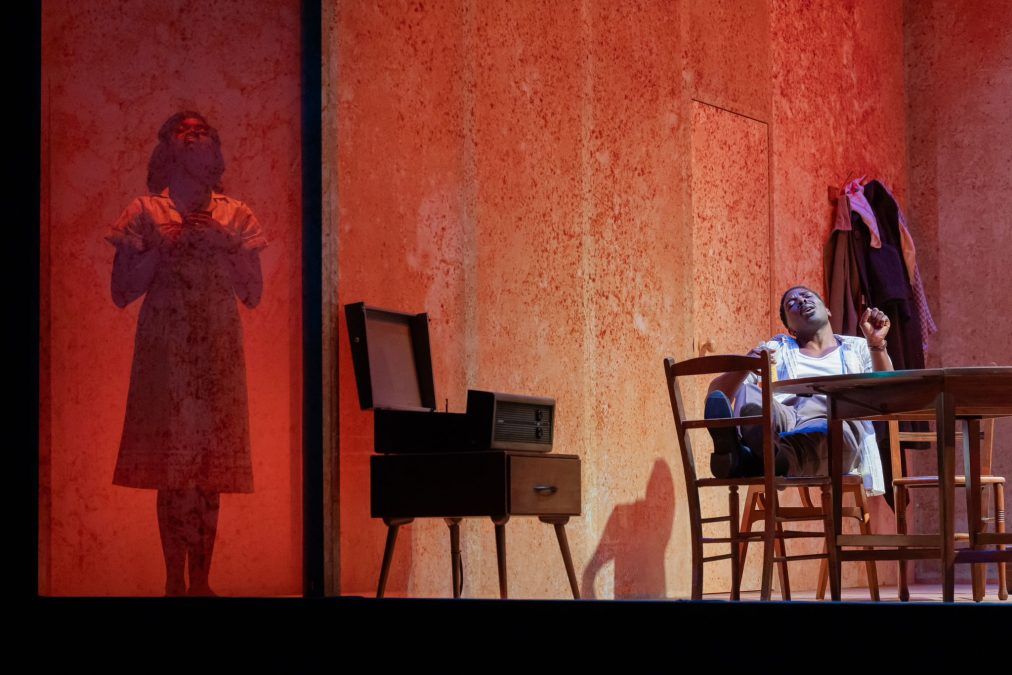
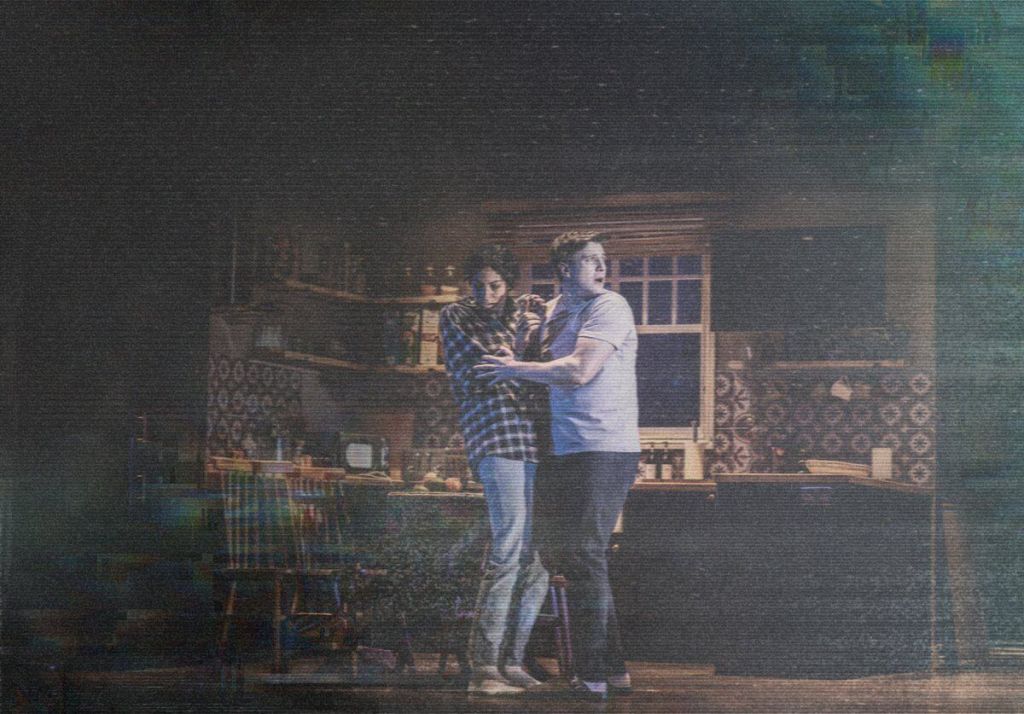
The set design by Fly Davis is like my childhood dolls house where the front slides off to reveal a two story home complete with stairs and landing. Filled with homely details it evokes a cosy normality that may still hint at an uneasy undercurrent and has a similar attention to detail that is typical of a Punchdrunk set where Barrett delights in dropping clues and meta references. This is a house on a typical London road where street lights glow and where car lights and flashing lights from emergency vehicles will occasionally illuminate the front windows. Where the outside sound of the incessant pelting rain of a British “summer” blends with sounds within a typical home where Alexa playing a chill out soundtrack  is punctuated by the whistle of a kettle on the stove or the reassuring voice of Rachel from Countdown is on Channel 4. An American couple have recently moved into this pleasant home and are adapting to married life and adjusting to life in London having left Chicago. Jimmy has video chats with his overbearing Christian Mom while Lou likes to listen to podcasts about the supernatural. All seems well…

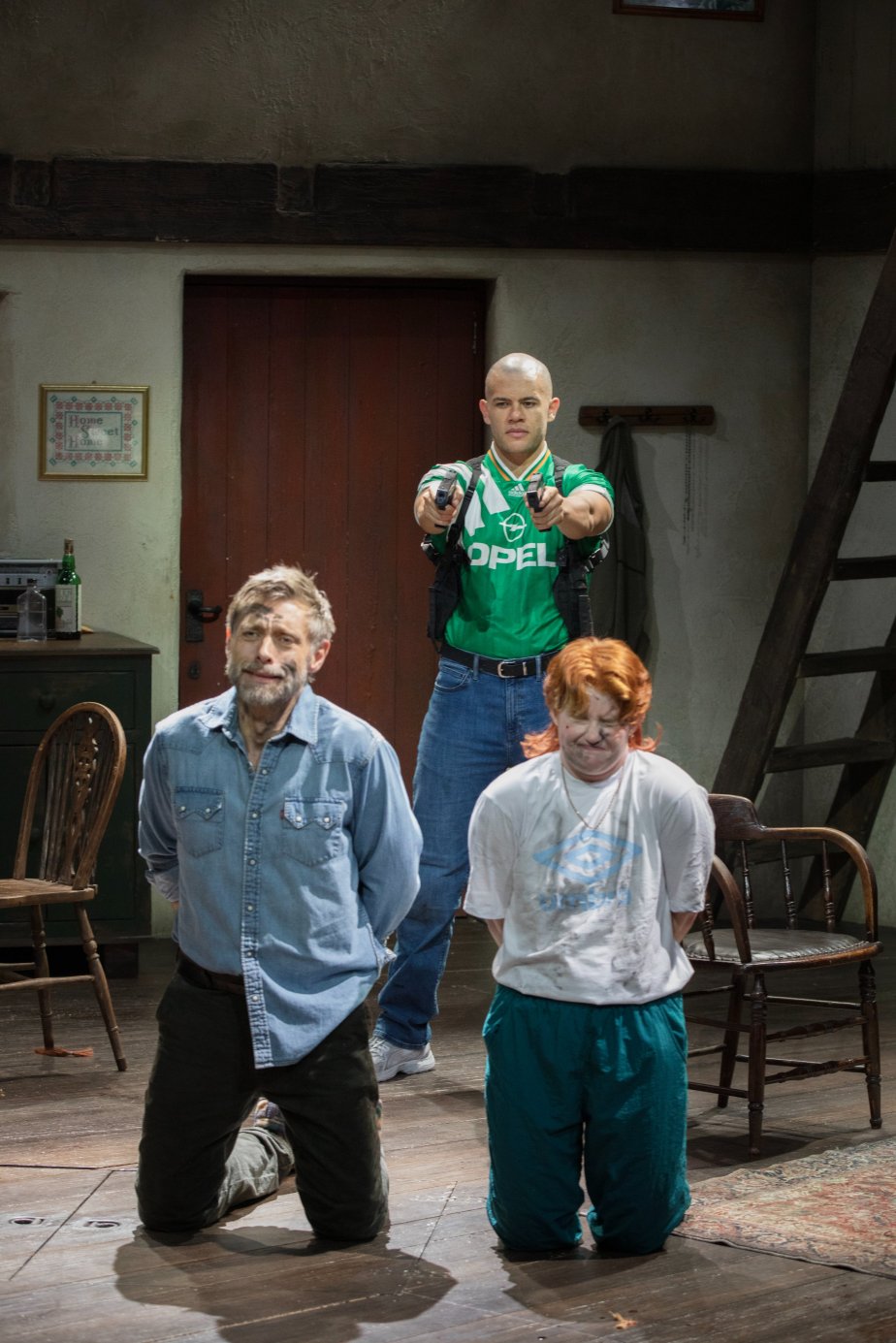
Patrick Heusinger as Jimmy and Melissa James as Lou in Paranormal Activity at LeedsPlayhouse. Image credit: Pamela Raith

The very naturalistic performances are uniformly strong and the tight, well paced writing by Levi Holloway is peppered with pithy dialogue and some very funny one- liners that give the characters real depth but also allows humour to offset the gnawing fear or at times misdirect it by creating light relief then sucker punching you with a sudden shocker. With the aid of some truly mind blowing illusions by Chris Fisher and superb use of sound, Gareth Fry and lighting by Anna Watson the immersive sensory elements suck you in and take the audience on an emotionally turbulent journey that is always so much more than simply just a great story arc.

The story deftly explores love and trust and how we navigate what we struggle to understand or make sense off. We are all hardwired to feel certain core emotions and one of those is Fear…we need to recognise it and react appropriately to stay safe in the world whether we are being chased by a wild animal like our early ancestors or navigating modern life. We tend to fear what we don’t understand and the popularity of the horror genre perhaps allows us to explore fear in a “safe” way. This production certainly plays with our fears and builds a creeping dread with the slow burn of an increasingly spine chilling horror.

Of course not everyone believes in the Paranormal…though some like Lou believe Places aren’t haunted, people are. This made me remember my first introduction to the Paranormal was in childhood when I frequently saw my dead grandmother standing at the bottom of my bed after her death in a car accident. I was never remotely afraid of her silent presence and was not entirely relieved when she stopped appearing. My mother told me years later that the “visits” only stopped after she put a Bible under my pillow. I wonder how many in the audience buy only a ticket for themselves but perhaps turn up with their own unseen Spirit who hasn’t paid their entrance fee or go home afterwards and check behind the doors for shadows?

The only major Spoiler for this production is that it has all the quality production values elements required to suggest a highly successful transfer to the London stage.

LEEDS PLAYHOUSE 4th July – 3rd August 2024

The Taming of the “Shrew”

The cast of The Taming of The Shrew at Hope Mill Theatre. Image credit: Shay Rowan.

Written by William Shakespeare

Directed by Amy Gavin and Hannah Ellis Ryan

HOPE MILL THEATRE

The bawdy babes are back with another co-production from Unseemly Women, HER Productions and Girl Gang Manchester. Here this all female and non-binary collective take on Shakespeare’s portrayal of gender roles and a women’s place in a marriage. Under the spirited direction of Amy Gavin and Hannah Ellis Ryan this production zeroes in on the enduring horror of coercive control and the mind numbing impact of gaslighting. As the Bellas teach their drunken patron Sly a lesson he won’t easily forget, the audience get to watch as the action moves from a neon pink burlesque club to Padua where the “Shrew” Katerina and her sister Bianca are wooed by a selection of potential suitors.

Katerina is a force of nature who takes no prisoners and does not mince her words. As her father offers a large dowry on her being married before her younger and more malleable sister Bianca, Petruchio decides he is up the challenge of taming this wildcat. Multiple suitors are also vying for the hand of Bianca and as Shakespeare loves a confusing twist, the wealthy Lucentio is mascarading as a tutor to woo Bianca while his servant Tranio pretends to be his Master. Katerina is forced into marriage and her new husband sets in place an abusive plan to ensure his new wife is broken in like a wild horse.

Emily Spowage and Shady Murphy in The Taming of The “Shrew” at Hope Mill Theatre Image credit: Shay Rowan

The whole production has a feel of Baz Luhrmann meets Blackadder on a Hens night out in the Northern Quarter. The costumes look fabulous and strikingly individual. Zoe Barnes has been incredibly creative and adds real visual impact especially in the Vivienne Westwood inspired wedding dress which Shady Murphy is forced into. In fact everything about this production feels considered and creative from the lighting by Tom Sutcliffe to the sound by Hannah Bracegirdle and movement by Yandass Ndlovu.

It’s great to seem a dozen female and non binary performers on stage doing their thing and strutting their stuff. There is a real immersive feel to this production with the audience seated traverse and with some seated at candle lit tables in the burlesque club itself. The pole dancing by Leah Eddleston and the bluesy vocals of Megan Holland really add to the nightclub vibe.

Shady Murphy as Katerina nails her performance as the confident force of nature brought to her knees by an abusive husband. She is at turns vibrant and vociferous before being broken and cowed by her husband. Emily Spowage as Petruchio is also utterly compelling as the leering Lothario who verbally spars with his bride-to-be before his chilling shift into sadistic bridegroom who has his whole household flinching as they observe his cold cruelty.

This is a brilliant take on one of the Bard’s more difficult plays. In particular the scenes where Andy Williams Can’t Take My Eyes of You is used and at points dramatically slowed down, really ramps up the quiet terror of coercive control. The scene where Petruchio argues the sun is the moon and challenges Katerina’s very reality now plays as gaslighting behaviour. Gavin and Ellis Ryan have kept the original text and by not shying away from it have enabled this cast to reframe the narrative for the sisterhood. Sly Christopher may be a misogynistic boor in the manner of a Bernard Manning but here he sits bound and with a gag in his mouth.

HOPE MILL THEATRE 19th -30th June 2024

The Importance of Being Earnest

The Importance of Being Earnest at the Royal Exchange Theatre Image credit: Johan Persson

Written by Oscar Wilde

Directed by Josh Roche

ROYAL EXCHANGE THEATRE

Designer Eleanor Bull may have discarded the elaborate furnishings and overblown costumes usually associated with a production of The Importance of Being Earnest but the exaggerated fakery of the overhanging blossoms and the floofy pink fake garden shrubbery perfectly evokes modern style over substance. Director Josh Roche demonstrates a real love of and clear understanding for Oscar Wilde‘s wonderful wit and razor sharp analysis of the human condition. Using a modern setting for this Victorian classic works remarkably well as the allusions to Instagram and our fixation with documenting and exchanging every emotional experience for likes from virtual strangers aligns with Wilde’s enduring satire about what is actually profound and what is truly trivial.

This lively satire has always been a perfect showcase for the verbal dexterity and quicksilver mind of Wilde but here stripped back from all the frills, flounces and posturing is a chance to really listen to the eloquence and depth of the man’s emotional and intellectual process. The first Act sets the scene for Algernon and Jack to establish themselves as the bored city fops who are now seeking something new. Parth Thakerar ably conveys the studied nonchalance and easy arrogance of Algie while Robin Morrissey is all gangly limbs and exudes the nice but slightly dim awkwardness of Jack. Into the mix enters the formidable Lady Bracknell as Abigail Cruttenden who delivers a masterclass portrayal of a character utterly devoid of empathy but terrifying certain of the validity of her every opinion regardless of how misguided or ignorant it may sound.

Abigail Cruttenden as Lady Bracknell in The Importance of Being Earnest at the Royal Exchange Theatre. Image credit: Johan Persson

It is Act 2 where the production really starts to fizz as the two young women who are central to this romantic caper finally meet. In a totally delicious face-off Cecily and Gwendoline oscillate between being “sisters in arms” and ferocious opponents as they both set their sights on marrying a man called Earnest. Phoebe Pryce excels as the initially diffident, decidedly beige daughter of Lady Bracknell whose laser like manic intensity for getting her Earnest is as funny as it is scary. Rumi Sutton as  Cecily is every bit the pert, pretty and brattish teenager to win over Algernon. As the two women play a quickfire game of verbal table tennis it descends into thrusting mobile phones like rapiers as they duel for their men and quickly bond again like the Follow/Unfollow/Follow dance of social media relationships.

The other characters are all great foils to the central story and James Quinn playing several roles really ramps up the humour as he determinedly wields an especially noisy espresso machine or meanders across the stage with a leaf blower in the midst of a moment of heightened drama. This delightful romp is the perfect summer production to escape the dodgy weather and the the even dodgier politicians on the campaign trail. Wilde is rightly and gloriously celebrated in this production by Josh Roche, which may be a  fresh take but retains all the joy of the original script.

Royal Exchange Theatre 14th June – 20th July 2024

Tell Me How It Ends

Emmy Stonelake and Luke Sookdeo as Aster and Marc in Tell Me How It Ends at Liverpool Everyman.
Image credit: Andrew AB Photography

Written by Tasha Dowd

Directed by Gitika Buttoo

LIVERPOOL EVERYMAN

It’s the 60th year of Liverpool Everyman and fittingly the theatre is celebrating by looking forward and showcasing new work. Tasha Dowd is a graduate of the theatre’s new writing programme for young people. Her debut play Tell Me How It Ends celebrates and commemorates a particular period of social history that has often gone under the radar in the story of the AIDS crisis. Focusing on the late 80’s and early 90’s the plays looks at the work of the lesbian community who tirelessly volunteered their time; in many instances their blood, sweat and tears to support all the men in Liverpool dying from AIDS and related illnesses.

This is a meticulously researched play that is filled with period appropriate cultural references and references local clubs in Liverpool at that time. The belting soundtrack includes Whitney Houston and The Communards and local Liverpool groups such as Echo And The Bunnymen and The Christians. Books and films are also central to the narrative as volunteer Aster attempts to connect with Marc though sharing books like Misery, The Silence of the Lambs and watching movies such as The Bodyguard together.

This two hander has Emmy Stonelake as Aster who is a lesbian supporting Marc played by Luke Sookdeo who is HIV and on AZT drug cocktails as the hospital struggle to increase his T cell count. Stonelake really shines in this role giving her character an awkward, bumbling charm and a dry, sly wit. Her initially infuriating habit of always giving away the endings of books and films becomes a poignant metaphor for what is to come as Marc’s life is cruelly cut short. Sookdeo struggles a bit in the early hospital scenes which simply require him to be weakened and warily resistant to Aster’s help. As his character gets physically stronger the Sookdeo starts to hit his stride and Marc becomes more fleshed out as the duo become firm friends.

There is a lovely choreography to the scenes as Grace Goulding makes use of every element of the clever set design by Katie Scott. There is energy and flow to scenes that move from the hospital to Aster’s flat, Marc’s B&B to the disco and the really captivating cinema scene. The story moves from the unlikely pairing sparring on a hospital ward to them making a bucket list to make the most of Marc’s remaining life. For such a young writer Tasha Dowd has a light touch and manages to avoid a mawkish drawn death scene. Aster’s big final speech is genuinely heartfelt and impassioned but risks preaching to the converted.

In recent years there has been a lot more writing about this era and it’s impact as we grappled with the horror of HIV and AIDS. This production feels like filling in another part of the story of a particular group of volunteers and the people they supported. I worked on the telephone counselling lines in Manchester and helped organise the fundraising so I remember the tears, the rage, the fear and despair and the laughter. It was an extraordinary time and should never be forgotten. Tell Me How It Ends evokes the era extremely well and is as much about learning how to live on our own terms as it is about preparing for death in a way that gives an individual some autonomy.

Liverpool Everyman 12th – 22nd June 2024

My Fair Lady

The cast of My Fair Lady at Leeds Playhouse Image credit: Pamela Raith

Book and Lyrics by Alan Jay  Lerner

Music by Frederick Loewe

Directed by James Brining

LEEDS PLAYHOUSE and OPERA NORTH

This is a genuinely delightful production that is as delectable as a floral posy from Eliza’s basket. Director James Brining is clearly Team Eliza casting  Katie Bird as a strong vibrant Eliza who has learned how to take care of herself and is not giving up her independence for anyone. As a gritty working class girl she may dream of ‘a room somewhere, far away from the cold night air’ but she never loses sight of the reality of her circumstances. This linguistics experiment and potential transformation might be an intellectual challenge for  Professor Higgins but for Eliza it is a chance to strive for a more secure career not a passive assumption of acquiring a wealthy lover or husband. This Edwardian musical romp stays pretty close to the original which works well in a cost of living crisis where many head to their local library to keep warm just as Eliza warms herself at the street brazier and her father and his pals huddle in the cosy warmth of a gaslit pub.

This co-production with Opera North allows for the large scale scenes and gives power and vibrancy to the classic score. The orchestra led by Oliver Rundell fills the large Quarry Theatre and sounds pitch perfect for a production on this scale. The big musical numbers feel sumptuous and the chorus do a wonderful job of bringing these scenes to life aided by Lucy Hind‘s joyful choreography. There are some lovely touches such as the barbershop elements to numbers such as Wouldn’t It Be Loverly and the memorable crowd scenes at Ascot which are wittily portrayed using quirky photo boards to transform the chorus into the gentry. The Embassy Ball scene has real energy and perfectly portrays Eliza’s successful move into polite society. The clever staging by Madeleine Boyd allows for a very varied range of scenes and the two levels act as an effective allusion to the class division of Edwardian London.

Katie Bird as Eliza in My Fair Lady at Leeds Playhouse. Image credit: Pamela Raith

The chemistry between Katie Bird as Eliza and John Hopkins as Professor Higgins works well. Bird is earthy and feisty whereas Hopkins brings a loose-limbed laconic aspect to his Higgins that is both infuriating and endearing. The will they/won’t they get together element which was introduced in the original musical by Lerner & Loewe was never intended in George Bernard Shaw’s play Pygmalion. Director James Brining brings a truth to the closing scenes in that both characters are irrevocably changed by the other but that may not be enough to bring them together. Eliza has newfound confidence in herself that is no longer just bravado whereas Higgins may have discovered that we are all capable of profound and deep feelings regardless of how we sound when we seek to articulate our innermost emotions.

John Hopkins and Dean Robinson as Professor Higgins and Colonel Pickering in My Fair Lady. Image credit: Pamela Raith

The other main characters are well cast with  Richard Mosley-Evans bringing warmth and a certain likability to his portrayal as England’s most “original moralist” and Eliza’s pragmatic father. Dean Robinson as the kindly Colonel Pickering is a good foil for the more belligerent and foolish antics of the Professor, as is the calming influences of an excellent Helen Évora and Molly Barker as the housekeeper and Mrs Higgins. Ahmed Hamad is boyishly sweet and naive as Freddy who is hopelessly enamoured of Eliza.

There can be real risks in blending operatic styles with musicals but here they are in perfect accord. Katie Bird soars when required but retains the capacity to delightfully butcher her vowels as she attempts to follow Higgins rather extreme teaching methods. What John Hopkins delivers vocally builds as the extremes of his character are revealed but most vitally he brings a delightful quirkiness that is quite captivating. My Fair Lady is a musical classic filled with songs that most of us remember from childhood and this production at Leeds Playhouse is a satisfyingly pleasurable experience for anyone already familiar with or experiencing this classic for the very first time. For the cast, the creatives and the crew…You did It. You Did It…Ev’ry bit of credit for it all (And the credit for it all)
Belongs to you! (belongs to you!)

LEEDS PLAYHOUSE 31st May – 29th June 2024

ROBIN/RED/BREAST

Maxine Peake in ROBIN/RED/BREAST at AVIVA STUDIOS. Photo credit: Tristram Kenton

Adapted from Robin Redbreast by John Griffith Bowen

Writer Daisy Johnson

Co-Creators Maxine Peake, Sarah Frankcom and Imogen Knight

Director Sarah Frankcom

NORTH WAREHOUSE, AVIVA STUDIOS

ROBIN/RED/BREAST continues the highly successful collaboration between Factory International and Maxine Peake, Sarah Frankcom and Imogen Knight which began in 2013 with The Masque Of Anarchy. Last year’s Manchester International Festival saw Peake in a reading of the dystopian 70’s novel They which  further cemented her artistic reputation as an accomplished actress and a beguilingly natural storyteller. This time the artistic team behind the new production company MAAT (Music, Art, Activism and Theatre) re-examine Robin Redbreast which first featured on the BBC in 1970 as part of the iconic Play For Today series. This piece of folk horror is uncomfortably pertinent as women are once again having to fight for their bodily autonomy and the right to make our own reproductive choices.

For any of us who grew up in a rural community there is an absolute normal in the strangeness of folklore and ritual. Cures handed down by the seventh son of a seventh son and sneaked into hospitals by desperate relatives or teenagers spat on and then blessed by a total stranger living in a remote house up the mountain as a cure for chickenpox were not at all unusual…or perhaps my upbringing was not as mundane as I have presumed. The Seventies produced a plethora of folk horror stories focusing on rural rituals especially around fertility and sacrifice which coincided with huge social revolutions for women around contraception and abortion. In this production Norah played by Maxine Peake is an independent woman who feels confident about her own choices regarding relationships, family and career. Choosing to opt out of city life after a relationship breakdown she finds herself alone in a cottage seeped in history where the rustling of mice and the whirr of wasps seem to open up crevices in time through the ancient walls. As we listen on headphones to Norah’s thoughts it is clear her sense of her own identity may be being threatened by sinister elements in the community around her.

Maxine Peake and Tyler Cameron in ROBIN/RED/BREAST at AVIVA STUDIOS.
Photo credit: Tristram Kenton

The staging by Lizzie Clachan is stunning in its simplicity. Walking into the cool dimness of the North Warehouse with its huge ceiling, the wooden frame of the cottage nestled on a rich earth floor feels like magically coming across a forest cathedral. All pathways leads toward it and staged in the round with audience on benches it exudes the feeling of a natural amphitheatre. The audience don headphones and are immersed in the sound of birdsong, scuttling mice and the thoughts that come racing through Norah’s mind as loneliness, lust and looming fears begin to creep in like the bindweed that invades the sanctity and safety of her cottage walls. When the febrile dancing abates and the cottage is suddenly ripped away there is nothing left but the dank, rich earth of Mother Nature merging with the prone form of Norah asleep on the forest floor.

The music by Gazelle Twin blends beautifully with the dreamy poetry of writer Daisy Johnson who has also worked on Viola’s Room, the latest immersive production by Punchdrunk. There is a very surreal feel to this production further enhanced by elements such as a female brass band who silently observe Norah and are clad in vivid red and white band uniforms that may evoke a group of Robin Redbreasts yet also a female army who may or may not protect Norah from impending threat. The langorous choreography by Imogen Knight adds to the atmosphere as we observe Norah like a character from a fairytale awaking in this cottage, going about her chores and coupling in the woods with a handsome forester.

Maxine Peake draws in the audience as she moves around her cottage home, suitably vexed as she scrubs menstrual blood from her bedsheets and later perplexed as her contraceptive cup has seemingly vanished. Listening to her flurry of thoughts through headphones makes for a potent connection to the character so when she finally speaks aloud to the audience it feels like we might really know Norah or indeed perhaps Maxine. This could be any woman and that is where the true fear lies…rising like the torrent of water that threatens to wash away homes, hopes and security like a deluge of miscarriage blood or the tumultuous waters that may drown a mother or her child in a flimsy refugee boat.

Peake is at her very best when speaking directly with an urgent softness that evokes inclusion and intimacy. Huddled in a circle on blankets the  young women silently listen as she speaks of abortion choices, miscarriage traumas and the brutality of the lottery that occurs everyday in a maternity unit. Women bleed whether they abort,  miscarry or give birth. They do not know if they will love unconditionally or struggle to feel anything or  veer between fierce love and the overwhelming desire to put him down…whatever that may mean at any one time. In such a lottery of joy and despair it is terrifying enough to be a woman without additionally fearing others may try to enforce their choices and beliefs on us.

AVIVA STUDIOS 15th – 26th May 2024

SWEAT

Pooky Quesnel and Carla Henry as Tracey and Cynthia in SWEAT at the Royal Exchange Theatre. Image credit: Helen Murray

Written by Lynn Nottage

Directed by Jade Lewis

ROYAL EXCHANGE THEATRE

The ongoing cost of living crisis, the resurgence of strike action and current fears around the rise of AI  in the creative industry is certainly having an impact on theatre productions across the North West. Currently Liverpool Everyman has The Legend Of Ned Ludd while the Royal Exchange Theatre has  opted for a powerful piece by Lynn Nottage which was hailed by the New Yorker as “the first theatrical landmark of the Trump era” after it’s Broadway debut in 2017. SWEAT is a satisfyingly meaty production with strong performances all round that feels topical and relevant but Director Jade Lewis ensures never descends into earnest and preachy.

The play opens in 2008 with two young men attending their parole appointments. One is Aryan blond and boasts the facial tattoos of a white supremacist while the other is his apparent antithesis as a young black man carrying a bible. The play moves back in time to 2000 where we see these same young men are friends and workmates bonded from childhood through their mothers who are also lifelong friends and work colleagues all working in the same steel factory in Reading, Pensylvania. SWEAT zeroes in on the very human stories that emerge when huge economic changes rupture communities, destroy established industries and the resulting fissures rip through friendships and inflame racial prejudice.

The young men are truly their mother’s sons. Of German descent Tracey is a feisty widow whose tough belligerent nature has served her and her son well in the gritty environment of the shopfloor in a steelworks. Pooky Quesnel is utterly believable in this play where all the scenes and dialogue are very naturalistic. She moves from warm and loyal friend to embittered and brittle when for her a lifetime of identity tied up in the workplace fragments into opiod addiction as the steelworks cuts costs by moving its operation to Mexico. Cynthia played by Carla Henry is more measured and like her son, looks beyond the shopfloor and has aspirations for a brighter future.

Kate Kennedy as Jessie with Carla Henry as Cynthia in SWEAT at the Royal Exchange.
Image credit: Helen Murray

The other characters give the production warmth and texture. An always excellent Kate Kennedy brings humour and pathos in equal measure as the beauty and local lush  who also also works on the shopfloor but dreams of lost opportunities. Jonathan Kerrigan is the kindly bartender who was maimed in an industrial accident at the plant and whose measured views give perspective on this complex narrative. The young Columbian bartender is American born yet like his father cannot get a union card so will only get a foot in the factory door by stepping over the picket lines and with horrific consequences.

The staging by GOOD TEETH is minimalist but effective and the bar setting works well as the social epicentre for the workers to come together to celebrate birthdays and mourn losses and disappointments. The huge concrete blocks that occasionally sway precariously or emit showers of sparks are like an ominous sword of Damacles looming over the factory, it’s workers and indeed American democracy. The use of steel throughout the bar framework is also a neat allusion to the brooding presence of the steelworks.

SWEAT has a steely thread that runs through its narrative. Friendships and community cohesion are at the core of industry… when it thrives so do the people. When those making the big decisions in air-conditioned offices take a wrecking ball to the stability of local industry then those local communities are decimated. SWEAT is a searing indictment of poorly conceived economic decisions and casts a haunting spotlight on the human cost.

Royal Exchange Theatre 26th April – 25th May 2024

THE ACCOUNTANTS

THE ACCOUNTANTS at AVIVA STUDIOS
Image credit: Tristram Kenton

Director and Set Designer Keith Khan

THE HALL, AVIVA STUDIOS

THE ACCOUNTANTS delves into exploring the contemporary culture of modern China and India by exploding myths and throwing light upon these two vibrant countries who are becoming increasingly prominent in the 21st century.  Multi-disciplinary artist Keith Khan is known for his ambitious and dramatic work that explores culture and this deep dive into the cultural worlds of these two superpowers is no exception. This hybrid of dance, sound and video is linked by an intimate thread of very human interaction played out in text and voice notes. The result is a kaleidoscopic journey that crosses continents and vast populations inundated with information from the Internet but culminates in the lasting beauty that is human beings coming together in dance and connecting in a moment where there is no distraction and each one is enough in their own right.

The first half of this ambitious production is quite literally a shock to the senses. The video designers from Manchester based art and design studio idontloveyouanymore once again showcase their imaginative and innovative designs.  The vast backdrop to the stage is a projection screen that bombards with numbers, statistics, factual information and images. Either side of the stage are two giant smartphones belonging to the central characters, Liam and his favourite “non auntie” Auntie Kash. He is a young man of British/Chinese heritage visiting China and India in a bid to understand his cultural heritage and discover who he truly is as a person while she is his Mum’s close friend who is of Indian descent but has only ever lived in Britain. Josh Hart and Shobna Gulati are never on stage but their relationship plays out in their messages and voice notes as Liam explores a world where he feels increasingly frustrated at both discovering he is no longer a minority in a country but is also a cultural tourist who cannot speak the language. He quickly discovers the reality of the countries he visits is often very different to what is portrayed on the Internet.

There are two dance companies on stage both making their International debut in Britain. From India comes Terence Lewis Contemporary Dance Company choreographed by Terence Lewis and Mahrukh Dumasia and from China, Xiexin Dance Theatre choreographed by Xie Xin. The twelve dancers onstage start out looking scarily similar in grey suits and generic bob wigs and seem to almost fade into the background like your proverbial stereotypical accountant. It’s initially frustrating and mildly stressful trying to simultaneously focus on the dancers while also paying attention to images onscreen and on the smartphones. The dance performances can seem blurred and the minutiae of movements sometimes feel lost but that is clearly the intention of Keith Khan as increasingly the actions on stage mirror the daily bombardment we all face in a fast paced world where the population growth and the online data growth is exploding exponentially.

The second half of the production is a very different beast. The phone messages reduce dramatically and the giant projection screen slowly rises to open up a strikingly cavernous backstage giving the dancers a vast space to fill. It’s no mean feat but fill it they most certainly do. Stripped back from all the distractions and discarding the wigs that make them appear so uniform there is now nothing but six Chinese dancers and six Indian dancers who start to explore each other’s culture and dance disciplines to emerge as a cohesive whole. All three choreographers involved faced huge adversities attempting to not only find commonality in their practice but to do a lot of this work on Zoom before finally coming together in a physical space. The result works beautifully with the music and sound design from Somatic. The dancers create a space for both companies to work separately and together. Vibrant energy meets taut precision and the dance is sometimes fluid and others tensile as bodies jerk like firing neurons. There are haunting moments where some are so far back and motionless that they resemble shadowy statues like the Antony Gormley installation Another Place. As the dancers work and merge together there is a palpable shift in their energy. Tiny hand movements etc that are ingrained in each other’s dance culture start to infiltrate the choreography and create a potent sense of what we gain when we try to understand another culture.

THE ACCOUNTANTS is undoubtedly a huge creative undertaking requiring artistic risks as well as benefits. It feels very relevant to the space and the artistic vision at AVIVA STUDIOS which Factory International has worked so hard to develop. On a personal note the production hit an artistic high note when the projection screen rose to reveal that huge shadowy floorspace. In that moment it felt like Factory had recaptured the magic and majesty of previous MIF performances at Old Mayfield Depot.

AVIVA STUDIOS  4TH- 11TH MAY  2024

Still Got It…!?

David Hoyle
Image credit: Lee Baxter

AVIVA STUDIOS

Still Got It…!? is the cabaret show from David Hoyle and is the culmination of his three week residency at Factory International. There may be no obvious sign of a pier or chips and candyfloss but this production has as much a rich vein of  darkly sweet seaside humour as a stick of Blackpool rock. Hoyle is the consummate performer and seems as at home on the vast stage in The Hall as in a more typically intimate cabaret venue. He delivers a performance that is warm, witty, pithy and droll. There’s something quite beautiful and incredibly touching to see this avant-garde performer who has so openly documented his own personal struggles taking to this packed auditorium to ask Still Got It…!?

Hoyle is joined on stage by a range of cabaret artists and although they are all undoubtedly talented there is also a strong sense of Hoyle using this opportunity in a 1600 capacity auditorium to celebrate friendships he has made on his own creative journey. Glitterbomb Dancers are a cabaret dance group produced by Joseph Mercier are as hi energy as they are big on sequins, glitter and dark and twisty charm. Their numbers are dotted through the show and include a dystopian ballet and a pointed and dark allusion to the Pan’s People dancers of Top of the Pops and a time when we switched on to Gary Glitter and Jimmy Saville.

David Hoyle
Image credit: Lee Baxter

Thom Shaw otherwise known as Pam Lustgarden joins Hoyle on stage to discuss jam making in the W.I. as well as well as her well documented love of poetry and building improvised incendiary devices. Her act includes poetry by John Cooper Clarke and a unique take on Pull My Daisy by  Jack Kerouac, Allen Ginsberg and Neal Cassidy. The best element however is a sly epitaph for Hoyle when he supposedly dies from Empathy.

There are burlesque performances that include Lilly Snapdragon who performs in a child’s paddling pool and delivers an act that may destroy or increase the traditional Mancunion fondness for the great British fry up depending on your fondness for blending food and sex in a particularly graphic manner!! Symoné whirls across the stage on rollerskates using hulahoops while the Alternative Miss Ireland Veda Lady delivers a powerhouse performance involving a shopping trolley and later educates the audience about PrEP and her podcast Poz Vibe.

Some of these performances translate better than others unto such a large stage however that becomes increasingly irrelevant as Hoyle  himself wields his laconic charm and stage majesty across proceedings. The huge audience is always on his side and revelling in seeing one of their own up on that stage delivering songs and reverie in his unique style. The interactive quiz show Still Got It, Never Had It, Lost It Years Ago has the audience riotously involved as Hoyle strides across the stage discussing rats in his Longsight abode, a belief in Capitalist reality and his childhood stamp collection. There truly is a broad church in the house tonight and Hoyle is the perfect High priest. He may wonder aloud how a lot of us are still alive…or ask himself How did I get away with that? The answer from the crowd to the big question of the night…David Hoyle,Still Got It…!? A resounding YES!!!

Please Feel Free to Ignore My Work

Still Got It…!?

The Legend Of Ned Ludd


Menyee Lai, Reuben Johnson and Shaun Mason in The Legend Of Ned Ludd at Liverpool Everyman. Image credit: Marc Brenner

Written by Joe Ward Munrow

Directed by Jude Christian

LIVERPOOL EVERYMAN

The Legend Of Ned Ludd is the first of three homegrown productions celebrating sixty years of the Liverpool Everyman. Joe Ward Munrow, as a graduate of the theatre’s playwright programme, delivers a confident, \ exhilarating piece of theatre. This is a play about people, the work they do and the impact of automation. The story pivots around Nottingham in 1816 and The Luddites who sought to destroy the first machines of the industrial revolution as they witnessed the decimation of their working lifestyle as they had known it. In this production the workers/actors are at the mercy of a machine which randomly selects most of the scenes from a possible 256 permutations. The three actors on stage have to respond to whatever is thrown at them, necessitating quick fire moves through the centuries and across the globe.

The staging by Hazel Low has a suitably stark, industrial feel with the central structure containing the tubes through which flow the balls that determine scenes…a bit like the old National Lottery show. The bright blue and yellow is suggestive of IKEA and  the brown cardboard boxes of props and costumes relative to each scene roll down conveyor belts allude to an Amazon warehouse. Larger props rise up through the floor aided by the invisible unheralded workers in the pit of the theatre. As the scenes evolve through the production the numbers of balls in the perspex boxes silently grow and by the end of the play’s run may well overflow.

Menyee Lai and Reuben Johnson in The Legend Of Ned Ludd at Liverpool Everyman
Image credit: Marc Brenner

Tonight’s show opens in Detroit in 2016 where a multinational is slashing wages and staff are holding yard sales and fearing bad weather will render them unable to get to work as they don’t earn enough to repair their car. Next up is Liverpool 1985 where a painter and decorator tries to embue his apprentice with a sense of pride in a job well done. Paris 1844 shows Karl Marx and Fredrich Engels discussing the politics of labour and the human condition. Other vignettes include a prison in China where one inmate who is a writer has mysteriously disappeared, another alludes to a possible trans identity and his poignant desire to just be pretty. The enforced work is relentless and includes gaming to earn gold coins for the Prison Overseer…automation means these prisoners do mind breaking work unlike the old chain gangs who endured backbreaking labour. A school in Lagos 2018 has school children reflecting on a shift in history from BC to AD that is now about BI to AI that is After Internet rather that artificial intelligence.

Some  vignettes are more substantial than others but together they build a sense of the worldwide human experience. The THEN/NOW piece is very powerful where the rhetoric becomes robustly poetic and Reuben Johnson delivers this piece with real passion and an innate sense of beat and rhythm. The production is interspersed with pieces about The Luddite movement in Nottingham 1816 where the machine breaking is gathering pace and the risk to life for the protesters is becoming ever more real. The closing scenes are beautifully evoked and the final moments are perfectly pitched and incredibly moving. Each actor like a good team of workers bring their individual skills to the production and complement each other. The three actors play multiple characters that include Menyee Lai as an exhausted, keening prisoner to Shaun Mason as a despondent worker with limited options struggling to make ends meet and Reuben Johnson as an articulate working class man at the heart of the Luddite movement driven to suicide by cop.

Emerging from this production, work is suddenly everywhere from the words of the playwright whether composed with pad and pen or by fingers flickering across a laptop to the choreography on stage, the actor’s sweat and passion, to the staff at the Everyman lighting the stage or pouring the interval drinks, to the Uber driver  picking up theatre goers after the show, to the reviewer noting down their thoughts. Some work is poorly paid or unpaid, some is fair and some may well be obscenely overpaid. Work can bring satisfaction and a sense of achievement or simply be a means to an end or be enforced drudgery but by its very nature it can hopefully also help bring structure and give us an identity and autonomy. As the play gathers momentum one corner of the back of the stage slowly starts to fill with the detritus of used and discarded props from past scenes giving a subtle sense of our growing landfill problem from our throwaway culture caused by an increasingly mechanised world and a growing surplus of sweatshop workers desperate for and reliant on a pittance wage. If the eponymous Ned Ludd was here today and could access Google translate he would probably say Plus ça change, plus c’est la même chose.

Liverpool Everyman 20th April – 11th May 2024