Tell Me How It Ends

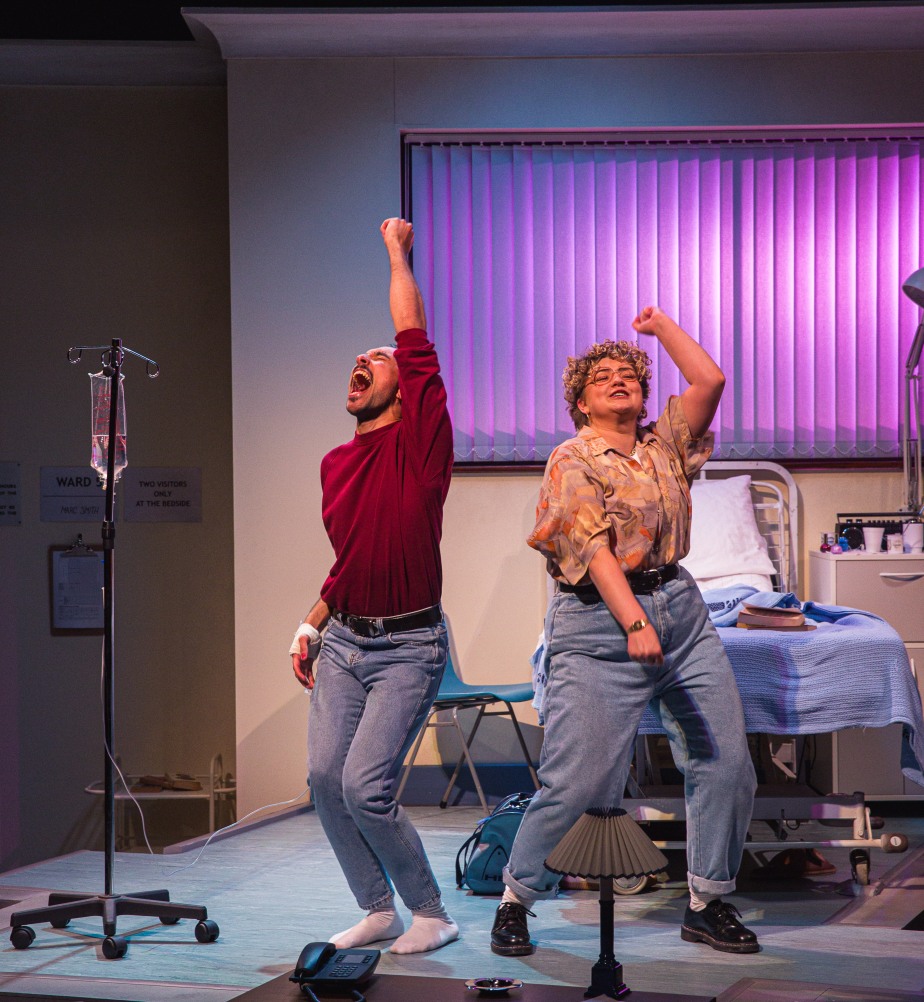
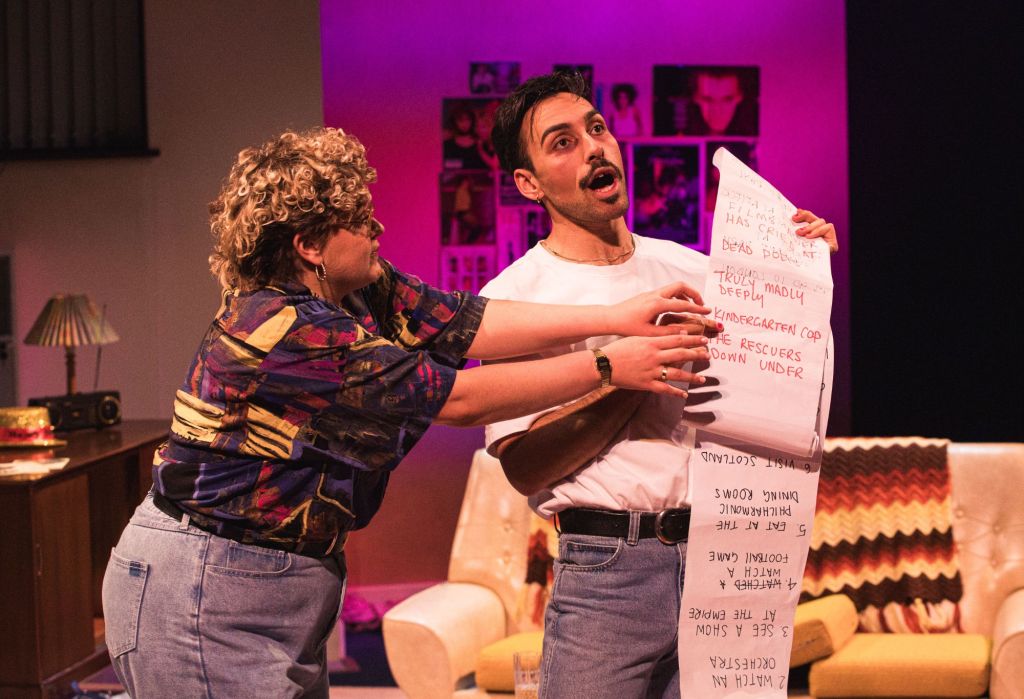
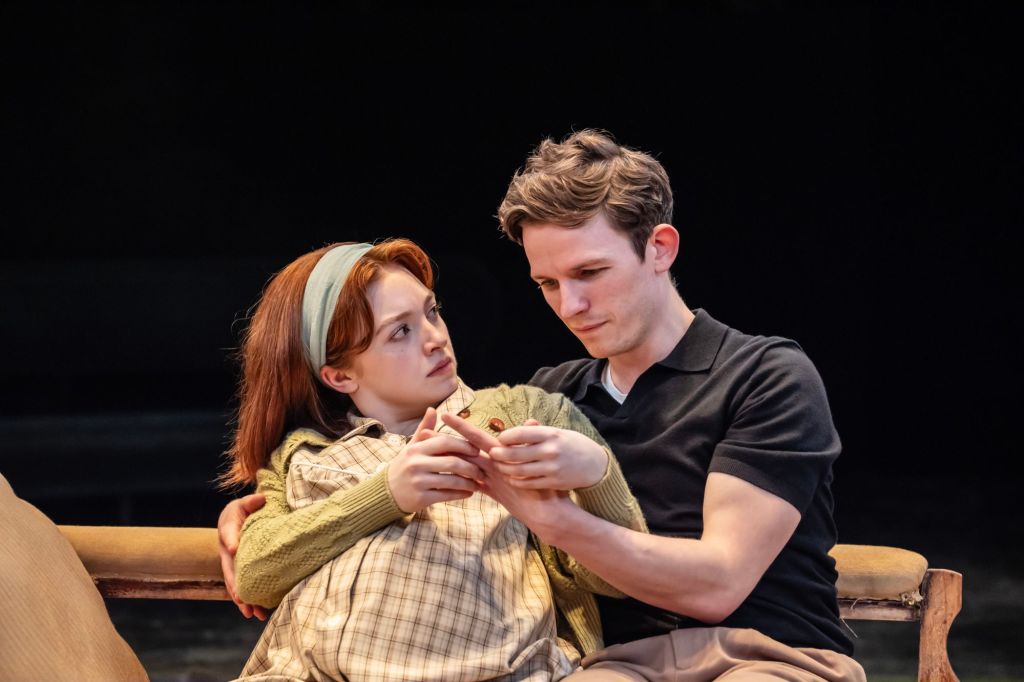
Emmy Stonelake and Luke Sookdeo as Aster and Marc in Tell Me How It Ends at Liverpool Everyman.
Image credit: Andrew AB Photography

Written by Tasha Dowd

Directed by Gitika Buttoo

LIVERPOOL EVERYMAN

It’s the 60th year of Liverpool Everyman and fittingly the theatre is celebrating by looking forward and showcasing new work. Tasha Dowd is a graduate of the theatre’s new writing programme for young people. Her debut play Tell Me How It Ends celebrates and commemorates a particular period of social history that has often gone under the radar in the story of the AIDS crisis. Focusing on the late 80’s and early 90’s the plays looks at the work of the lesbian community who tirelessly volunteered their time; in many instances their blood, sweat and tears to support all the men in Liverpool dying from AIDS and related illnesses.

This is a meticulously researched play that is filled with period appropriate cultural references and references local clubs in Liverpool at that time. The belting soundtrack includes Whitney Houston and The Communards and local Liverpool groups such as Echo And The Bunnymen and The Christians. Books and films are also central to the narrative as volunteer Aster attempts to connect with Marc though sharing books like Misery, The Silence of the Lambs and watching movies such as The Bodyguard together.

This two hander has Emmy Stonelake as Aster who is a lesbian supporting Marc played by Luke Sookdeo who is HIV and on AZT drug cocktails as the hospital struggle to increase his T cell count. Stonelake really shines in this role giving her character an awkward, bumbling charm and a dry, sly wit. Her initially infuriating habit of always giving away the endings of books and films becomes a poignant metaphor for what is to come as Marc’s life is cruelly cut short. Sookdeo struggles a bit in the early hospital scenes which simply require him to be weakened and warily resistant to Aster’s help. As his character gets physically stronger the Sookdeo starts to hit his stride and Marc becomes more fleshed out as the duo become firm friends.

There is a lovely choreography to the scenes as Grace Goulding makes use of every element of the clever set design by Katie Scott. There is energy and flow to scenes that move from the hospital to Aster’s flat, Marc’s B&B to the disco and the really captivating cinema scene. The story moves from the unlikely pairing sparring on a hospital ward to them making a bucket list to make the most of Marc’s remaining life. For such a young writer Tasha Dowd has a light touch and manages to avoid a mawkish drawn death scene. Aster’s big final speech is genuinely heartfelt and impassioned but risks preaching to the converted.

In recent years there has been a lot more writing about this era and it’s impact as we grappled with the horror of HIV and AIDS. This production feels like filling in another part of the story of a particular group of volunteers and the people they supported. I worked on the telephone counselling lines in Manchester and helped organise the fundraising so I remember the tears, the rage, the fear and despair and the laughter. It was an extraordinary time and should never be forgotten. Tell Me How It Ends evokes the era extremely well and is as much about learning how to live on our own terms as it is about preparing for death in a way that gives an individual some autonomy.

Liverpool Everyman 12th – 22nd June 2024

My Fair Lady

The cast of My Fair Lady at Leeds Playhouse Image credit: Pamela Raith

Book and Lyrics by Alan Jay  Lerner

Music by Frederick Loewe

Directed by James Brining

LEEDS PLAYHOUSE and OPERA NORTH

This is a genuinely delightful production that is as delectable as a floral posy from Eliza’s basket. Director James Brining is clearly Team Eliza casting  Katie Bird as a strong vibrant Eliza who has learned how to take care of herself and is not giving up her independence for anyone. As a gritty working class girl she may dream of ‘a room somewhere, far away from the cold night air’ but she never loses sight of the reality of her circumstances. This linguistics experiment and potential transformation might be an intellectual challenge for  Professor Higgins but for Eliza it is a chance to strive for a more secure career not a passive assumption of acquiring a wealthy lover or husband. This Edwardian musical romp stays pretty close to the original which works well in a cost of living crisis where many head to their local library to keep warm just as Eliza warms herself at the street brazier and her father and his pals huddle in the cosy warmth of a gaslit pub.

This co-production with Opera North allows for the large scale scenes and gives power and vibrancy to the classic score. The orchestra led by Oliver Rundell fills the large Quarry Theatre and sounds pitch perfect for a production on this scale. The big musical numbers feel sumptuous and the chorus do a wonderful job of bringing these scenes to life aided by Lucy Hind‘s joyful choreography. There are some lovely touches such as the barbershop elements to numbers such as Wouldn’t It Be Loverly and the memorable crowd scenes at Ascot which are wittily portrayed using quirky photo boards to transform the chorus into the gentry. The Embassy Ball scene has real energy and perfectly portrays Eliza’s successful move into polite society. The clever staging by Madeleine Boyd allows for a very varied range of scenes and the two levels act as an effective allusion to the class division of Edwardian London.

Katie Bird as Eliza in My Fair Lady at Leeds Playhouse. Image credit: Pamela Raith

The chemistry between Katie Bird as Eliza and John Hopkins as Professor Higgins works well. Bird is earthy and feisty whereas Hopkins brings a loose-limbed laconic aspect to his Higgins that is both infuriating and endearing. The will they/won’t they get together element which was introduced in the original musical by Lerner & Loewe was never intended in George Bernard Shaw’s play Pygmalion. Director James Brining brings a truth to the closing scenes in that both characters are irrevocably changed by the other but that may not be enough to bring them together. Eliza has newfound confidence in herself that is no longer just bravado whereas Higgins may have discovered that we are all capable of profound and deep feelings regardless of how we sound when we seek to articulate our innermost emotions.

John Hopkins and Dean Robinson as Professor Higgins and Colonel Pickering in My Fair Lady. Image credit: Pamela Raith

The other main characters are well cast with  Richard Mosley-Evans bringing warmth and a certain likability to his portrayal as England’s most “original moralist” and Eliza’s pragmatic father. Dean Robinson as the kindly Colonel Pickering is a good foil for the more belligerent and foolish antics of the Professor, as is the calming influences of an excellent Helen Évora and Molly Barker as the housekeeper and Mrs Higgins. Ahmed Hamad is boyishly sweet and naive as Freddy who is hopelessly enamoured of Eliza.

There can be real risks in blending operatic styles with musicals but here they are in perfect accord. Katie Bird soars when required but retains the capacity to delightfully butcher her vowels as she attempts to follow Higgins rather extreme teaching methods. What John Hopkins delivers vocally builds as the extremes of his character are revealed but most vitally he brings a delightful quirkiness that is quite captivating. My Fair Lady is a musical classic filled with songs that most of us remember from childhood and this production at Leeds Playhouse is a satisfyingly pleasurable experience for anyone already familiar with or experiencing this classic for the very first time. For the cast, the creatives and the crew…You did It. You Did It…Ev’ry bit of credit for it all (And the credit for it all)
Belongs to you! (belongs to you!)

LEEDS PLAYHOUSE 31st May – 29th June 2024

SWEAT

Pooky Quesnel and Carla Henry as Tracey and Cynthia in SWEAT at the Royal Exchange Theatre. Image credit: Helen Murray

Written by Lynn Nottage

Directed by Jade Lewis

ROYAL EXCHANGE THEATRE

The ongoing cost of living crisis, the resurgence of strike action and current fears around the rise of AI  in the creative industry is certainly having an impact on theatre productions across the North West. Currently Liverpool Everyman has The Legend Of Ned Ludd while the Royal Exchange Theatre has  opted for a powerful piece by Lynn Nottage which was hailed by the New Yorker as “the first theatrical landmark of the Trump era” after it’s Broadway debut in 2017. SWEAT is a satisfyingly meaty production with strong performances all round that feels topical and relevant but Director Jade Lewis ensures never descends into earnest and preachy.

The play opens in 2008 with two young men attending their parole appointments. One is Aryan blond and boasts the facial tattoos of a white supremacist while the other is his apparent antithesis as a young black man carrying a bible. The play moves back in time to 2000 where we see these same young men are friends and workmates bonded from childhood through their mothers who are also lifelong friends and work colleagues all working in the same steel factory in Reading, Pensylvania. SWEAT zeroes in on the very human stories that emerge when huge economic changes rupture communities, destroy established industries and the resulting fissures rip through friendships and inflame racial prejudice.

The young men are truly their mother’s sons. Of German descent Tracey is a feisty widow whose tough belligerent nature has served her and her son well in the gritty environment of the shopfloor in a steelworks. Pooky Quesnel is utterly believable in this play where all the scenes and dialogue are very naturalistic. She moves from warm and loyal friend to embittered and brittle when for her a lifetime of identity tied up in the workplace fragments into opiod addiction as the steelworks cuts costs by moving its operation to Mexico. Cynthia played by Carla Henry is more measured and like her son, looks beyond the shopfloor and has aspirations for a brighter future.

Kate Kennedy as Jessie with Carla Henry as Cynthia in SWEAT at the Royal Exchange.
Image credit: Helen Murray

The other characters give the production warmth and texture. An always excellent Kate Kennedy brings humour and pathos in equal measure as the beauty and local lush  who also also works on the shopfloor but dreams of lost opportunities. Jonathan Kerrigan is the kindly bartender who was maimed in an industrial accident at the plant and whose measured views give perspective on this complex narrative. The young Columbian bartender is American born yet like his father cannot get a union card so will only get a foot in the factory door by stepping over the picket lines and with horrific consequences.

The staging by GOOD TEETH is minimalist but effective and the bar setting works well as the social epicentre for the workers to come together to celebrate birthdays and mourn losses and disappointments. The huge concrete blocks that occasionally sway precariously or emit showers of sparks are like an ominous sword of Damacles looming over the factory, it’s workers and indeed American democracy. The use of steel throughout the bar framework is also a neat allusion to the brooding presence of the steelworks.

SWEAT has a steely thread that runs through its narrative. Friendships and community cohesion are at the core of industry… when it thrives so do the people. When those making the big decisions in air-conditioned offices take a wrecking ball to the stability of local industry then those local communities are decimated. SWEAT is a searing indictment of poorly conceived economic decisions and casts a haunting spotlight on the human cost.

Royal Exchange Theatre 26th April – 25th May 2024

THE ACCOUNTANTS

THE ACCOUNTANTS at AVIVA STUDIOS
Image credit: Tristram Kenton

Director and Set Designer Keith Khan

THE HALL, AVIVA STUDIOS

THE ACCOUNTANTS delves into exploring the contemporary culture of modern China and India by exploding myths and throwing light upon these two vibrant countries who are becoming increasingly prominent in the 21st century.  Multi-disciplinary artist Keith Khan is known for his ambitious and dramatic work that explores culture and this deep dive into the cultural worlds of these two superpowers is no exception. This hybrid of dance, sound and video is linked by an intimate thread of very human interaction played out in text and voice notes. The result is a kaleidoscopic journey that crosses continents and vast populations inundated with information from the Internet but culminates in the lasting beauty that is human beings coming together in dance and connecting in a moment where there is no distraction and each one is enough in their own right.

The first half of this ambitious production is quite literally a shock to the senses. The video designers from Manchester based art and design studio idontloveyouanymore once again showcase their imaginative and innovative designs.  The vast backdrop to the stage is a projection screen that bombards with numbers, statistics, factual information and images. Either side of the stage are two giant smartphones belonging to the central characters, Liam and his favourite “non auntie” Auntie Kash. He is a young man of British/Chinese heritage visiting China and India in a bid to understand his cultural heritage and discover who he truly is as a person while she is his Mum’s close friend who is of Indian descent but has only ever lived in Britain. Josh Hart and Shobna Gulati are never on stage but their relationship plays out in their messages and voice notes as Liam explores a world where he feels increasingly frustrated at both discovering he is no longer a minority in a country but is also a cultural tourist who cannot speak the language. He quickly discovers the reality of the countries he visits is often very different to what is portrayed on the Internet.

There are two dance companies on stage both making their International debut in Britain. From India comes Terence Lewis Contemporary Dance Company choreographed by Terence Lewis and Mahrukh Dumasia and from China, Xiexin Dance Theatre choreographed by Xie Xin. The twelve dancers onstage start out looking scarily similar in grey suits and generic bob wigs and seem to almost fade into the background like your proverbial stereotypical accountant. It’s initially frustrating and mildly stressful trying to simultaneously focus on the dancers while also paying attention to images onscreen and on the smartphones. The dance performances can seem blurred and the minutiae of movements sometimes feel lost but that is clearly the intention of Keith Khan as increasingly the actions on stage mirror the daily bombardment we all face in a fast paced world where the population growth and the online data growth is exploding exponentially.

The second half of the production is a very different beast. The phone messages reduce dramatically and the giant projection screen slowly rises to open up a strikingly cavernous backstage giving the dancers a vast space to fill. It’s no mean feat but fill it they most certainly do. Stripped back from all the distractions and discarding the wigs that make them appear so uniform there is now nothing but six Chinese dancers and six Indian dancers who start to explore each other’s culture and dance disciplines to emerge as a cohesive whole. All three choreographers involved faced huge adversities attempting to not only find commonality in their practice but to do a lot of this work on Zoom before finally coming together in a physical space. The result works beautifully with the music and sound design from Somatic. The dancers create a space for both companies to work separately and together. Vibrant energy meets taut precision and the dance is sometimes fluid and others tensile as bodies jerk like firing neurons. There are haunting moments where some are so far back and motionless that they resemble shadowy statues like the Antony Gormley installation Another Place. As the dancers work and merge together there is a palpable shift in their energy. Tiny hand movements etc that are ingrained in each other’s dance culture start to infiltrate the choreography and create a potent sense of what we gain when we try to understand another culture.

THE ACCOUNTANTS is undoubtedly a huge creative undertaking requiring artistic risks as well as benefits. It feels very relevant to the space and the artistic vision at AVIVA STUDIOS which Factory International has worked so hard to develop. On a personal note the production hit an artistic high note when the projection screen rose to reveal that huge shadowy floorspace. In that moment it felt like Factory had recaptured the magic and majesty of previous MIF performances at Old Mayfield Depot.

AVIVA STUDIOS  4TH- 11TH MAY  2024

Still Got It…!?

David Hoyle
Image credit: Lee Baxter

AVIVA STUDIOS

Still Got It…!? is the cabaret show from David Hoyle and is the culmination of his three week residency at Factory International. There may be no obvious sign of a pier or chips and candyfloss but this production has as much a rich vein of  darkly sweet seaside humour as a stick of Blackpool rock. Hoyle is the consummate performer and seems as at home on the vast stage in The Hall as in a more typically intimate cabaret venue. He delivers a performance that is warm, witty, pithy and droll. There’s something quite beautiful and incredibly touching to see this avant-garde performer who has so openly documented his own personal struggles taking to this packed auditorium to ask Still Got It…!?

Hoyle is joined on stage by a range of cabaret artists and although they are all undoubtedly talented there is also a strong sense of Hoyle using this opportunity in a 1600 capacity auditorium to celebrate friendships he has made on his own creative journey. Glitterbomb Dancers are a cabaret dance group produced by Joseph Mercier are as hi energy as they are big on sequins, glitter and dark and twisty charm. Their numbers are dotted through the show and include a dystopian ballet and a pointed and dark allusion to the Pan’s People dancers of Top of the Pops and a time when we switched on to Gary Glitter and Jimmy Saville.

David Hoyle
Image credit: Lee Baxter

Thom Shaw otherwise known as Pam Lustgarden joins Hoyle on stage to discuss jam making in the W.I. as well as well as her well documented love of poetry and building improvised incendiary devices. Her act includes poetry by John Cooper Clarke and a unique take on Pull My Daisy by  Jack Kerouac, Allen Ginsberg and Neal Cassidy. The best element however is a sly epitaph for Hoyle when he supposedly dies from Empathy.

There are burlesque performances that include Lilly Snapdragon who performs in a child’s paddling pool and delivers an act that may destroy or increase the traditional Mancunion fondness for the great British fry up depending on your fondness for blending food and sex in a particularly graphic manner!! Symoné whirls across the stage on rollerskates using hulahoops while the Alternative Miss Ireland Veda Lady delivers a powerhouse performance involving a shopping trolley and later educates the audience about PrEP and her podcast Poz Vibe.

Some of these performances translate better than others unto such a large stage however that becomes increasingly irrelevant as Hoyle  himself wields his laconic charm and stage majesty across proceedings. The huge audience is always on his side and revelling in seeing one of their own up on that stage delivering songs and reverie in his unique style. The interactive quiz show Still Got It, Never Had It, Lost It Years Ago has the audience riotously involved as Hoyle strides across the stage discussing rats in his Longsight abode, a belief in Capitalist reality and his childhood stamp collection. There truly is a broad church in the house tonight and Hoyle is the perfect High priest. He may wonder aloud how a lot of us are still alive…or ask himself How did I get away with that? The answer from the crowd to the big question of the night…David Hoyle,Still Got It…!? A resounding YES!!!

Please Feel Free to Ignore My Work

Still Got It…!?

JUNGLE BOOK

Cast of Jungle Book at AVIVA Studios
Image credit: Lucie Jansch

Based on The Jungle Book by Rudyard Kipling

Direction, Set and Lighting Design Robert Wilson

Music and Lyrics CocoRosie

Co-produced by Factory International with Théâtre de la Ville

THE HALL, AVIVA STUDIOS

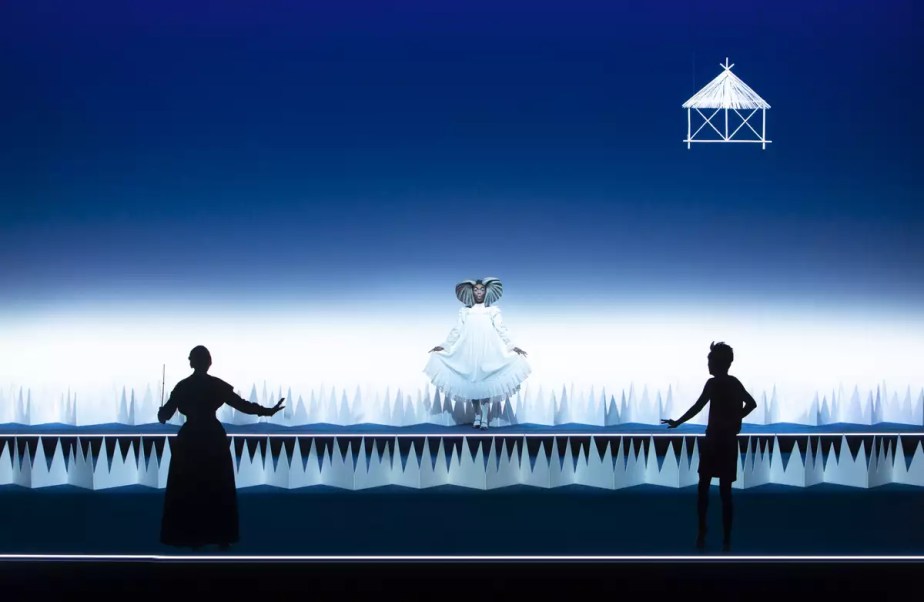
Acclaimed Director and Designer Robert Wilson is collaborating once more with Factory International having previously brought several productions to Manchester International Festival. This time the avant-garde Wilson has joined forces with American composers CocoRosie to give their unique “family friendly” take on the classic The Jungle Book by Rudyard Kipling. The result is visually sharp and stylised with a suitably vibrant score. The story is somewhat fractured and evolves in a rather staccato manner which may challenge anyone expecting a more traditional retelling. Vivid and crisply architectural in form, the scenes unfold like the pages of a very minimalist pop-up storybook.

Aurore Déon as Hathi The Elephant and Dira Sugandi as Mowgli. Image credit: Lucie Jansch

Wilson’s trademark style of elaborate lighting and projections and shadowplay with a use of deliberately artificial looking landscapes is very striking. The vivid costumes and makeup reminiscent of Japanese Noh theatre add to an otherness in the characters and the landscape they inhabit. Each animal is highly stylised and the performers inhabit their animal personas rather than don obvious animal costumes so they straddle the world’s of man and beast just as the “man-cub” Mowgli did. Roberto Jean as Shere Khan exudes part Tiger part, Studio 54 snake hipped rock star. Aline Belibi as Bagheera is clad in sleek, vampish black velvet and smoulders and purrs like  a glorious Eartha Kitt. The whole story is narrated by Hathi The Elephant who is clad in a white colonial style dress which alongside her grey ear headdress looks like an otherworldly Bjork.

The soundscape swathes the theatre in slightly off-kilter animal and jungle sounds that both enchant and disarm. The original music and lyrics by American performance artists CocoRosie are lively and vibrant with impish lyrics punctuated by dreamy ballads. The performers all sound great and a few including Dira Sugandi as Mowgli are particularly memorable. The overall feel has a decidedly French vibe and one scene change is used to employ the trademark coloured spotlights to shine on each of the musicians in the pit with great effect.

This production celebrates otherness and is intended as a plea for tolerance and understanding. The use of The Jungle Book as a base text is fitting as these varied creatures demonstrate “the law of the Jungle” as they struggle and strive to come together and try to move between the different worlds in an ever changing climate. There are issues in this production if you expect a smooth narrative flow but if you can sit back and enjoy the music and appreciate this as a montage of striking tableau scenes then there is much to appreciate. Absolute moments of striking beauty, a quirky sense of artful play that is present throughout and scenes that look like a Banksy mural brought to life are all present in this punchy piece which also includes some clowning and aerial work. It may not be the Disney rendition realised on stage but that was clearly never the intention.

AVIVA STUDIOS 27TH – 31ST MARCH

A Taste Of Honey

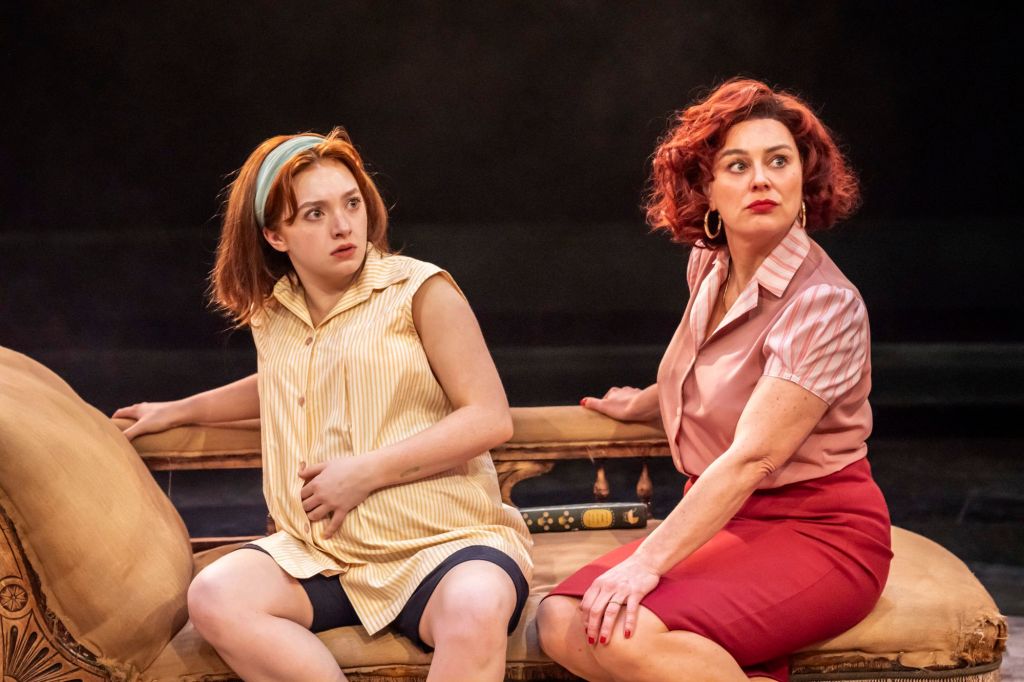
Rowan Robinson as Jo and Jill Halfpenny as Helen in A Taste Of Honey at The Royal Exchange Theatre
Image credit: Johan Persson

Written by Shelagh Delaney

Directed by Emma Baggott

ROYAL EXCHANGE THEATRE

This revival of the classic kitchen sink drama A Taste Of Honey by Director Emma Baggott is clearly a fan girl love letter to Shelagh Delaney and her beloved Salford. Impassioned and vibrant, the women that Delaney wrote at age 19, burst unto the stage unapologetically flawed and unflinchingly forthright. The men here are secondary whether callous or kind, they are merely there as supporting roles in the women’s stories. Over sixty years on and this story of impoverished, working class women still has the capacity to shock. Today there may be more choices and acceptance around homosexuality and race but the cost of living crisis is still leaving families on the breadline, reproductive rights are under threat and sky rocketing rents and greedy landlords have families living in accommodation every bit as grim as this Salford maisonette.

Designer Peter Butler has really accentuated the dreamy realism of A Taste Of Honey. There are all the authentic looking furnishings of a sparse, shabby rented flat with few touches of homeliness but suspended above the bleakness is a vast construction that can illuminate the space with fairground bulbs. Like a skeleton of a carousel it looms over the stage with echoes of the Salford gasworks and when illuminated by Lighting Designer Simisola Majekodumni there is the  sudden warm glow of endless possibilities in this usually drab environment.

Image credit: Johan Persson

Jill Halfpenny epitomises all the restless dissatisfaction of Helen with her casual disregard of her teenage daughter Jo and her unflinching focus on her own survival. She is a she wolf with scant maternal instincts incapable of loving either wisely or well. Halfpenny oozes the kind of tough, gritty sensuality reminiscent of the great Elsie Tanner in Coronation Street. She truly is an overblown rose ripe for the picking and full of thorns as daughter Jo is just blossoming and already sprouting her own defensive prickly thorns.

This thorny relationship is harshly devisive as both women battle for survival and supremacy. Rowan Robinson gives Jo moments of vulnerability fitted to this child woman who finds herself pregnant and repeatedly abandoned by those who could and should do better. Recognising a mother who had so much love for others and none for me she fleetingly tests love and rejects it. Robinson is the sparky and stroppy teenage girl capable of  giving as good as she gets but there are moments in certain exchanges such as when she flirts with her new stepfather that can seem slightly off kilter. Scenes with an excellent David Moorst as Geoffrey are beautifully executed as she plays house with this young gay man and seems destined to play out the patterns of her own deeply flawed Mother.

Rowan Robinson as Jo and David Moorst as Geoffrey in A Taste Of Honey at Royal Exchange
Image credit: Johan Persson

Moorst gives an intense and brittle performance that perfectly encapsulates the grief of a young gay man in The Sixties who realises he will never get the family life and children he craves. Andrew Sheridan as Peter is his polar opposite as the younger man who thinks he can buy love and then casually discard it like a sweet wrapper in the gutter.

There is much to love in this production but like its characters there are flaws. There are moments when performers are hard to hear which is less due to them and more about the staging. The positioning slightly off stage of the bed for instance allows for a very intimate experience for certain seats but means that a few scenes occur with quite a restricted experience for much of the audience. Overall it is rich and vibrant production pulsing with all the passion Delaney imbued her original script with. The  arrangement by Alexandra Faye Braithwaite and the use of Nishla Smith as the  jazz singer who weaves in melodies such as Dirty Old Town written about post-war  Salford by Ewan MacColl are perfect. The silent observing of every scene by Smith punctuated by her glorious etheral singing is the glue that pulls together this collection of lost souls. Her vocal is the only taste of honey that does not lose its sweetness or turn sour.

ROYAL EXCHANGE THEATRE 15TH MARCH – 13TH APRIL 2023

DARK NOON

DARK NOON Image credit: Søren Meisner

Director and Scriptwriting Tue Biering

Choreographer and Co-Director Nhlanhla Mahlangu

AVIVA STUDIOS

It is great to see AVIVA STUDIOS showing a big explosive production fresh from Edinburgh Fringe 2023. Award winning Danish company Fix+Foxy unite with a cast of South African performers to open the history books that celebrate the birth of the American Dream and gleefully rip it up and rewrite the story. Film and Television endlessly celebrate the first settlers, the brave battles protecting “their” land from the Native American tribes, the thrill of the Gold Rush and the romance of the cowboys riding out on the frontier plain. DARK NOON exposes the mythology and is a darkly funny and brutal reimagining.

DARK NOON Image credit: Søren Meisner

The Warehouse plays host to a vast bare stage depicting the rich red soil of the Wild West. The audience sit on three sides of the stage with the fourth dominated by a massive screen on which many of the scenes play out in close up. Somehow the cast of seven seem to fill the space with action from the onset. At times props appear as small vignettes are played out as chapters of history. The first settlers take their perilous journey from Europe starving, sick and often drowning. Its a powerful reminder of what migrants are suffering right now as they seek their own to fulfil their own dream of a better future. Finding and claiming land they protect it fiercely from the indigenous population. At one point the stage becomes a sports stadium where the live commentary is broadcast as the Settlers play the Natives with brutal consequences.

The props on stage grow almost imperceptibly, first a little house on the prairie appears, a railway track is built by Chinese immigrants signalling the arrival of a saloon bar, a church, a gold mine and a barb wire enclosure for the Native Americans. All is deftly done with a fluid , muscular choreography and the pace of the action never falters. Audience members are interacted with and frequently immersed into the performance as slaves in the auction, churchgoers or incarcerated prisoners. 

Throughout the frequent costume changes the performers reapply their white-face make up and blonde wigs as they poke fun at the imperious settlers who now seem as misguided and out of touch with reality as the current contenders for the next American presidency. Writer and Director Tue Biering has zeroed in on the terrifying reality that a mass historical psychosis where violence becomes the acceptable norm is not the dream but a living nightmare. DARK NOON lays bare uncomfortable truths and  pulls its audience quite literally unto the pages of a terrifying pop-up storybook that is still being written today.

AVIVA STUDIOS 6th-10th March 2023

Work It Out

The cast of Work It Out at HOME
Photo credit:Chris Payne

Written by Eve Steele

Directed by Sarah Frankcom

HOME

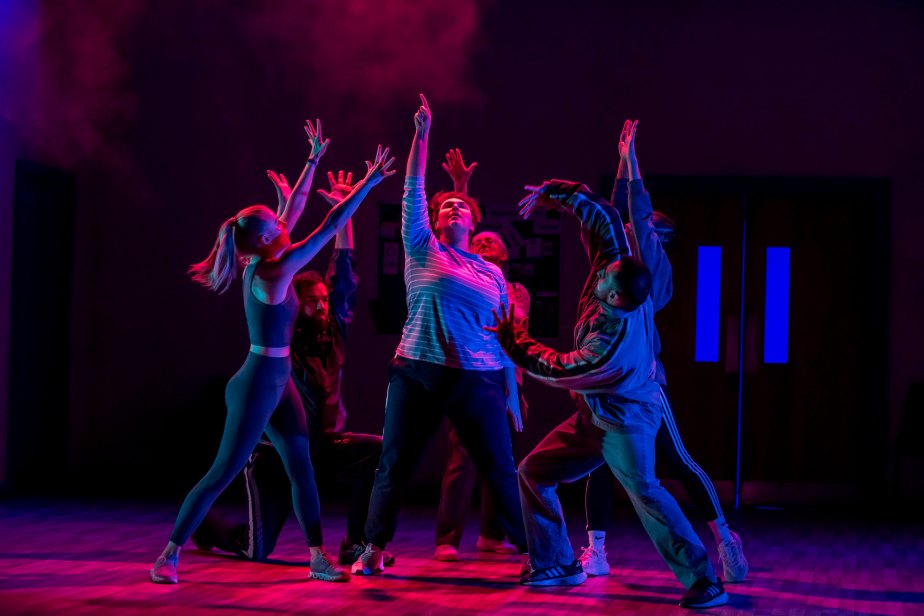
Work It Out shines a light on the week to week experience of a disparate group of vulnerable individuals as they start to form bonds within a dance fitness class they have been prescribed at their local Community Centre. The naturalistic setting and the format of weekly sessions allows writer Eve Steele to deftly explore the journeys that each of her characters experience as they attempt to change their lives. It also gives Steele a perfect platform for an unashamedly polemic rant about a broken Britain where the most vulnerable in the population are increasingly isolated and unsupported. This could be a hard hitting, grim litany of despair but instead Steele imbues her characters with sufficient warmth and humour to ensure there is also a sense of hope as her characters re-engage with a love of life and all its possibilities.

Eve Steele as Siobhan in Work It Out at HOME Photo credit: Chris Payne

The motley crew are all dealing with their own demons. Pensioner and Grandma Marie is both feisty and vulnerable with her anxieties masked by brusqueness and antipathy. Eithne Brown embodies this elderly hoarder with compassion and humour as she gradually opens up to the group and starts to regain some confidence. Raffie Julien plays her deaf granddaughter who having fallen out of love with music and dance has retreated to a world where her primary social engagement is with her phone. This is a beautiful performance and Julien shines as the prickly young woman who starts to regain joy and freedom in dance as she also makes new friends. The use of BSL throughout the production is seamlessly blended and works especially well within the fluid choreography of the whole production. Compulsive eater Colette initially tries to blend into the nondescript walls but Eva Scott blossoms on the dance floor as she connects with her repressed emotions. Writer Eve Steele is Siobhan, a heroin addict attempting to beat the drugs and  the System while trying to get her daughter out of Care. Her character is  both frustratingly disruptive in the class yet also acts as a catalyst for change in others that tragically she can sustain for herself. As always Steele is utterly believable as this chaotic and desperate woman who has suffered multiple traumas since childhood.

Dominic Coffey as Shaq and Raffie Julien as Rebecca in Work It Out at HOME
Photo credit: Chris Payne

The men here are interesting characters who despite their issues seem readily at ease amongst the predominantly female class. Aaron McCusker as Rab is a recovering alcoholic finding solace in acerbic one-liners and reiki. There is a bleak stoicism in his determination to live despite his own child wishing him dead. Dominic Coffey as Shaq has been through the care system and his burgeoning dance skills compete with his tics and stimming. The seemingly perfect class teacher played by Elizabeth Twells unites these characters but is woefully unprepared for the issues that erupt and she soon reveals herself as equally vulnerable and just as in need of a support group.

There is much to like in this production. Jennifer Jackson has done a brilliant job with the movement and choreography which is very impactful especially in scenes such as Coffey’s solo dance to a great version Creep by Radiohead. Katie Scott has created a set that embodies every detail of a down at heel community space. For Eve Steele and Director Sarah Frankcom this has clearly been a labour of love and the naturalistic direction feels like a homage to the wonderful Annie Baker. There are however issues with the overall length of the play and the pacing. The first half feels too long and risks losing its momentum on several occasions and there are occasions where the dialogue is hard to hear during some dance sequences. Overall Work It Out is a well written piece with a big heart. It celebrates the redemptive quality of kindness and the vital importance of community in our increasingly fractured world. It also highlights the hidden tragedy of those who are often better at helping others than knowing how to truly help themselves.

HOME 1st – 16th March 2024

FRANKENSTEIN

Nedum Okonyia and Georgia-Mae Myers in Frankenstein at Leeds Playhouse
Photo: Ed Waring

Inspired by the writing of Mary Shelley

Co Directed by Andrew Quick, Peter Brooks and Simon Wainwright

An Imitating The Dog and Leeds Playhouse Co Production

Quarry, Leeds Playhouse

Frankenstein was written over two hundred years ago by the nineteen year old Mary Shelley. The themes of the book have resonated through the centuries as we humans continue to grapple with the concepts of birth, life and death and what it essentially means to exist. Inspired to compete with her husband Shelley, the poet Byron and John Polidori to write a horror story, she wove together a story of a creature formed from the gruesome parts of cadavers stitched together and sparked into life by the principle of galvanism. The full tragedy is that this creature willed into life is destined never to be loved by his creator Frankenstein. This new rendition by Imitating The Dog splices together this Gothic romantic masterpiece with a story  where a young couple grapple with coming to terms with a pregnancy and its implications in an uncertain world.

Georgia-Mae Myers and Nedum Okonyia in Frankenstein at Leeds Playhouse
Photo: Ed Waring

This latest production by Imitating The Dog is a creative departure from their work of recent years as they abandon their trademark use of live camera projections used so effectively in work such as Night of the Living DeadRemix, Dracula:The Untold Story and Macbeth. This new work blends story telling with digital technology and movement. The result is visually glorious as Video Designers Davi Callanan and Alan Cox make every use of the strikingly simple set design by Hayley Grindle. The staging comes alive as violent weather patterns erupt across the stage, snowy blizzards and terrifying thunderstorms encompass the characters and beautifully compliment the radio broadcasting of the original text. There are other gems as set props illuminate with video images such as embryos, sonograms and birds that are reminiscent of a Damien Hirst installation or a Victorian laboratory.

The overall impact is highly effective as it allows the drama of Frankenstein, the claustrophobia of Walton’s ship and the beauty of the  polar landscape to come alive. Composer  James Hamilton has created a glorious score that weaves through the piece and creates a perfect alchemy with the rest of the staging. The score also brings additional powerful to the taut, muscular performances of the two leads. The choreography by Casper Dillen has an urgency and desperation that channels that of Victor Frankenstein and his Creature while also illustrating the push/pull of the young couple deciding what to do regarding the pregnancy.

Georgia-Mae Myers and Nedum Okonyia give their all to this production. Utterly invested in the characters they bring to life from the book and in the modern day embodiment of a couple wrestling with a momentous decision in an uncertain world. It is frustrating that the naturalistic dialogue employed for the modern setting seems to get lost when in translation when up against the writing of Mary Shelley. On occasion some of the parallels drawn, such as between the Creature and the shouty man outside the couple’s flat can seem heavy-handed and unnecessary. The couple come alive during the movement sequences but perhaps would have benefited from stronger dialogue to give them more depth so that ultimately an audience could care and invest in them as much as with the characters in the book.

There is much to enjoy in this production and the themes of Frankenstein will remain relevant as it continues to astound as to how Shelley’s vision of a man sewn together from discarded body parts and galvanised into life could ever be fully realised in anything but our imagination. Yet two hundred years on we think nothing of using defibrillators to breathe fresh life after a heart stops beating and use organ, body and skin implants to give loved ones hope and a new lease of life. Imitating The Dog have used their unique set of components and galvanised their own vision of Frankenstein and it seems to be a pretty successful rebirth!

Leeds Playhouse  15 – 24 February 2024

FRANKENSTEIN Tour dates