Written and Directed by Stuart Campbell
HOPE MILL THEATRE
⭐️⭐️⭐️
Queerdogs’ Kind of Love wants to dissect love in all its unruly guises, romantic, platonic, obsessive, redemptive, and to do so with a structure that splinters chronology into jagged shards. Set in the late Nineties when New Labour were gearing up to finally change the age of consent for the gay community; the play features four teenage friends navigating love and lust with messy consequences.
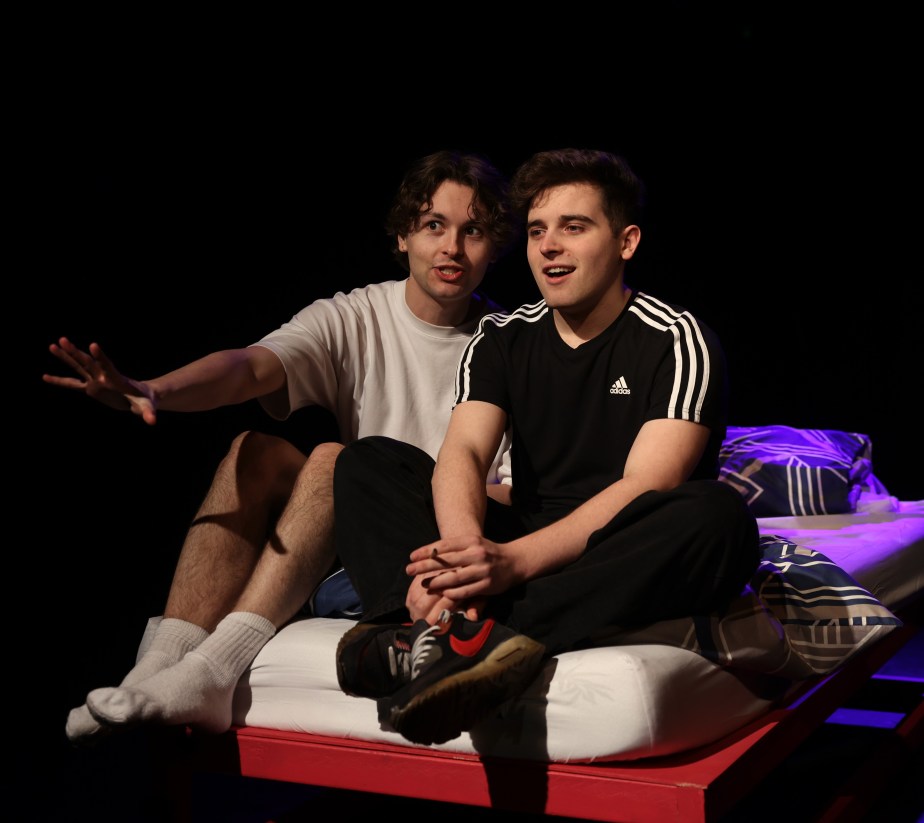
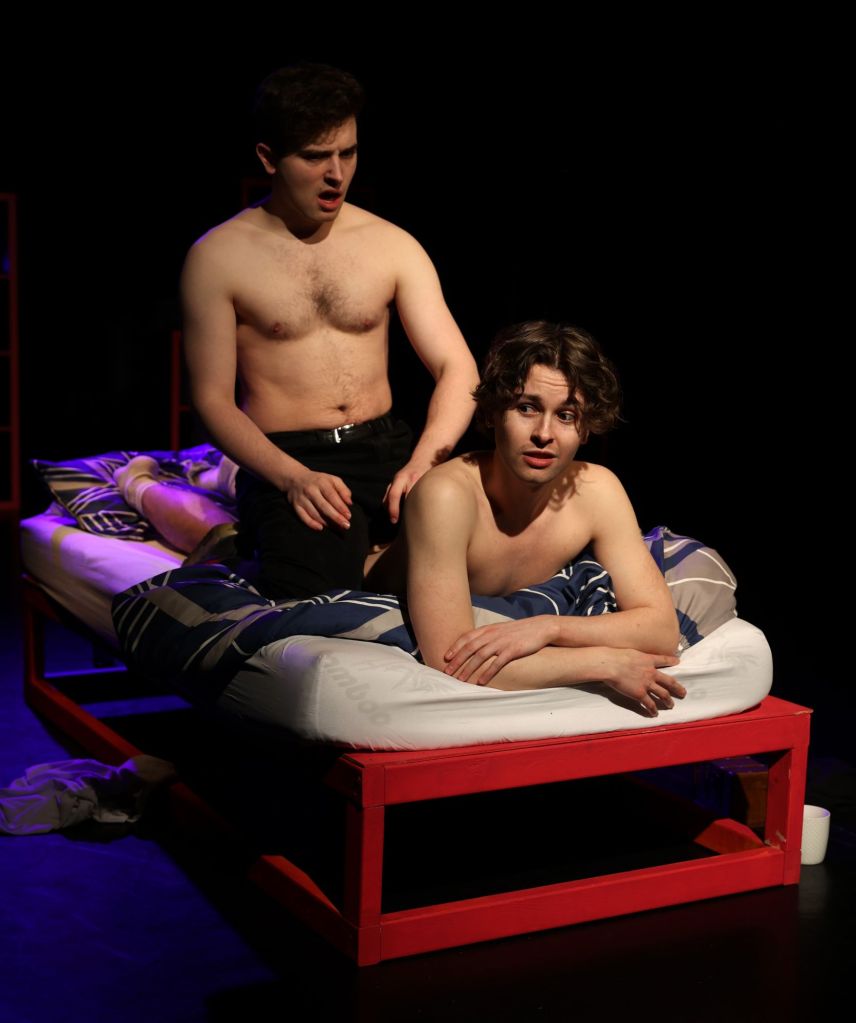
Steffan is the archetypal beautiful young gay boy with a big heart and a tender disposition. George Bellamy is convincing and beguilling as this young man falling in love with his school friend Jay. Tom Ryder is Steffans’ childhood friend and his performance convincingly leans into the hyped up masculinity and casual homophobia of his character which makes for a contrasting dynamic in this narrative. However the casting makes for slightly uncomfortable viewing as the actor looks like a mature man rather than a teenage boy who started having sex with girlfriend Gemma when she was underage. Ben Goulding is Jay whose confused choices and actions give rise to the ensuing tragedy in this piece. Here the character feels authentic as a teenager grappling with his sexuality but the writing fails to convincingly show him as someone actually impacted or attuned to outcome of his choices. The most impactful performance is from newcomer Rachel Burbridge as Gemma who anchors all the messy relationships with an authentic emotion integrity.
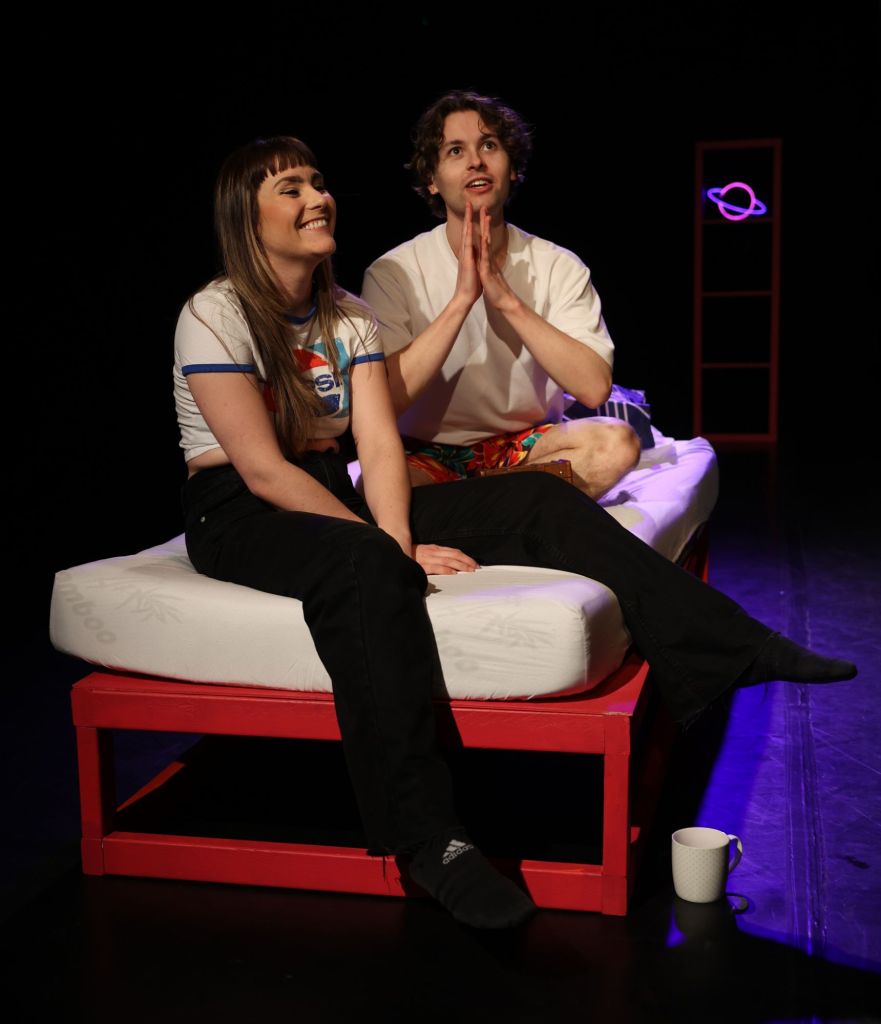
The production leans hard into fragmentation. Scenes loop and fracture; conversations restart from alternate angles, characters slip between memory and present tense or recite poetry without warning. It is an intriguing premise, suggesting that love itself is rarely linear and often feels like rummaging through a box of mismatched photographs. Yet the execution proves uneven with the emotional clarity often sacrificed at the altar of cleverness. By the second act, the audience seems less invited to feel and more tasked with assembling a particularly tricky jigsaw puzzle without the picture on the lid. The young ensemble commit wholeheartedly to the material and when the script pauses its structural gymnastics, the performers seize the opportunity to let vulnerability breathe. In these instances, the play finds its pulse and reminds us why we are here: to witness connection, not to decode a puzzle. However as revelations pile up and spiral into further complications, the central relationships risk becoming obscured. Rather than deepening the exploration of intimacy, the convolution occasionally distances us from it. Love may be complicated, but theatre thrives on clarity of stakes, and here those stakes blur into abstraction.
Queerdog are clearly unafraid to experiment, to challenge form, and to refuse easy resolutions. The play may be overstuffed with ideas, but it is never dull. It brims with passion, even when it tangles itself into knots.
In the end, Kind of Love is an intriguing, imperfect exploration of love in its many messy forms. It has some moments of real impact when it leans into the pain of navigating teenage love but confounds in others, and leaves you pondering what might have emerged had it trusted simplicity a little more.
 Live Art Alive