40/40

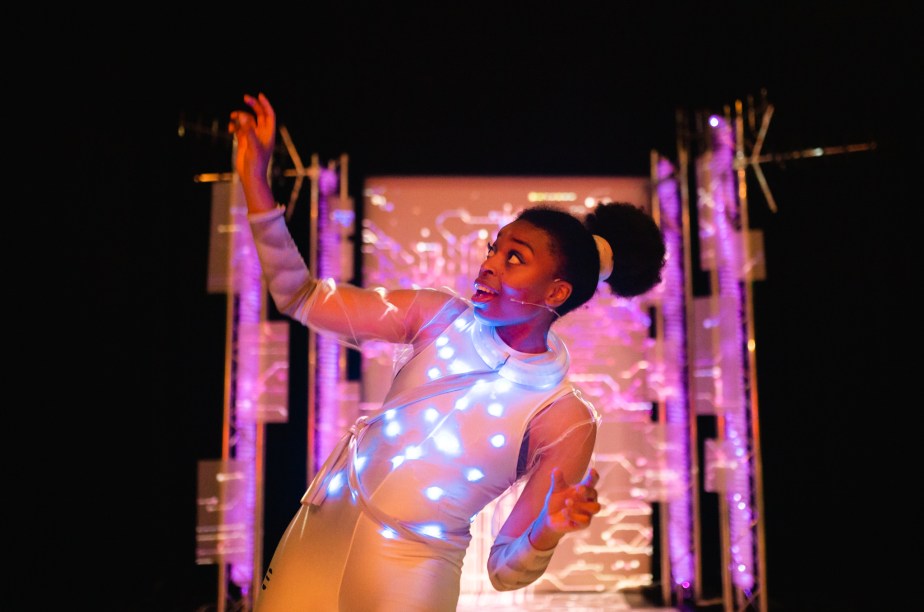
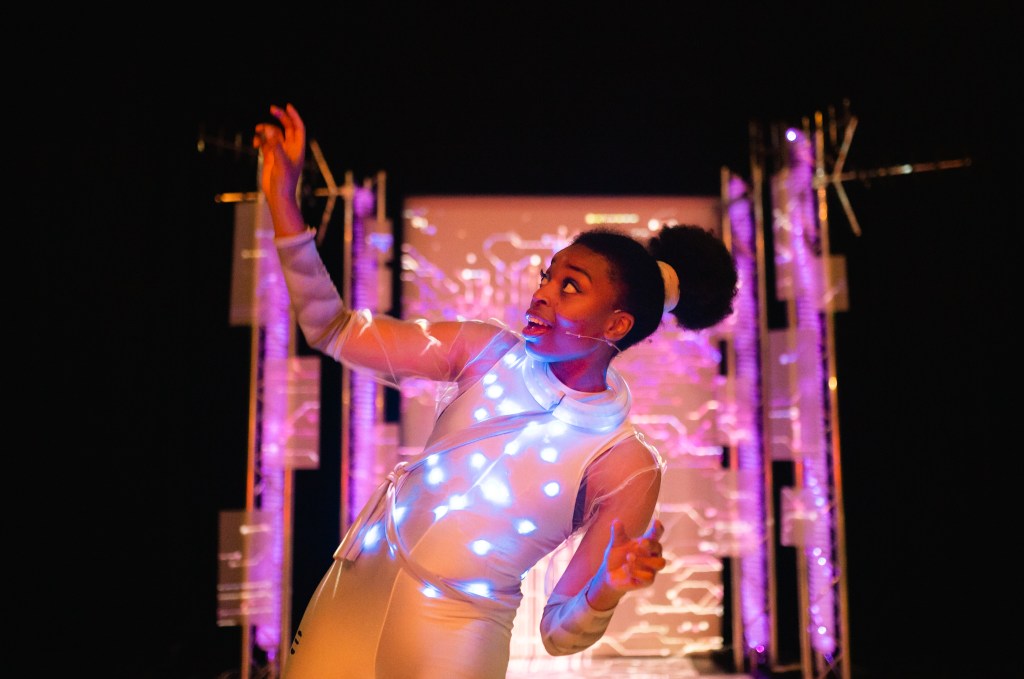
Katherina Radeva in 40/40
Image credit: Beth Chambers

Created, Conceived, Designed and Performed by Katherina Radeva

HOME

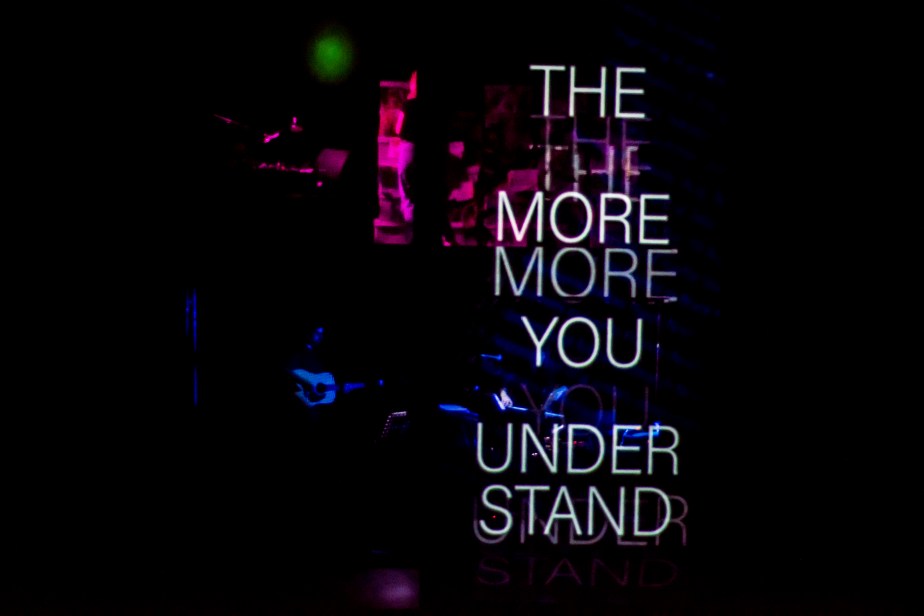
A middle aged woman kitchen dancing is something I can easily relate to. Heading to HOME on a Saturday night to watch someone else do it was not necessarily on my bucket list. Seated in a square around a dance floor that is taped up to resemble a unique take on Snakes and Ladders, the audience stare across at each other and wait. Katherina Radeva welcomes us as though we had actually entered her kitchen…warm and smiley…in her opening deluxe she might initially be underselling herself…until that moment when she reveals that this is what she wants to do and she just wants to f**k about and people are gonna have a real good time.

Dressed in a grey suit she opens with the frantic beat of Work! by Gnucci. It perfectly sums up the experience of many women juggling careers, relationships and family, trying to do it all but often just running on empty. Throughout the dance there is an powerful connection to the audience that is incredibly engaging. She later speaks of her childhood in Bulgaria and the body shaming of an enthusiastic child naturally good at rhythm gymnastics but told she was too fat too perform at competition level. Perhaps what makes this performance so joyful is the real sense that at reaching 40 Radeva is welcoming that chubby child unto the dance floor and centre stage.

Costume changes happen between each dance and feel like a blend of behind scenes wardrobe changes and raiding the dressing up box. They also serve to bring nudity onstage that is a statement of this is the female body at 40. This piece is all about Radeva claiming space and choosing how to define herself rather than having others pigeonhole her identity as a migrant, a wife, a set designer or a performance artist.

Katherina Radeva in 40/40.
Image credit: Beth Chambers

Sweet Dreams by Eurythmics is a pure joy to observe as watching her footwork in the intro is mesmerising as she explores the beat and the space. Increasingly sweaty or breathing heavily never feel like the performance is a strain on her as a performer but perfectly encapsulate the sheer physical joy of being present in the moment and enjoying every second. Other pieces reflect her Bulgarian heritage such as Maki Maki by Goram Bregović.

As the 50 minute performance closes on Radeva barefoot and knickerless and wearing a loose flimsy gown she is dancing to Rings of Saturn by Nick Cave. The lyrics seem incredibly apt as this time the chorus presents the woman as the divine force beyond explanation, beyond description. She just cosmically is. A truly joyous celebration of body positivity and acceptance.
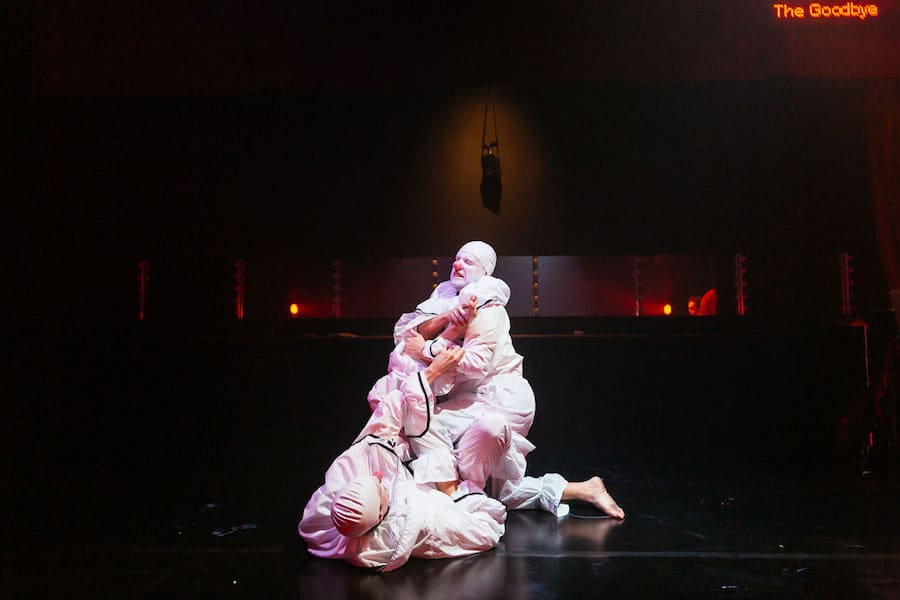
HOME 7th October 2023

Tour dates for 40/40

PROJECT DICTATOR

Julian Spooner and Matthew Wells
in Project Dictator.
Photo credit: Cesare  De Giglio

Directed and Written by Julian Spooner, Matthew Wells, and Hamish McDougall

HOME

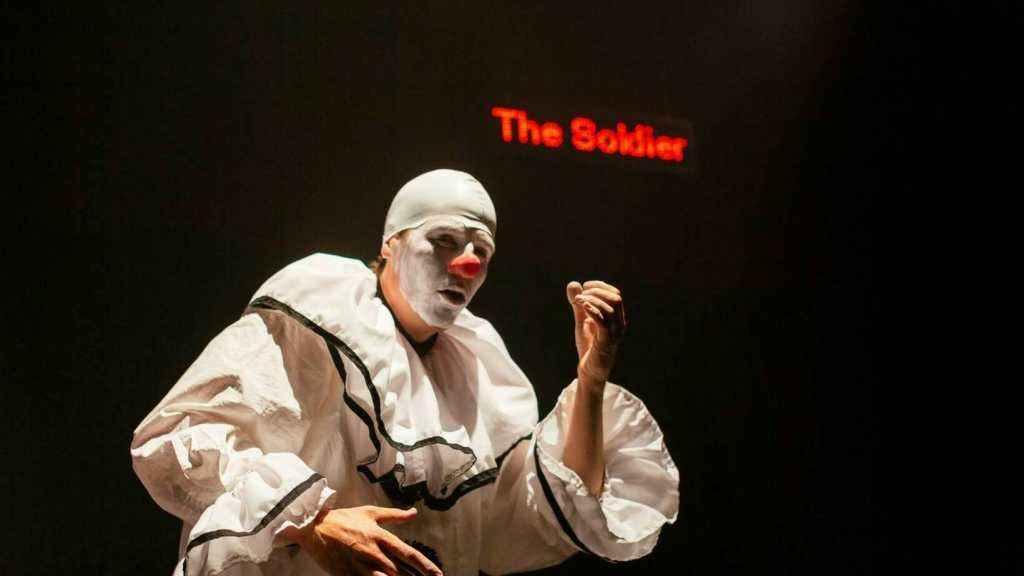
Rhum + Clay delight in devising and delivering intelligent theatre that asks pertinent and  challenging questions. Shows such as The War of the Worlds, TESTOSTERONE and award winning Mistero Buffo have all had critical acclaim. This production commissioned by New Diorama Theatre last year is dedicated to international artists living and working under authoritarianism. Project Dictator (Or: Why democracy is overrated and I don’t miss it at all) is whiplash smart with a meta script that opens as a farce masquerading as a state of the nation play which increasingly pokes fun at flaccid over-hyped politicians before descending into darker more sinister asides about tinpot dictators. The chilling conclusion dramatically shifts pace into a stark and disquieting nightmare that illustrates the perils and restrictions on artists working in oppressive régimes. This really is a case of whether a committed performer chooses to risk dying onstage or potentially behind the scenes.

The opening scene invites the audience into a cosy setting where the stage is set with opulent red velvet stage curtains and a smiling pianist  who belts out seemingly endless cabaret tunes. A closer look reveals a palpable tension…the pianists’ eyes flutter nervously and her smiles are more unnerving rictus grins than genuine cheer. The playwright and star of the show within the show has the smooth confidence of an Alan Partridge who describes his character as Emmanuel Macron meets Jesus Christ without a trace of irony. Matthew Wells oozes the easy confidence of a politician with a Messiah complex on a campaign trail full of soundbites, babies and photo ops. Then there is his counterpart Jeremy Spooner, initially relegated to multiple small supporting roles or as the logo on his boilersuit states simply Everything Else. Spooner plays the absurdist buffoon, a comedic sidekick to Wells’ straight man.

This classic teaming allows for the entertaining initial farce before this political sketch is suddenly upended. Roles are reversed as Spooner challenges the narrative and what unfolds is a vicious political coup on stage. The comedy is cleverly ramped up as he crashes through the audience brandishing a baby monitor strapped to a megaphone and adorns himself with flashy epaulettes and a huge fake moustache. Suddenly the OTT charisma of this Ollie Reed/Freddie Mercury characterisation starts to dissipate as the sinister agenda becomes clearer. The smooth polish of an ineffectual politician with soundbites instead of solutions has been overthrown by a narcissistic dictator. As the audience is whipped into a frenzy so comes the uncomfortable acknowledgement that no dissent is allowed. The audience is now as unsafe as the performers as we start to turn on each other to save ourselves.

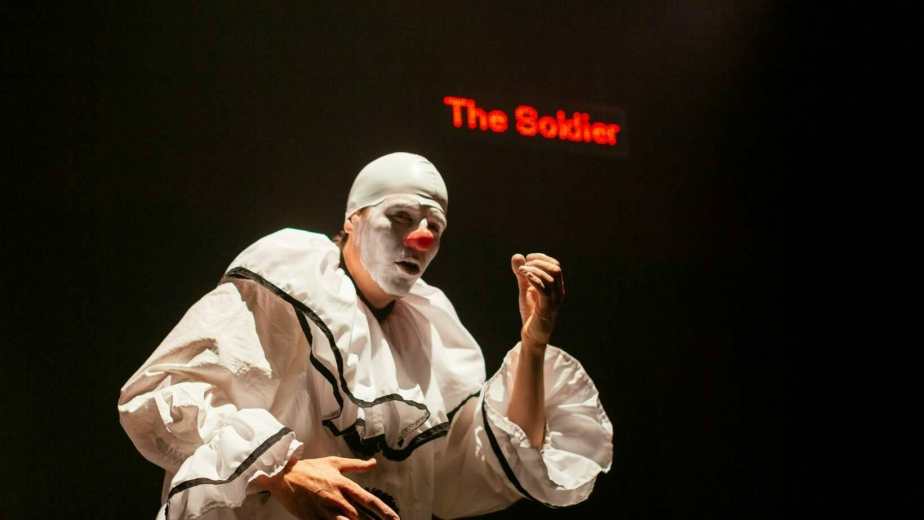
The political farce onstage is over and the nightmare really begins as the set reveals backstage. There the performers falter…suddenly vulnerable and wary as they clear away the props. Literally everything and everyone is stripped bare and all illusion is gone. They are now sinisterly hooded prisoners ordered to perform, deviating off script at their peril. Donning heavy clown make up and costumes the loop of performance begins only broken by hellish ruptures before the loop begins again. The performance starts to fragment until exhausted and traumatised each individual must choose their path. The powerful closing scene is full of pathos and pain as it alludes to the constraints and dangers for those artists producing work under authoritarian regimes.

HOME 20th – 30th September 2023

Rhum and Clay

All Right. Good Night.

Written and Directed by Helgard Haug

Score by Barbara Morgenstern

Arranged by Davor Vincze

HOME

For Manchester International Festival/Factory International

MIF23 is once again working with German theatre company Rimini Protokoll. This time it is to present the UK premiere of the award winning All Right. Good Night. This is a deeply meditative piece which uses sound and text to immerse its audience in a reflection on disappearance, loss and how we as humans deal with uncertainty. Running at approximately 140 minutes without interval, this could be a daunting prospect but it is actually one of the highpoints of this Festival. Beautifully conceived and exquisitely rendered this piece interweaves two real stories of loss to highlight the fragility of life and the tenacity of hope even in the most desperate of situations.

Helgard Haug explores the uncertainty, grief and bewilderment faced by those who lost loved ones on Malaysian Airlines Flight MH370 from Kuala Lumpur to Beijing which disappeared from the skies in 2014. She draws parallels with her own experience of watching her Father descend into dementia around a similar time. The Father as he is referred to in this piece was a man who meticulously planned for his future and poignantly had already built flats for dementia patients. Plans and actual outcomes sadly often differ…people may queue up to board a plane that never arrives…parents may plan for the possible onset of dementia never knowing that the illness may rob them of the capacity to adhere to those plans.

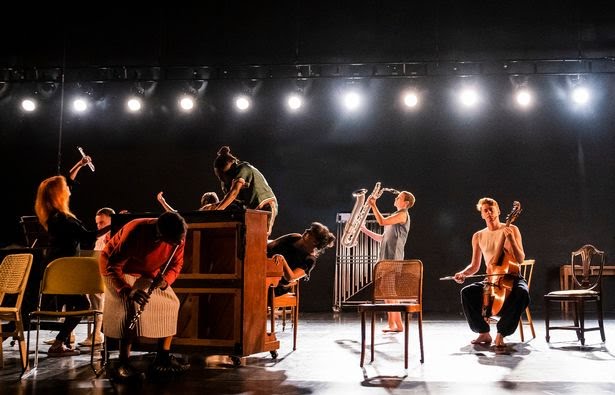
On Stage are 5 musicians from ZAFRAAN ENSEMBLE MUSICIANS and the rest appear on screen and in recordings. The music by Barbara Morgenstern is beautiful and perfectly reflects each event and year that passes for the families in these two stories of loss. The use of projection screens at the front and back of stage help narrate the story as text floats across the gauze hinting at the fragility of life. When the music expands to include the full ensemble they are projected moving across the screen playing their instruments and loop around to surround those actually on stage. The overall effect by Marc Jungreithmeier is wonderfully playful yet hints at the ephemeral ghosts of those lost souls no longer tangible in this world.

The performers on stage ebb and flow…queuing up as a crackling tannoy makes flight announcements, they reappear to literally build a sandy beaches as others dressed in swimwear merges instruments with deckchairs and other beach paraphernalia and fragments of plabe wreckage. Waves lap on the projector screen and light becomes warm and sun drenched as the performers gaze out at the endless horizon. Years roll by as The Father moves from gaffes with birthday cards, confusion, terrors and rages to the inevitable loss of self. Meanwhile each day family members gather at the Malaysian Embassy in Beijing still hopeful of news of loved ones. Each reported possible cure for dementia reignites hope for families just as endless conspiracy theories continue to let individuals hold a glimmer of hope that one day they will be reunited with loved ones.

All Right. Good Night. was reportedly the last recorded words of the pilot on that fated flight. They sound eerily similar to the reassurances of a parent as they leave a child to sleep in the knowledge that the dawn of a new day reunites them. This production gently reminds us all of the fragility of life and the uncertainty that it evokes. Like this lush production it is to be cherished and fully appreciated in the moment…for that may be all any of us have, and perhaps that is ultimately enough.

Manchester International Festival. HOME 6 -8 July 2023

The Faggots And Their Friends Between Revolutions

Image credit: Tristram Kenton

Music by Philip Venables

Wtiting and Direction by Ted Huffman

Based on novel by Larry Mitchell and Ned Asta

HOME

MANCHESTER INTERNATIONAL FESTIVAL

The Faggots & Their Friends Between Revolutions achieved cult status since Larry Mitchell self published in 1977. In a world where acceptance and compassion can flow generously and hopefully then quickly appear to ebb away again, this new production feels timely as LGBTQIA+ rights and safety seems to be worryingly under threat. The blending of a wide range of musical styles, instruments and voices are a carousing anthem for unity and change. A high point of this performance is Kit Green breaking the fourth wall to bring the whole audience together in song. There is a palpable sense of unified passion as everyone literally sings from the same hymn sheet. The word Faggot is cherished here and used with real love in this celebration of queerness and the revolutionary attitude to male patriarchal society required to achieve self-determination.

This is the third collaboration between Composer Philip Venables and Writer/Director Ted Huffman. This new opera commissioned by Factory International is one of the touring productions which premieres at HOME before going to festivals in France and Austria. Previous work includes a highly disturbing opera production of Sarah Kane’s 4.48 Psychosis which apparently induced panic attacks in some of the audience members. Here there is a warmth and generosity in the music that is playful and highly engaging. The Faggots are alongside the faeries, the faggatinas and the women who love women. The music here has opera sitting alongside baroque, bossa nova, and club music. Fifteen musicians, singers, dancers and actors play multiple instruments from lutes and accordions to violins and viola da gambas. The score vividly evokes the sexually charged urgency as magic cock fluid is ejaculated, the folky sense of campfire singing in a Commune and the euphoria of a drug fuelled club night.

Image credit: Tristam Kenton

The history of the patriarchal society is told as a subversive fairytale. This story flips the history books and slyly suggests it’s the power and paper hungry men who are the aberrations in Society and its the Faggots and their friends who are the original people. All the performers have their moment in the spotlight with some beautiful virtuoso performances. However it’s the inimitable Kit Green and dancer/choreographer Yandass who primarily tell the story. They are a perfect foil for each other with Green all laconic, fluid elegance and pithy delivery whereas Yandass is a powerhouse of taut, passionate energy.

The stage at HOME looks like a vast black box creating a wonderful sense of looking back in time and seeing these performers in a stripped back way where there are no other visual distractions…they have to be seen…and they are seen…as extraordinary, gifted and ultimately human individuals who will carry on and survive whatever Revolutions are yet to come.

HOME 28 JUNE – 2 JULY

Manchester International Festival 29 JUNE – 16 JULY

The Merchant Of Venice 1936

Image credit: Marc Brenner

Written by William Shakespeare

Adapted by Brigid Larmour from an idea by Tracy-Ann Oberman

Directed by Brigid Larmour

A Co-production by Watford Palace Theatre and HOME Manchester

HOME

This new adaptation of  Shakespeare’s “problem play” sees actress and writer, Tracy-Ann Oberman and director Brigid Larmour rework The Merchant of Venice for a female Shylock who is a widow and a mother. This female money lender is based on Annie, the great-grandmother of Oberman and all those strong women who emigrated to Britain after the 1905 progroms in Russia. Tracy-Ann Oberman embraces the discomfort of this role as the beleaguered moneylender demanding her pound of flesh, giving a strong impassioned performance in this still widely debated play that questions Shakespeare and his views on Judaism.

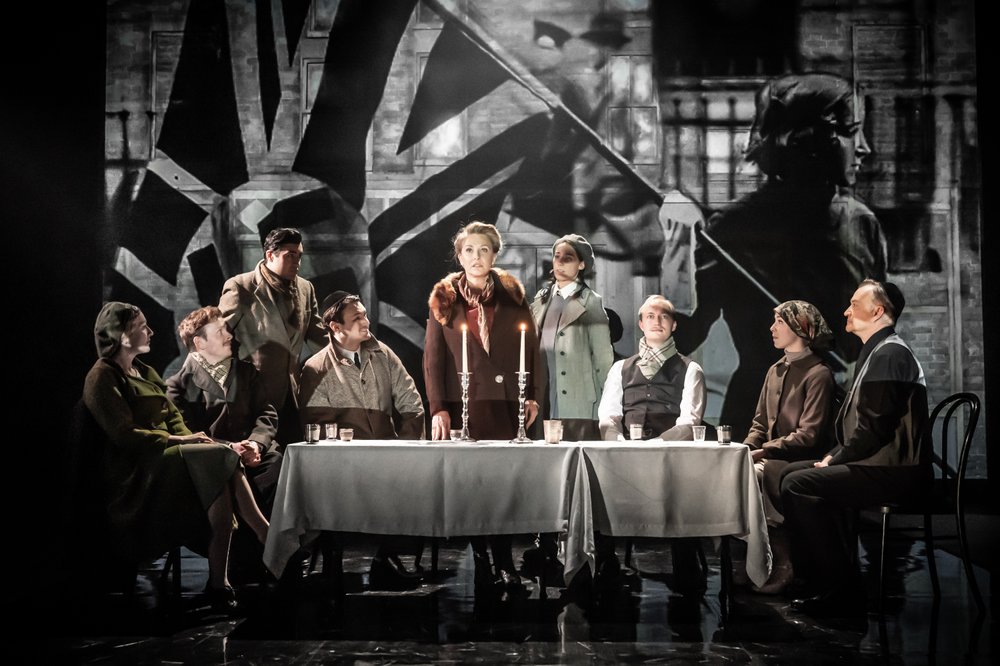
The sound of shattering glass offstage indicates that the brewing antisemitism of Thirties Europe is alive and flourishing in the East End of London.This production is set in 1936 to the backdrop of the rise of Oswald Mosley and his British Union of Fascists party and the resulting riots during The Battle of Cable Street on 4th October 1936  when working class people came together in support of the Jewish community. The deeply divisive aspects of this play are further highlighted by the fact that it was also adopted by the Nazi regime in Germany where the characterisation of Shylock was used to validate antisemitism. After Kristallnacht The Merchant of Venice was performed all across Germany.

Here Larmour and Oberman do not shy away from the complexity of their Shylock but balance it neatly against a background of privilege and arrogance as the Venetian noblemen became rather less noble as entitled  Bullingdon Boys in the vein of Boris Johnson, David Cameron and George Osborne caricatures. Their Portia is a cool willowy blonde society heiress equally at home in riding jodhpurs or a bias cut ivory satin evening dress. Clearly modelled on the infamous Diana Mitford, wife of Oswald Mosley who married him at the home of Joseph Goebbels, this is a woman giddy and lethal in her own sense of power.

Image credit: Marc Brenner

The set design and costumes by Liz Cooke work together wonderfully well to capture the gritty side of East End London and the sleek sophistication of society life. Everything about this production suggests a real love for the project and great attention to detail. The music of the period blends Yiddish music and classics such as the apt Stormy Weather. The screen images tell a story of the rise of Fascism and quiet poignant moments on stage such as a disparaging glance between Portia and Jessica say more than words ever could about a society where old money and breeding will always sneer at new money.

This is a strong cast with well balanced performances but ultimately it is the women who shine most brightly. As Portia, a pitch perfect Hannah Moorish hands out money and a ring to Brassanio, her new husband and Shylock finances the Merchant Antonio with her bond; it’s notable that these very different women are also moneylenders exacting and expecting their own pound of flesh. Tracy-Ann Oberman relishes a role that celebrates women she clearly feels incredibly proud off. Her call to arms in the closing sequence is a plea that we are better together…perhaps the placing of some of the audience on stage is also a powerful unifier. In difficult times we all have to make choices where we stand…if we do not then those choices can be ripped away. The most powerful moment in the production is not Oberman onstage but sitting on the rough wooden step. Momentarily beaten by the bullying elite, she is clutching a tiny brown suitcase just like all those still stacked together as a memorial to all those sent to camps such as Auschwitz.

HOME 15th – 25th March 2023

Too Much World At Once

Paddy Stafford as Noble and Ewan Grant as Ellis. Image credit: Chris Payne.

Written by Billie Collins

Directed by Adam Quayle

HOME

The biggest things happen

In the quietest of ways

And we don’t even notice

Don’t even see it

Don’t make a fuss

Or a dance

Until

Too Much World At Once is an impressive theatre debut for Billie Collins. This coming of age story has big aspirations; looking at themes around queerness, mental health issues and environmental disaster. There is a real lyricism in the writing and a strong feel for naturalistic dialogue. It’s no mean feat to write a fifteen year old boy who turns into a bird and readies himself to fly thousands of miles to his neurotic sister who is doing her bit for climate change by gathering data on albatrosses on a remote island in Antarctica. Meanwhile closer to home his Mum is struggling to connect and parent in a fractured family, while teaching and trying quite literally to hold the family home together. New boy Ellis is a breath of fresh air to both mother and son, bringing colour to their lives in ways that go beyond his nail polish and rainbow take on school uniform. It’s a lot to cram into two hours on a small stage but director Adam Quayle does a excellent job of bringing the writers’ vision to life. Quayle who is the Joint Artistic Director of Box of Tricks has made this ambitious debut look and feel authentic.

Alexandra Mathie, Paddy Stafford, Ewan Grant and Evie Hargreaves. Image credit: Chris Payne.

The staging by designer Katie Scott is really beautiful in its simplicity. The central dias is shaped like the Earth with a backdrop of decaying wood…orange boxes, simple wooden furniture, bare window frames and driftwood that look like they may have been washed ashore. Overhead hangs a chandelier of driftwood that is reminiscent of the sword of Damacles. This staging is compact but highly effective in driving the narrative of the play. It’s further enhanced by sensitive and imaginative lighting by Richard Owen. At times the soft spread of light looks like the oceans of  Earth or the rich splatter shades of guano. The lighting effects are at times simply gorgeous as in the closing moments where the the cast are lit like a rich tableau that is truly memorable.

The four actors are all well cast and give good performances. Paddy Stafford as central character Noble embodies the withdrawn boy who has closed off from his mother and desperately misses his sister. He gives a highly effective performance as he transitions into a bird and the occasional delicate movements of his head evoke a curious, perhaps wary bird. Evie Hargreaves plays his sister Cleo, a research scientist on Bird Island who is pulsating with nervy energy, passionate about conservation but overwhelmed by the harsh reality of the task and her surroundings in Antarctica. Alexandra Mathie is Fiona, their mother and the local science teacher. She is utterly believable as a brusque Northerner who seems more sentimental over her crumbling family home than sensitive to the emotional needs of her children. The force of nature in the play is Ewan Grant as Ellis, a newcomer to the school and excluded by his peers due to his sexuality. Grant exudes the enthusiasm and openness of a Labrador puppy bringing an upbeat and humorous energy to the production. He is the perfect foil to this family who have lost their way and each other.

Collins writes with the confidence of a natural poet. There is an innate lyricism and a sense of magical storytelling in this piece. It will be exciting to see her work develop as a playwright. The central flaw within Too Much World At Once is precisely that…there is a lot of world and not enough about who the characters are within this world on stage. This is an exciting premise for a play but the characters feel underdeveloped at times. The mother has some back story and context yet it is frustrating to watch this woman who sits painting the nails of a boy her son barely knows instead of battering down the doors of the local police when her 15 year old child has been missing for days. A lot of the action in this narrative is driven by what has happened within the fractured dynamics of this family unit yet these are barely touched upon. What has happened in the marriage? A deeply depressed and highly anxious daughter…is she living out her mothers’ unfulfilled ambitions? Most frustrating is the central character Noble as he never feels fully fleshed out…but perhaps he is just a fledgling in a damaged nest.

Director Adam Quayle has done a lot to make a potentially tricky play come to life on a small stage. At times the production can seem unwieldy or too busy as the chorus moves around swooping like birds or moving chairs like they are being swept away in a storm. This would all probably lend itself more effectively to a larger stage. The sound design by Lee Affen adds additional charm as he works magic to bring the world of nature and the elements to life onstage. This is a big play on a small stage but perhaps aptly so…

And this is all I know…that it’s a good world to be small in. And there is so much here to love.

HOME 3rd March -11th March 2023

Box of Tricks Theatre tour

SONG FROM FAR AWAY

Will Young as Willem. Song From Far Away. HOME Image credit: Chris Payne

Written by Simon Stephens and Mark Eitzel

Directed by Kirk Jameson

HOME

Song From Far Away is an evocative study of grief, emotional repression and isolation that is at turns both delicate and brutal. This monologue  with song perfectly blends the talents of playwright Simon Stephens and songwriter Mark Eitzel. It feels like a musical for those of us who want to see something that feels more ethereal like the vibe of Cocteau Twins rather than a big West End number. Will Young is a singer, actor and writer who excels as the emotionally repressed and weary cynic that is Willem. Like his character Willem, Young has also lost his only brother but if the performer is channeling his own grief, anger or frustration it is subtle and never remotely self indulgent.

Grief is like a fault line that opens up inside of us and irrevocably changes our emotional landscape. When we speak of grief as a journey or a process, perhaps what we are really describing is how we accommodate this new version of ourselves that still fits our outward clothing but internally feels alien and strange. We see the world in double vision…part familiar terrain and part unchartered waters. Song From Far Away takes Willem from his adopted New York, once New Amsterdam, back to his childhood home of Amsterdam for the funeral of his 20 year brother Pauli. The monologue is in form of letters written to Pauli as  Willem reluctantly navigates a return to his childhood home.

Will Young gives a controlled and emotionally nuanced performance as a hedge fund manager rich in wealth but pauper poor in empathy. Willem is emotionally guarded and aloof and his initial response to hearing his brother has died is one of irritation. Young channels Willems’ disdain for others into micro gestures, facial expressions and clipped tones that convey the character as emotionally stunted and terribly damaged by his family dynamics. This is story telling with caustic wit and casual cruelty yet punctuated by moments that catch Willem by surprise. In those, Young can dazzle with the small agonies of walking into his brothers’ bedroom and finding a sock drawer left open and a half read Kafka novel never to be unfinished or a sudden rush of joy as his little niece Anka singles him out to play with.

The staging by Ingrid Hu is sleek and minimalist, as beige as an airport lounge, a Manhattan loft apartment or a perfectly tended dutch townhouse. Marbled walls and sweeping curtains frame vast windows that act is a backdrop to the magic of quietly falling snow or the hazy sparkle of fireworks dancing in a night sky. The ceiling occasionally lowers or rises, and walls and curtains ebb and flow echoing the emotional tides of grieving. The contracting and expanding like a heart that carries on despite another having stopped forever. Jane Lalljee uses light to move the scenes letter by letter as Young recounts the week after his brothers’ death. The hazy, dreamy lighting is punctuated by occasional plumes of amorphous smoke that create almost a sense of another being circling Willem as he reads to Pauli.

A song fragment heard in a bar lodges in his memory and encapsulates his sense of loss and fragmentation. Young hums and later sings as the song takes form and something seems to open up in Willem. Young sings exquisitely and wistfully. This feels like a prayer to loss and the possibilities of love and connection. Young manages to rein in his performance so we never lose the sense of Willem on stage rather than Young, the singer.  Stephens and Eitzel beautifully convey a sense of rootless dislocation and the complexities of family, relationships and grief. Director Kirk Jameson has been sensitive and controlled in his directing. The production retains a strong flavour of European theatre and the style of Ivo Van Hove who originally commissioned the play in 2014. Jameson has retained the contradictions and sense of alienation in the production but allowed the writing to feel equally at home at HOME…rather fitting as a homecoming for Simon Stephens who is Stockport born and bred.

HOME 22nd Feb – 11th March 2023

Things Hidden Since the Foundation of the World

Javaad Alipoor in Things Hidden Since the Foundation of the World
Photo credit Chris Payne

Written by Javaad Alipoor with Chris Thorpe

Directed by Javaad Alipoor

HOME

Things Hidden Since the Foundation of the World is the final piece of a trilogy that follows on from two Fringe First winners, The Believers Are But Brothers and Rich Kids: A History of Shopping Malls in Tehran. Any concerns regarding that tricky “third” album are quickly dissipated as Javaad Alipoor introduces the subject matter for the next 90 minutes. This is a whip-smart journey that delves into the unsolved murder of ’70s Iranian pop icon Fereydoun Farrokhzad via murder mystery podcasts and an exploration of digital culture and post colonial theory. This new production expands on themes from the previous works looking at how technology, resentments and fracturing identities are changing our world. 

Alipoor sends his audience down Internet rabbit holes where we ride the hyperlinks and visit the land of Wikipedia where not everything is as it seems and via a live murder mystery podcast we emerge as seasoned supersleuths face to face with a real life Persian musical superstar. An actual flesh and blood man with a Wikipedia page who steps onstage mindfully aware that someone in this audience tonight might actually be there to assassinate him. This is a production that is fast moving and demands the rapt attention of its audience; anything less and you risk being cast adrift in Tehran, Vancouver or the lowlands of Scotland.

The staging is deceptively simple with an all black set and a lecturn but as with the Internet and cross cultural experience nothing is quite as it seems. Screens move from side to side and sets appear to open like in an advent calendar…this is multi cultural, multi layered and multi dimensional experience that invites the audience to look at the big picture in all its elements and shades. Live action as King Raam and Me-Lee Hay make music in a studio, blurred newspaper images, colour TV film footage, Alipoor at his lecturn, Asha Read delivering a podcast, Wikipedia pages floating over screens…like translucent layers of onion being peeled back…its heady stuff that you can’t not breathe in and may leave a tear in your eye.

Photo credit Chris Payne

In the ’70s a beloved Persian music icon, by the ’80s Farrokhzad was a political refugee in Germany working in a grocery store and just 6 months before his brutal and unsolved murder in 1992 he sold out two nights at The Royal Albert Hall. That’s quite a story…imagine if something similar had happened to our national treasure Tom Jones! Shocking, sad and tragic but in the past. Yet it really isn’t when a death remains stubbornly unsolved and theatre makers like British/Iranian Javaad Alipoor make us click those hyperlinks. It really isn’t when Raam Emami speaks of his experience as a Canadian/Iranian musician whose work is both celebrated and castigated in Iran. It really isn’t when he tells you about his father Kavous-Seyed-Emami, a lecturer, tortured and murdered in Tehran…though Wikipedia says he committed suicide while on detention. It really isn’t when Raam Emami or King Raam is on a death list discovered by the FBI.

Things Hidden Since the Foundation of the World is one of those really great pieces of theatre that makes you think, it provokes and it informs but it does so without being earnest or preachy. This is the kind of theatre we need more off so click on the hyperlink below and book your ticket now!!

HOME until Saturday 5th November 2022

Battersea Arts Centre 9th -26th November 2022

Vice Versa

Dorcas Seb. Image by Robin Clewley

Written, Co-produced and Performed by Dorcas Seb

Directed by Emmy Lahouel

HOME

Wide eyed and smiling earnestly Dorcas Seb dances in a repetitive, slightly robotic style. The audience slowly start to fill 3 sides of the stage and sit while Seb continues to dance. The music shifts subtly as a more electronic hum starts to merge in and create a more ominous tension. The 3D effect set by Dylan Howells is strikingly beautiful with its neon blue and pink lights that flicker and flow across the floor and backdrop like neural pathways in an artificial brain or a strange simulation of the tree of life. By the time Seb actually starts to speak she has already created an absorbing, dystopian vibe that feels trance like and strangely calming.

Vice Versa was originally conceived as an E.P in 2018 but has been crafted into a visually arresting, evocative piece of performance art/gig theatre. Commissioned by Eclipse Theatre and HOME as part of the Slate: Black. Arts. World project in 2018/19, with development support from Unity Theatre and funded by Arts Council England. It is clearly a deeply personal project for Seb which explores the modern digital world and our increasing fixation and reliance on our phones and computer screens as a means of communication. The original ideas behind this piece in 2018 were to become even more sharply prevalent during the pandemic when our spoken words mainly flowed from our fingers and direct eye contact was via a Zoom screen.

Dorcas Seb is a confident and accomplished artist who creates an engrossing audience experience. The production feels genuinely immersive and the seating layout brings the audience so close to Seb it’s as if they too are awaiting induction into this new dystopian world. As a performer she seems to effortlessly move between dance, spoken word, song and some wickedly good characterisations. As she morphs into her Boss and gives a sassy, evangelical spiel to the new recruits, she really brings the character alive. There is a wonderful physicality to her performance and likewise when she sings her voice is rich and pure moving from spoken word to disco to RnB without flaw.

Dorcas Seb in Vice Versa. Image by Robin Clewley

Vice Versa takes us to a world where the Welfare State no longer exists and the Welt-exe state governs our thoughts and actions. Working hard and being a good citizen is rewarded with a  repetitive bliss created by the experiences purchased when codes are currency and real dreams are a thing of the past. The world as perceived by Seb’s alter ego Xella is not exactly unpleasant in its familiarity and routine but her character is increasingly aware of her isolation and lack of human connectivity. 17 hour work days are interspersed with subway journeys, state infomercials and moments of joy when plugged into code REM where Xella momentarily can play Grandma’s Footsteps among the pixilated trees. It is during one of her journeys into artificial REM that the code glitches and her unwavering acceptance of this dystopian reality is challenged. Suddenly there are questions to be answered but no one to answer them…simply a quietly ruthless invitation to reboot or risk being ostracised as a crossed out.

Xella charts her own course and removes her digital collar to suddenly look up at the blue sky and the birds. Her redemptive journey is about connection and being in the moment. For the Crossed outers this may be an evangelical connection with Christ…for others it may be simply about living in the moment and being fully present with ourselves and others. However you choose to express your connectivity in the world Vice Versa is certainly a cautionary tale and we would all be wise to still connect to the digital world but start thinking about how we use it and not how it uses us.

HOME Theatre 1st and 2nd July 2022

Unity Theatre Friday 8th July 2022

THE WHITE CARD

Estella Daniels. Image by Wasi Daniju

Written by Claudia Rankine

Directed by Natalie Ibu

HOME

Claudia Rankine’s first play forensically dissects the debate around white privilege and guilt in a world where collecting  artworks of black deaths is perceived by some as more worthy than taking an unflinching look at why white skin remains invisible. The White Card is a cool, clinical look at themes of art, race, suffering, discrimination and patronage. Written in 2019, it predates the murder of George Floyd and the Black Lives Matter protests and highlights an America that is increasingly racially divided. Rankine places a cultured  black artist at a dinner party with her privileged white hosts and invites her audience to sit back and watch as the conversation implodes.

The White Card. Image by Wasi Daniju

The dinner party from hell includes wealthy, liberal hosts Charles and Virginia, their woke son Alex, their obsequious art broker friend Eric, and Charlotte, a successful black artist who they hope to impress with their patronage. The first half plays out a number of  classic racial faux pas as Virginia mixes up the identity of her guest with another black artist she had previously met and later in the party delivers the ultimate cringe worthy comment. The first half focuses primarily on highly intellectual and rather stiff conversations around American artists such as JeanMichel Basquiat and Robert Longo interspersed with details of numerous, horrific race hate crimes. The dialogue is debate heavy with little action and is undoubtedly interesting, however the degree of detail and the volume of factual information involved makes for a somewhat heavy, rather plodding script. The characters are all very well played by the actors especially Estella Daniels who brings so much nuance to her character Charlotte. The main issue is that the pacing doesn’t quite work and the result is a play with fascinating subject matter that somehow remains quite flat and static. The characters are so elite that they feel largely unrelatable and the core theme of the play about the invisibility of whiteness risks getting greyed out by the equally stark, unspoken visibility of class.

Image by Wasi Daniju

The set design by Debbie Duru looks fabulous and perfectly conveys a sleek, minimalist Manhattan loft apartment. Everything screams whiteness including the male protagonist’s carefully curated art collection despite its content. All the paintings are blank with their subject matter of black suffering conveyed starkly by their titles simply written on white canvases. In the second half the cleverly crafted set reveals Charlotte’s much more personal studio workspace.

It is the second half where the dialogue becomes more richly human rather than cerebral. The energy and drama of the set change accompanied by the thrombing beat of Childish Gambino‘s This is America seem to breathe life and colour into the proceedings. It’s one year on from the disastrous party where Charlotte’s artwork was compared to Charles’ latest acquisition which is a sculptural piece that included the autopsy report for Michael Brown. The artist has profoundly changed her style and is now making work to make the invisible visible instead of photographing renactments of black trauma. When Charles comes to her studio he is bewildered by her shift and is aghast to discover that it is his white skin on display in her latest exhibition. The great white curator has been redacted down to simply become Exhibit C.

This is a genuinely fascinating piece of theatre and definitely provokes dialogue on complex subject matter. The performances are all strong and perfectly pitched especially those of Estella Daniels and Matthew Pidgeon. I really wanted to love this piece but somehow this dissemination of race issues that affect all of us feels too elitist and removed from the everyday conversation we all need to be having if things are to ever truly change.

HOME 18th – 21st May 2022

On tour Leeds Playhouse 24th May – 4th June 2022

Birmingham Rep Theatre 8th – 18th June 2022

Soho Theatre 21st June – 16th July 2022