FRANKENSTEIN

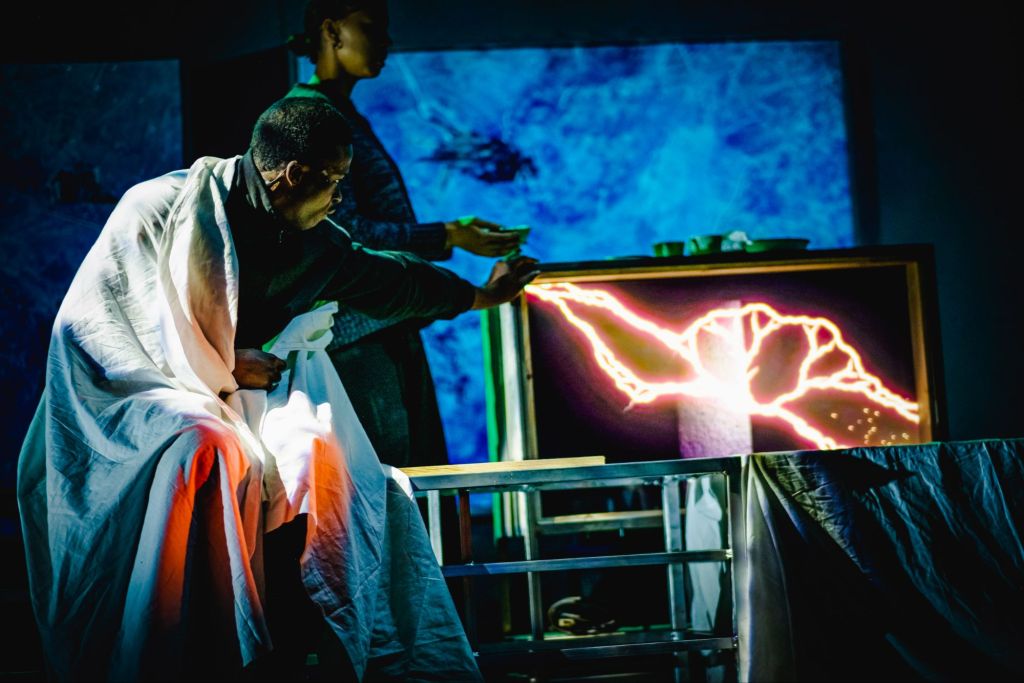
Nedum Okonyia and Georgia-Mae Myers in Frankenstein at Leeds Playhouse
Photo: Ed Waring

Inspired by the writing of Mary Shelley

Co Directed by Andrew Quick, Peter Brooks and Simon Wainwright

An Imitating The Dog and Leeds Playhouse Co Production

Quarry, Leeds Playhouse

Frankenstein was written over two hundred years ago by the nineteen year old Mary Shelley. The themes of the book have resonated through the centuries as we humans continue to grapple with the concepts of birth, life and death and what it essentially means to exist. Inspired to compete with her husband Shelley, the poet Byron and John Polidori to write a horror story, she wove together a story of a creature formed from the gruesome parts of cadavers stitched together and sparked into life by the principle of galvanism. The full tragedy is that this creature willed into life is destined never to be loved by his creator Frankenstein. This new rendition by Imitating The Dog splices together this Gothic romantic masterpiece with a story  where a young couple grapple with coming to terms with a pregnancy and its implications in an uncertain world.
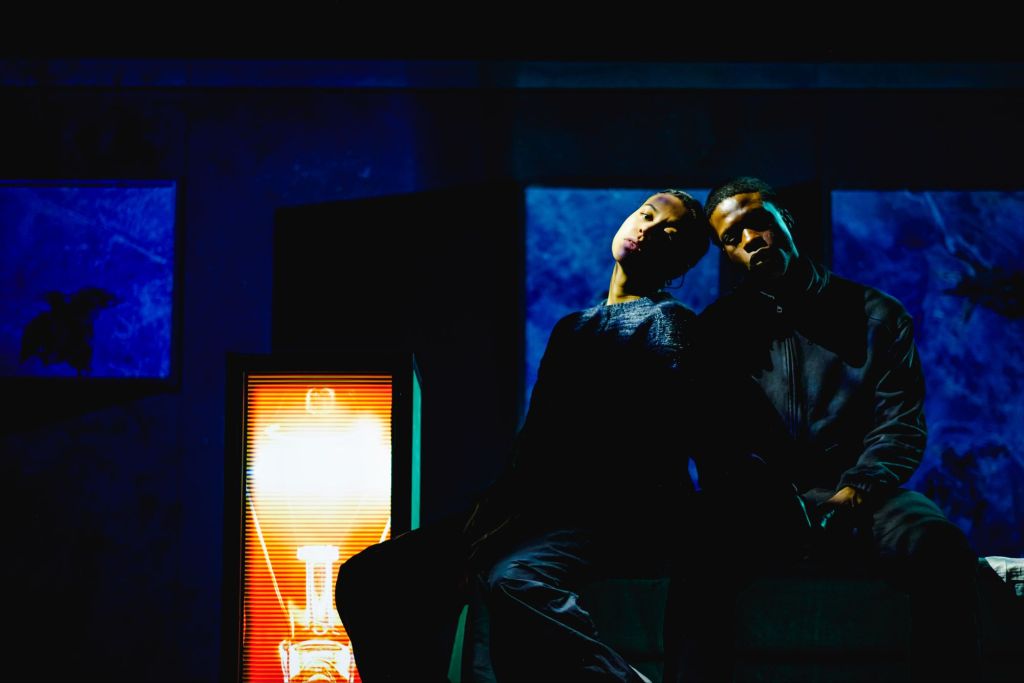
Georgia-Mae Myers and Nedum Okonyia in Frankenstein at Leeds Playhouse
Photo: Ed Waring

This latest production by Imitating The Dog is a creative departure from their work of recent years as they abandon their trademark use of live camera projections used so effectively in work such as Night of the Living DeadRemix, Dracula:The Untold Story and Macbeth. This new work blends story telling with digital technology and movement. The result is visually glorious as Video Designers Davi Callanan and Alan Cox make every use of the strikingly simple set design by Hayley Grindle. The staging comes alive as violent weather patterns erupt across the stage, snowy blizzards and terrifying thunderstorms encompass the characters and beautifully compliment the radio broadcasting of the original text. There are other gems as set props illuminate with video images such as embryos, sonograms and birds that are reminiscent of a Damien Hirst installation or a Victorian laboratory.

The overall impact is highly effective as it allows the drama of Frankenstein, the claustrophobia of Walton’s ship and the beauty of the  polar landscape to come alive. Composer  James Hamilton has created a glorious score that weaves through the piece and creates a perfect alchemy with the rest of the staging. The score also brings additional powerful to the taut, muscular performances of the two leads. The choreography by Casper Dillen has an urgency and desperation that channels that of Victor Frankenstein and his Creature while also illustrating the push/pull of the young couple deciding what to do regarding the pregnancy.

Georgia-Mae Myers and Nedum Okonyia give their all to this production. Utterly invested in the characters they bring to life from the book and in the modern day embodiment of a couple wrestling with a momentous decision in an uncertain world. It is frustrating that the naturalistic dialogue employed for the modern setting seems to get lost when in translation when up against the writing of Mary Shelley. On occasion some of the parallels drawn, such as between the Creature and the shouty man outside the couple’s flat can seem heavy-handed and unnecessary. The couple come alive during the movement sequences but perhaps would have benefited from stronger dialogue to give them more depth so that ultimately an audience could care and invest in them as much as with the characters in the book.

There is much to enjoy in this production and the themes of Frankenstein will remain relevant as it continues to astound as to how Shelley’s vision of a man sewn together from discarded body parts and galvanised into life could ever be fully realised in anything but our imagination. Yet two hundred years on we think nothing of using defibrillators to breathe fresh life after a heart stops beating and use organ, body and skin implants to give loved ones hope and a new lease of life. Imitating The Dog have used their unique set of components and galvanised their own vision of Frankenstein and it seems to be a pretty successful rebirth!

Leeds Playhouse  15 – 24 February 2024

FRANKENSTEIN Tour dates

Frankenstein

ROYAL EXCHANGE THEATRE

By Mary Shelley

Adaptation by April De Angelis

Directed by Matthew Xia

Matthew Xia reanimates Mary Shelley’s Frankenstein 200 years after its first publication. This new adaptation by April De Angelis sticks closely to the original text and relates the story in flashbacks as the traumatised Dr Frankenstein tells his story to the Captain of the ship which rescues him from the ice. Xia turns his focus to producing a darkly Gothic exploration of the perils of dogged human ambition at the expense of family and friends. In this visceral production he also explores the vulnerability of those seen as “Other” in this World – the abandoned, the wounded and the misunderstood. The creations that don’t conform to our perception of idealized perfection or cosy sameness.

Mary Wollstonecraft Shelley wrote this extraordinary piece of literature in her late teens and was barely 20 when it was first published in January 1818. The child of the early feminist Mary Wollstonecraft, she had fallen in love with the married poet Percy Bysshe Shelley at 17. Flouting social propriety of the period she had children with him before he was free to marry her after the suicide of his first wife. Traveling in Geneva in 1816 they joined the poet Byron and together conspired to each write a ghost story. From this challenge came Frankenstein, a Gothic novel influenced by the Romantic Movement and the study of Galvanism. The themes of death and reanimation must have resonated strongly with Mary. Her own Mother had died shortly after her birth and she was to have buried two of her babies before her novel was publisher.

Opening in sheer blackness the story unfolds with Captain Walton (Ryan Gage) on stage throughout the performance as the calm and steady listener to Victor Frankenstein’s wild, frenzied story that comes to life in a series of vivid flashbacks. Trapped on his ship in the ice Walton is transfixed as audiences and readers have been for two centuries.

This storytelling honours the original book but perhaps at the cost of developing authentic and empathic relationships between the characters. The dialogue sometimes sounds ponderous and doesn’t always flow in the way natural conversation would. The scenes can appear more as static tableau scenes and therefore the power of this drama can suffer at times.

The only truly potent and memorable character on stage is the Monster. Harry Atwell looms over the rest of the cast partly due to sheer physical presence and primarily because he steals the show as this doomed, traumatised creation, abandoned and rejected like a wounded refugee from the Underworld. Atwell is all wild eyed and unkempt with more than a look of Marty Feldman, yet his sensitive nature and eagerness to learn and to love and be loved seems very much taken from the creature as portrayed in the television adaptation Penny Dreadful by Rory Kinnear.

His journey is tragic and heartrending as he starts out stammering hesitant words and twitching with movements that seem like a creature with agonising phantom limb pain as nerve endings are raw or still newly knitting together. His journey is brutal as wounded and rejected, he becomes increasingly vengeful. Yet he evolves to develop a humanity and awareness that seems greater than the men before him. His quest for knowledge and his self education are sadly not really explored in this production but the result is a fully fledged man who feels emotions and can articulate his pain. Shaped by his experiences and composed of unknown body parts he is literally Everyman.

However this production like it’s namesake is deeply flawed. The other characters never develop in a satisfactory way. Indeed some feel as wooden as the bizarre marionette used to portray William the child. This addition seems awkward and uneccessary on stage and does nothing to create the emotional potency of a child’s death. There are occasional moments where humour appears to seep in jarring the intensity. The character of Henry, Frankenstein’s friend or the introduction of The Professors creates an almost vaudeville humour that simply does not work.

Designer Ben Stones has created a set which is lush with gore and bones and limbs. Death is everywhere and escape impossible. From the trunks filled with wedding clothes or body parts to the spectacular honeymoon bed or the Frankenstein’s laboratory; detail is everything in this lavish production. The costumes are fabulous and create an almost filmic aspectic to this theatre of the grotesque.

This is visually a feast in carnage and pathos. There are some moments of real terror and genuine poignancy, yet it all feels unsatisfactory and a lost opportunity to truly chill the audience. Just as the characters are trapped on the ice, I felt trapped in my seat daring to hope but feeling ultimately doomed to disappointment.

At The Royal Exchange until April 14th

Images by Johan Persson