The Faggots And Their Friends Between Revolutions

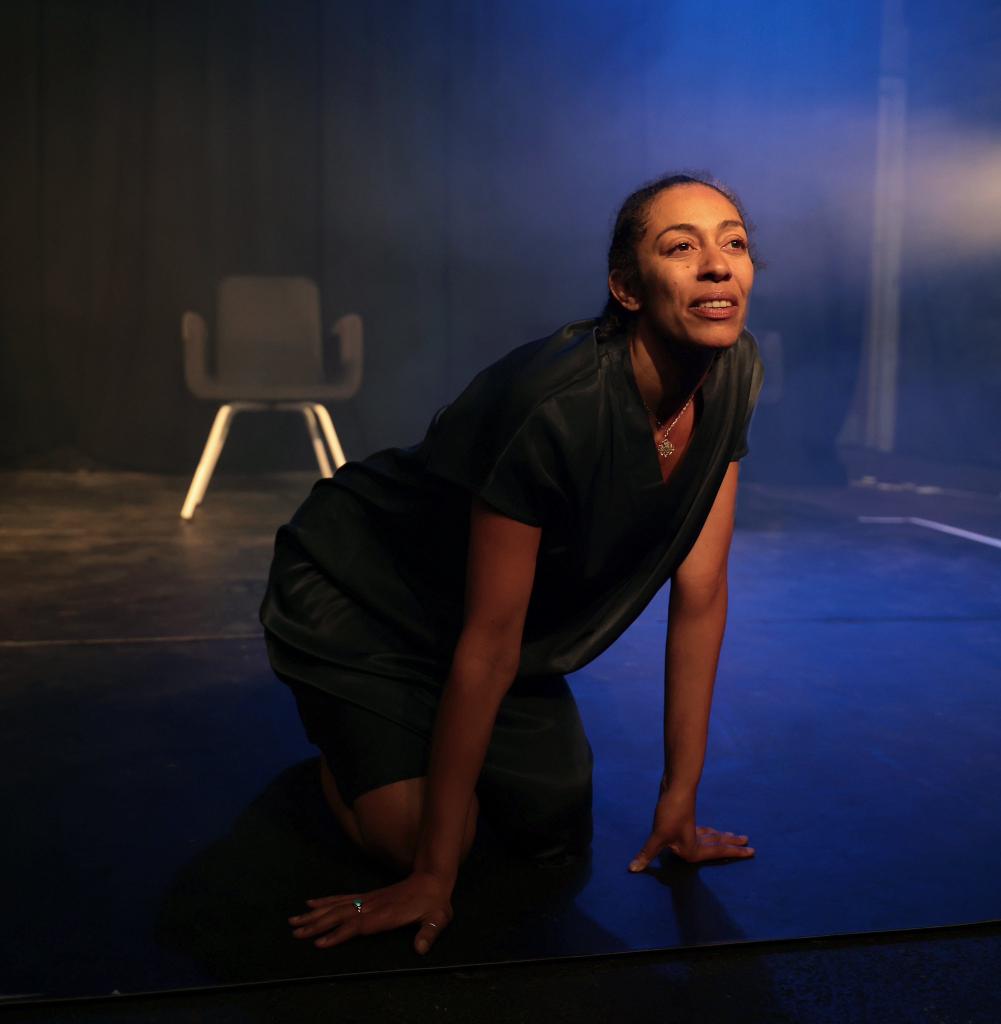
Image credit: Tristram Kenton

Music by Philip Venables

Wtiting and Direction by Ted Huffman

Based on novel by Larry Mitchell and Ned Asta

HOME

MANCHESTER INTERNATIONAL FESTIVAL

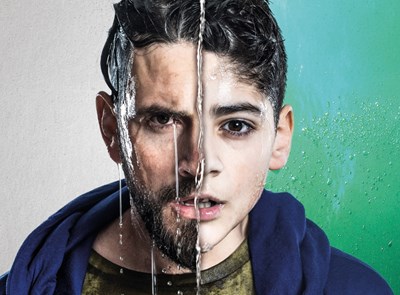
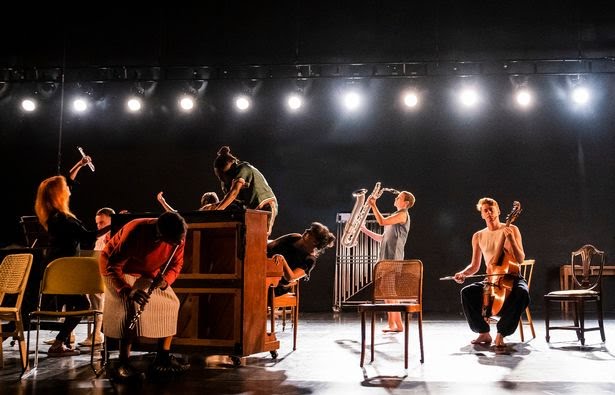
The Faggots & Their Friends Between Revolutions achieved cult status since Larry Mitchell self published in 1977. In a world where acceptance and compassion can flow generously and hopefully then quickly appear to ebb away again, this new production feels timely as LGBTQIA+ rights and safety seems to be worryingly under threat. The blending of a wide range of musical styles, instruments and voices are a carousing anthem for unity and change. A high point of this performance is Kit Green breaking the fourth wall to bring the whole audience together in song. There is a palpable sense of unified passion as everyone literally sings from the same hymn sheet. The word Faggot is cherished here and used with real love in this celebration of queerness and the revolutionary attitude to male patriarchal society required to achieve self-determination.

This is the third collaboration between Composer Philip Venables and Writer/Director Ted Huffman. This new opera commissioned by Factory International is one of the touring productions which premieres at HOME before going to festivals in France and Austria. Previous work includes a highly disturbing opera production of Sarah Kane’s 4.48 Psychosis which apparently induced panic attacks in some of the audience members. Here there is a warmth and generosity in the music that is playful and highly engaging. The Faggots are alongside the faeries, the faggatinas and the women who love women. The music here has opera sitting alongside baroque, bossa nova, and club music. Fifteen musicians, singers, dancers and actors play multiple instruments from lutes and accordions to violins and viola da gambas. The score vividly evokes the sexually charged urgency as magic cock fluid is ejaculated, the folky sense of campfire singing in a Commune and the euphoria of a drug fuelled club night.

Image credit: Tristam Kenton

The history of the patriarchal society is told as a subversive fairytale. This story flips the history books and slyly suggests it’s the power and paper hungry men who are the aberrations in Society and its the Faggots and their friends who are the original people. All the performers have their moment in the spotlight with some beautiful virtuoso performances. However it’s the inimitable Kit Green and dancer/choreographer Yandass who primarily tell the story. They are a perfect foil for each other with Green all laconic, fluid elegance and pithy delivery whereas Yandass is a powerhouse of taut, passionate energy.

The stage at HOME looks like a vast black box creating a wonderful sense of looking back in time and seeing these performers in a stripped back way where there are no other visual distractions…they have to be seen…and they are seen…as extraordinary, gifted and ultimately human individuals who will carry on and survive whatever Revolutions are yet to come.

HOME 28 JUNE – 2 JULY

Manchester International Festival 29 JUNE – 16 JULY

CRAVE

Etta Fusi as M in CRAVE
Image credit:Shay Rowan

Written by Sarah Kane

Directed by Chris Lawson

53TWO

CRAVE is the penultimate play by controversial playwright Sarah Kane. It was first performed shortly before her suicide at 28 and was dedicated to Mark Ravenshill writer of Shopping and Fucking. She was part of the 90’s movement In-Yer-Face Theatre and was known for her use of violence, unlikeable characters and shocking material. Unlike her other plays, CRAVE is written in a fragmentary style with no stage directions and 4 characters only identified by the initials A,B,C and M who may be elements of separate entities or simply aspects of one very troubled consciousness. Running at about 55 minutes, this is not an easy or comfortable watch but rather a murky and fascinating merging of cast and audience as the plays’ intensity seeps and swirls around the space. The staging in this dark, dank railway arch at 53TWO adds to the insidious horror of what can lurk in the real world and how it impacts the darker recesses of a troubled psyche.

Director Chris Lawson creates an almost prayer- like litany as his sensitive blocking allows for these fragmented beings to take form then fade off but never entirely disappear as another voice emerges. The lighting is highly effective in occasionally illuminating certain lines or characters yet sometimes plunging the stage into blackness leaving simply a disembodied voice. At times languid and poetic, then erratic and frenzied, the pacing sometimes shifts suddenly to laserlike focus such as the soliloquy by Jake Ferrettis’ A where its taut tenacity is truly haunting. Lawson has done a great job of allowing his cast to be equally vulnerable and repugnant while always utterly fascinating.

This is no mean feat for a cast dealing with sparse dialogue that is often just a single line. Although peppered with a strange sort of violent poetry, the dialogue is at times not enough in itself to fully carry and elevate this work. The cast are excellent as they give each other space and create a musicality rather like a well oiled string quartet. Always on stage, they all maintain a physicality that is arresting but never distracts from another character speaking. Matthew Heywood as B and Elizabeth Meadows as C are the younger characters and they both give raw performances vividly evoking the pain and trauma of abuse. Jake Ferretti as A is scarily intense as a moralistic paedophile whose piercing soliloquy lingers like a damp chill long after leaving the theatre. Etta Fusi as M is a study in languid regret and despair with the slow burn of her sensual physicality bringing real depth to her performance.

CRAVE asks is ecstasy just a lack of grief? This painful and ambiguous study delves into a mind at war with itself and the push pull struggle of redemptive hope against the eviserating pain of trauma and mental illness. When first performed in 1998 it was viewed as the most hopeful of Kane’s plays yet the writer saw it as the bleakest saying her earlier works were written by someone “who believed utterly in the power of love”. However it is interpreted, it is a potent reminder the power and range of human consciousness.

CRAVE was produced at 53TWO 31st May to 4th June 2023 by HER Productions

NO PAY? NO WAY!

Katherine Pearce and Samantha Power.
Image credit: Johan Persson

Written by Dario Fo and Franca Rame in a new version by Marieke Hardy

Directed by Bryony Shanahan

ROYAL EXCHANGE THEATRE

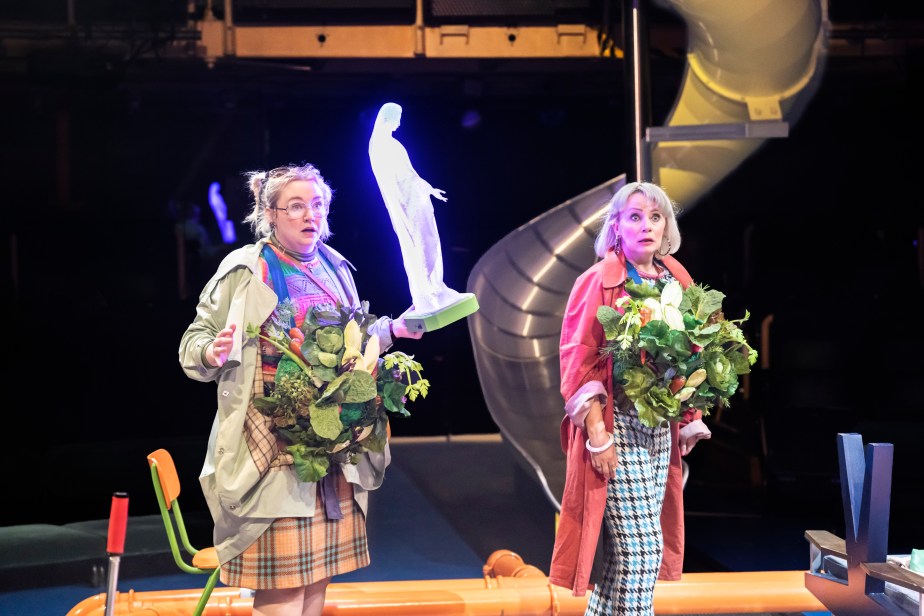
We are in a cost of living crisis with strikes becoming our everyday norm and inflation seemingly spiralling out of control. Our NHS is haemorrhaging staff and needing more than just life support. Post-Brexit Britain is a joke in the eyes of our European cousins and on the World Stage. Our current government is utterly self-serving and increasingly more fascist. So no time like now for our Royal Exchange to stage the anarchic farce that is NO PAY? NO WAY! Written in the Seventies by world renowned Italian playwright Dario Fo and his wife Franca Rame; this new version by Marieke Hardy was first performed in Sydney in February 2020. Bryony Shanahan could have opted for her last production of this season to be something earnest and sensitive but in choosing this gloriously silly and madcap farce she has struck the perfect mood for so many of us. This a production that celebrates the ridiculous and the absurd while packing in a powerful political rallying call against poverty and injustice.

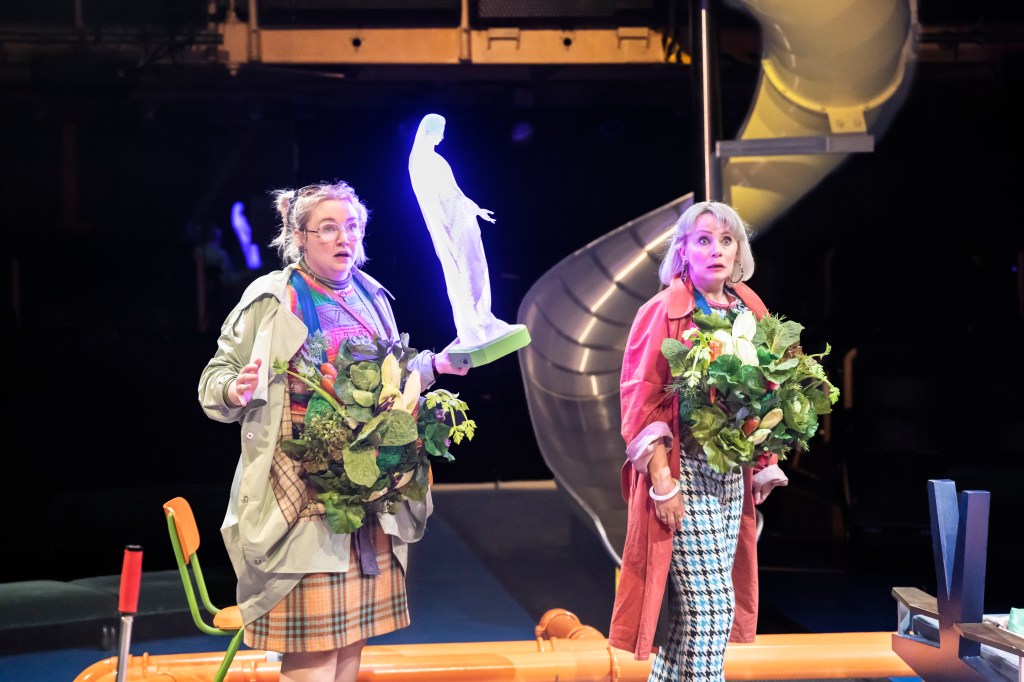
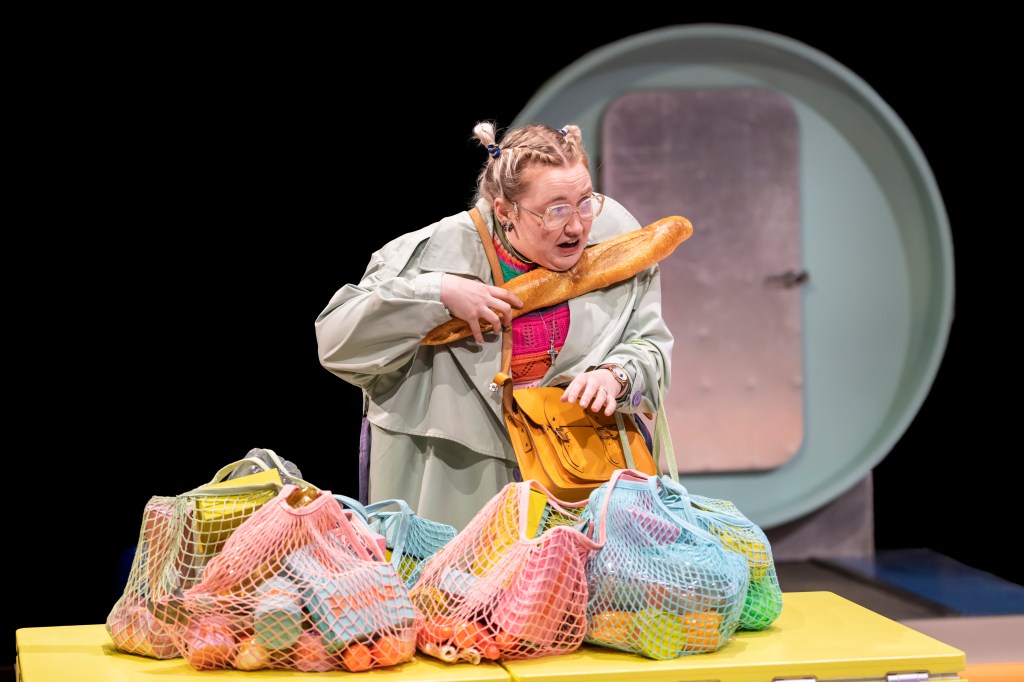
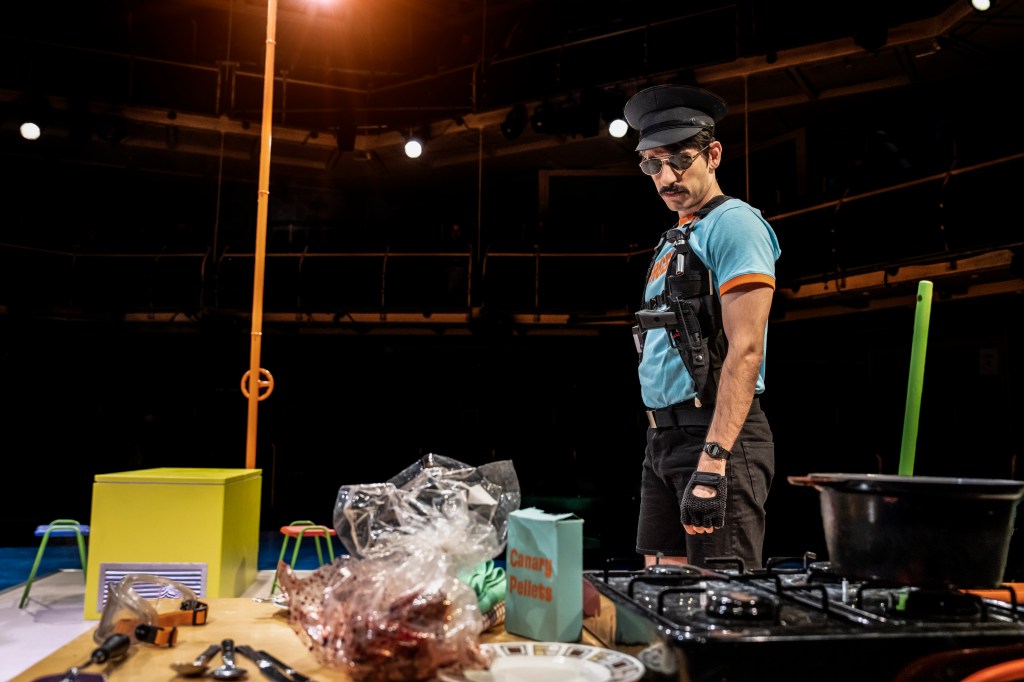
Cécile Trémolières has created a high energy, hugely entertaining set filled with bright colours, divided up by orange pipes with exits and entrances composed of bright yellow slides and round metal tunnels. It evokes a sense of childlike exuberance that is reminiscent of a scene from Super Mario Brothers blended with the playfulness of early Eighties French cinema. Everything has a cartoonish element from the costume design with actor’s roles spelled out on t-shirts to the fun packaging of foodstuffs. The periscope adds to the sense of industrial workers  living in the underbelly of society despite being the very foundation of the economy.

Katherine Pearce as Margarita.
Image credit: Johan Persson

The cast of five work as a tight unit making the slapstick, madcap humour flow seamlessly. They hit all the right beats and keep the pacing of the original play while balancing the new writing in a manner that celebrates Dario Fo while staying fresh and relevant in all its topical references. Samantha Power as Antonia delivers a powerhouse performance as she fizzes with the thrill of revolution and liberating bagfuls of groceries from the local supermarket. Her deft wrong footing of her beleagured hubby resembles a Premier goalscorer as she deflects his concerns and persuades him into believing the most ludicrous suggestions. Katherine Pearce delights as the younger, initially more reticent wife who ends up having to fake a pregnancy to hide the stolen groceries. She really hits her stride in the second act as her character grows in confidence and her anger and desperation yields a polemic speech that ricocheted through the theatre.

The male characters pontificate loudly but in the hands of Marieke Hardy and Director Bryony Shanahan they are as easily outwitted by the women as they have been molded by management. Roger Morlidge gives a gorgeous performance as Giovanni providing a solid foil to Antonia. His eye rolling and hapless brandishing of a fish slice during the birth scene are joyful. The chemistry in the scenes with Gurjeet Singh add to the Chaplinesque qualities of the production…none more than the physical comedy when they are on the non existent travelator and breaking the fourth wall. Anwar Russell flounces through multiple roles delineated by t-shirt logos, a selection of comedy moustaches. His posturing and camp asides are a real pleasure as he gives a hi-octane performance filled with playful charm.

Roger Morlidge and Gurjeet Singh.
Image credit: Johan Persson
Anwar Russell.
Image credit: Johan Persson

This production feels like a real labour of love. The lighting design by Elliott Griggs is playful and adds to the cartoon elements of the humour. The repeated breaking of the fourth wall allows Shanahan to ramp up the comedy and ingeniously add big drama elements to the production including large scale lorry crashes and helicopter swoops which are eluded to but are comically conveyed by responses to supposed theatre staff strikes. It’s a clever twist in this madcap frolic but also deftly illustrates all the theatre staff working behind a big production who sweep up or climb rigging and whose part in creating the magic on stage is usually unseen and unheard. This fun filled production packs a mighty punch as it eviserates those responsible for an unfair and unjust system. There is a system…The system is broken. Thankfully the only thing broken in this production is the fourth wall!!

ROYAL EXCHANGE 12th May – 10th June 2023

Cat On A Hot Tin Roof

Ntombizodwa Ndlovu as Maggie “The Cat”
Image credit Helen Murray

Written by Tennessee Williams

Directed by Roy Alexander Weise

Royal Exchange Theatre

It’s rather apt that this new staging of this classic play about greed, lies and family rivalries opens at the Royal Exchange as the final series of Succession also hits our screens. Director Roy Alexander Weise is clearly fascinated by themes of family dynamics and the ugliness that may lie beneath the surface and bubble up to the surface at any family gathering. There is a powerful moment when the Pollitt family circle in and sing Satan, We’re Gonna Tear Your Kingdom Down (memorable from another family drama series Greenleaf). The stage and cast are bathed in blood red light and the violence of avarice and mendacity is palpable at what is, on the surface a family birthday celebration.

Patrick Robinson as Big Daddy.
Image credit: Helen Murray

Weise subverts the classic text by casting black actors as the wealthy Plantation owning  family. The themes of exploitation, greed, capitalism and pride look as authentically ugly here as in the original. They are timeless and not subject to any one race or creed. Patrick Robinson is a stylish suited and booted Big Daddy, his veneer of brute determination and utter self-belief is softened only by his adoration of his younger son Brick. Bayo Gbadamosi is a beautiful, detached Brick who is weary of his wife’s passion and vitality. He has checked out and no longer has an interest in anything but liquor and chasing the click. There is a potential issue in the modern day setting in that it is more tricky to understand his absolute avoidance of confronting his own homosexuality. Perhaps it is best contextualised in the setting of Brick as a sportsman and football player and his absolute emotional paralysis as that of a man broken by guilt and grief.

Bayo Gbadamosi as Brick.
Image credit: Helen Murray

Ntombizodwa Ndlovu makes a memorable stage entrance and dominates the first Act. Her Maggie is as bootilicious as Beyonce and as lush as an overblown gardenia. She is all women and outwardly confident of her sexual allure but Ndlovu seamlessly also shows her vulnerability and frustration in this sexless, childless marriage.   Alternating between funny and vicious, this cat on a hot tin roof is not to be trifled with. Jacqui Dubois is great as Big Mama choosing only to see what suits her and flitting away any inconvenient truths. Danielle Henry relishes her role as the fecund Mae, flouting her pregnant belly and constantly referencing her brood of would-be heirs or as Maggie terms them…no neck monsters.

Image credit: Helen Murray

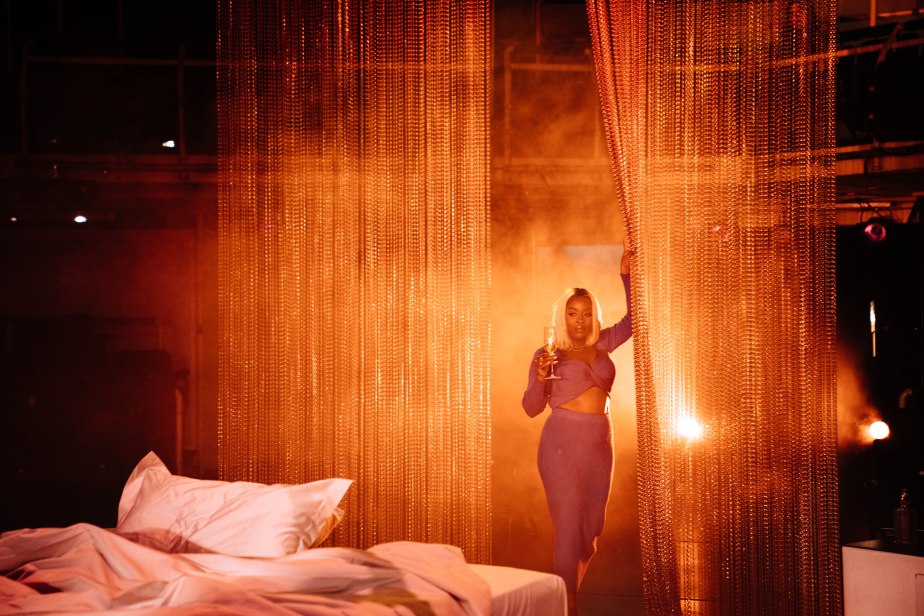
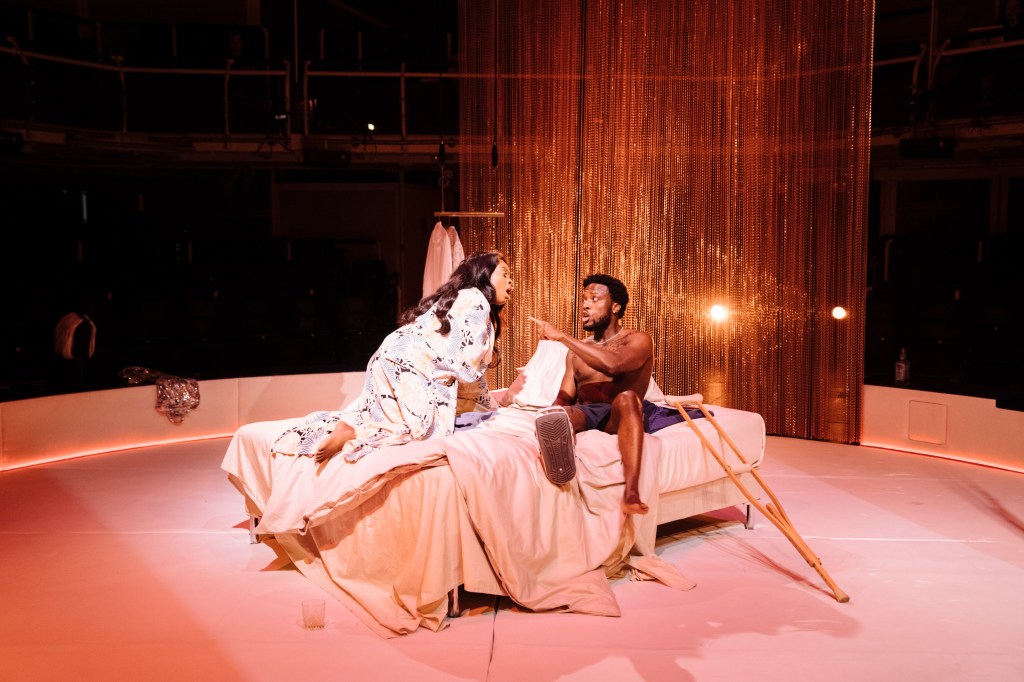
Set in modern day, Milla Clarke has created a beautiful set with a sleek bedroom setting and loads of hidden alcoves secreting as many empty booze bottles and wigs as the family hide secrets and ambitions. The huge rumpled bed is a constant allusion to restless but sexless nights in this unhappy marital bed. High above the bed and constantly turning like time is a stylish suggestion of a child’s mobile taunting Maggie. Gold beaded curtains hint at the great wealth in this house but also suggest the binding, suffocating chains of gleaming greed in this luxurious prison.

The soundscape by Alexandra Faye Braithwaite and the lighting design by Lizzie Powell work brilliantly together to build the dreamy, slightly unreal mood of the production. Ethereal echoes of voices and music and flashes of far off lightening or fireworks in the grounds create a great illusion of the space and scope of this grand house beyond this steamy, claustrophobic bedroom. Overall Weise has created a gorgeously engrossing piece of theatre worthy of sitting back and binging on.

Royal Exchange Theatre 24th March – 29th April 2023

HOW NOT TO DROWN

Written by Nicola McCartney and Dritan Kastrati

Directed by Neil Bettles

A ThickSkin and Traverse Theatre Company production

Oldham Coliseum

How Not To Drown is the last scheduled production at Oldham Coliseum before the final curtain comes down on March 31st. It is fitting that this is a powerful hard hitting piece of drama that is socially relevant and thoughtfully made. It seems incredibly sad and frustrating that important work like this programmed in a long established theatre with a vibrant history should be subject to Arts Council decisions that close its doors for good.

This story is the lived experience of co-writer and actor Dritan Kastrati who was only eleven years old when his parents paid to have him trafficked out of Kosova in the aftermath of the war. Alone and at the mercy of people smugglers, he made the perilous journey to England in the hope of being reunited with his older brother Alfred. What follows is a chilling indictment of our care system as this vulnerable child is subjected to intimidating procedures, passed around foster homes and kept away from his own brother. He spent five years feeling like an interloper and a financial business arrangement for foster carers. His return to his family after five years is unsatisfying and frustrating as this young man is still displaced and at odds with his environment as his homeland is irrevocably changed and his mother tongue feels unfamiliar.

“I don’t know why my Dad let me go, especially when he knew how dangerous, how hard it was… I was too young, too weak to make this journey. I wouldn’t have sent me… He wouldn’t have sent me unless there was a reason.”

ThickSkin use their trademark physicality to bring this story vividly alive. The five strong cast play multiple roles which powerfully reflects the confusion for the central character as faces and voices constantly change and shift precariously just like the raft on which they perform. The staging is bleak without any creature comforts…not even a lteddy bear or a life jacket; reflecting the harshness of the refugee experience of Ak47s, hard chairs and barricades. The whole production evokes the urgency and chaos of usurpments and resettlement where children are not allowed to be children and where sadly a hug isn’t safe. Watching the central character performing on stage it might be easy to assume that all is now well for Dritan Kastrati and he has finally found his place…I hope that is true and home for him is now more stable and content offstage as well as onstage.

Oldham Coliseum 23rd-25th March

ThickSkin Tour Dates

Lord Of The Flies

Image credit: Anthony Robling

Written by William Golding

Adapted by Nigel Williams

Directed by Amy Leach

Leeds Playhouse and Belgrade Theatre Company co-production with Rose Theatre

Leeds Playhouse

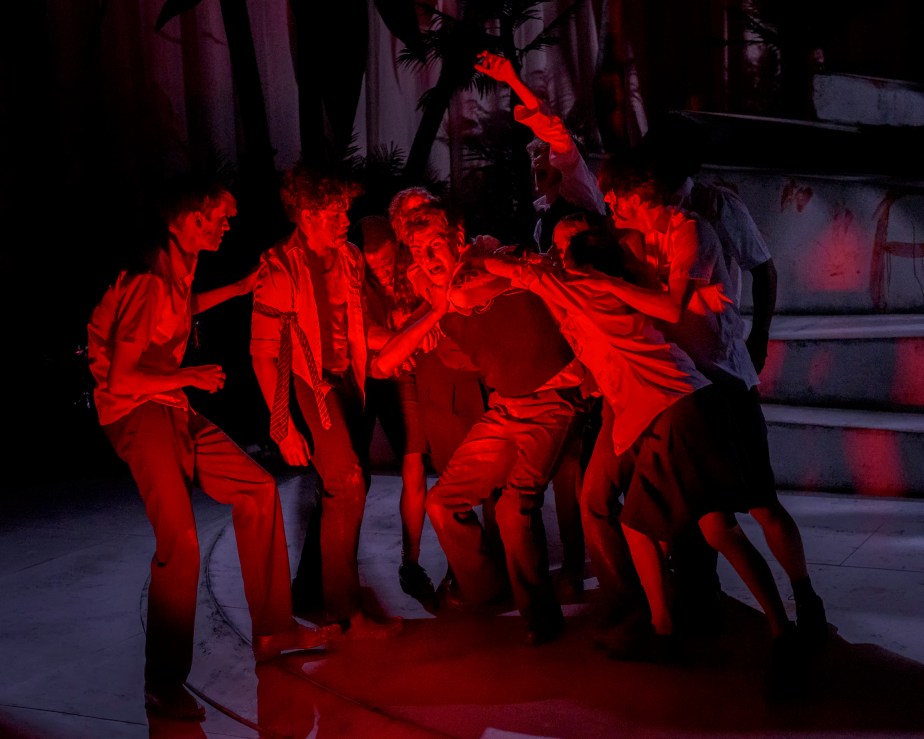
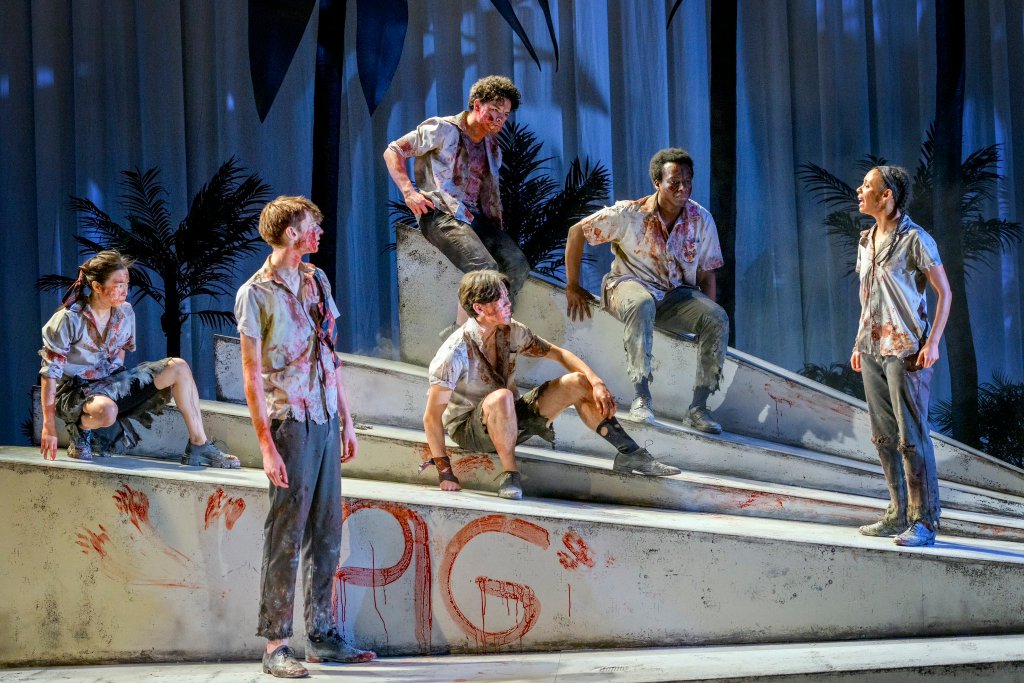
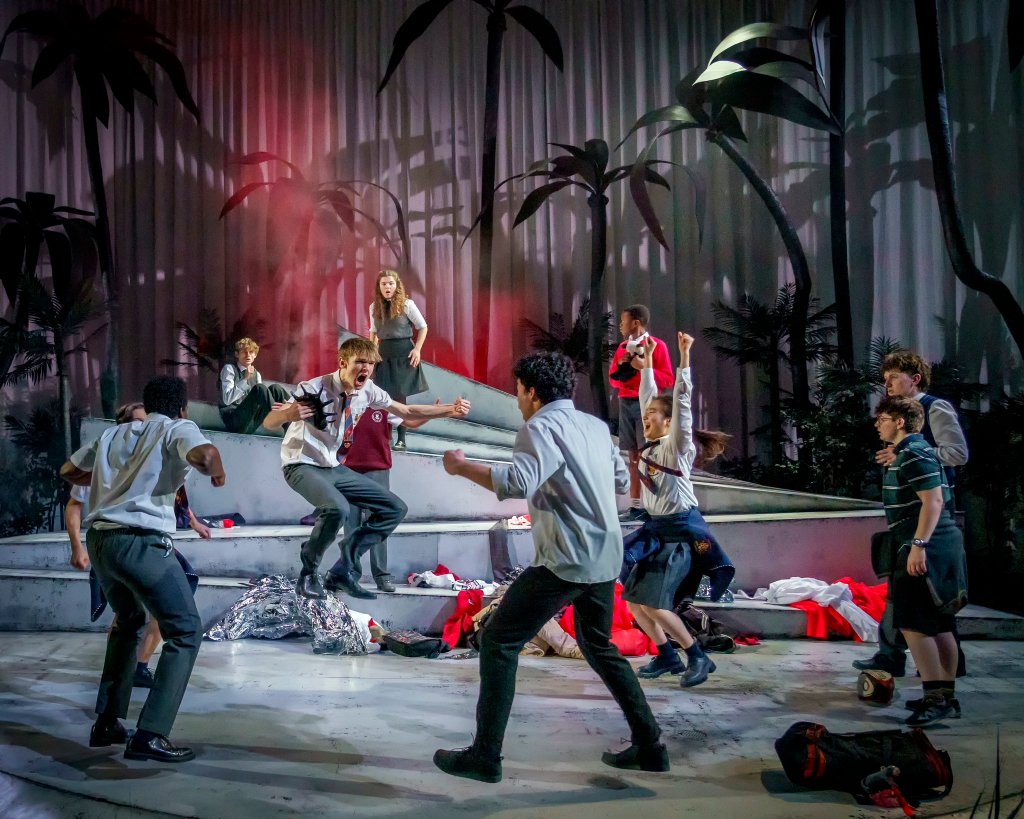
Written in 1957 and a GCSE English staple for generations this production could be, at best a useful adaptation for students and schools to schedule into the curriculum. In the hands of a skilled and creative director like Amy Leach it thankfully translates as a provocative and cautionary tale for the 21st century. The casting by Lucy Casson is really excellent, replacing a traditional group of schoolboys with a genuinely diverse cast that all work together to create a terrifyingly believable bunch of kids stranded alone on an island. As with any really excellent horror you may know what’s coming next but it’s dramatic impact repeatedly hits with a fresh sucker punch!

Max Johns’ set evokes elements of a lush tropical island; yet there is a darkness to the towering palm trees and the pale cliffs evoke an inner city skate park that might just be threatened by rival gangs. Leach jettisons her characters unto stage with a mighty jolt and a deluge of crash debris falls from the sky. Friendships are formed and reformed in seconds as some of this bunch of traumatised kids seek to find order and security while others revel in the new found freedoms of a world without family or schools. This cautionary tale of power struggles between good and evil, order and anarchy, and morality and immorality is as relevant now as nearly 70 years ago. It is no less shocking and perhaps more genuinely frightening in our modern world where knives and bullets are easily come by and our seeming capacity to see threat in “other” is alarmingly prevalent.

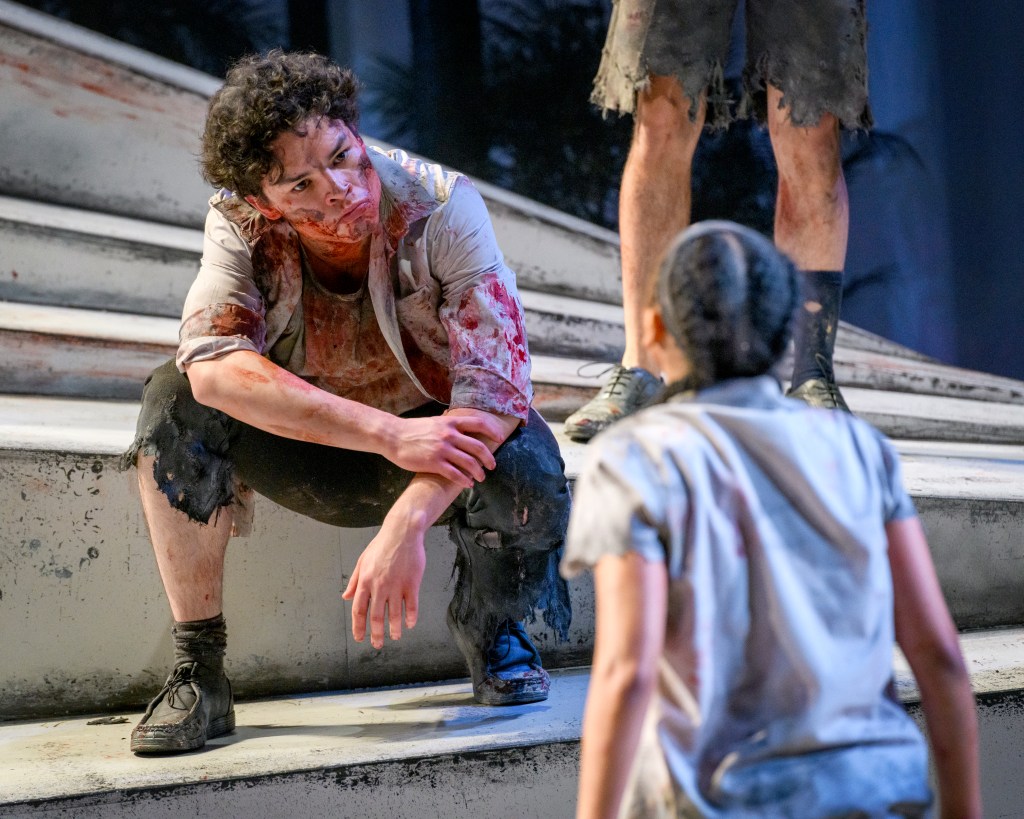
This disparate bunch of children from different schools pick a leader in Ralph who Sade Malone plays beautifully as a good all rounder who has a natural exuberance and an innate sense of fairness. Her role as leader is threatened by the gangly, arrogant Jack who Patrick Dineen embodies with all the elitist, self- aggrandisement of an Oxford Bullingdon boy. Neuro diverse actor Adam Fenton shines as the ticcing, epileptic Simon and Jason Connor gives a skilled performance as the wise Piggy who is likable yet annoying. Deaf actors Ciaran O’Breen and Eloise Pennycott bring a lot to this production with their comedic timing and expressive physicality. Jason Battersby gives a stand out performance as Roger who revels in the pain and misery of others. This is a chilling watch as Battersby gives his Roger a nihilistic stance as the quiet onlooker who quickly becomes a sadistic sociopath swaggering across the stage and dispassionately murdering Piggy.

Jason Battersby as Roger and Sade Malone as Ralph. Image credit: Anthony Robling.

Theatre programming that brings curriculum pieces to life on stage is crucial to widening learning opportunities and breaking down preconceptions and threshold anxiety for the next generation of theatre lovers. It is also sensible bread and butter programming for increasingly cash strapped theatres. Thankfully this Lord Of The Flies production achieves all the above but with the addition of being a genuinely elevated piece of theatre. Amy Leach and a talented team of cast and creatives have produced something really fresh and relevant that inspires and provokes.

At Leeds Playhouse until 8 April, then at Rose Theatre , Kingston, 18-22 April; Belgrade Theatre , Coventry, 25-29 April; and Northern Stage, Newcastle, 3-6 May.

The Merchant Of Venice 1936

Image credit: Marc Brenner

Written by William Shakespeare

Adapted by Brigid Larmour from an idea by Tracy-Ann Oberman

Directed by Brigid Larmour

A Co-production by Watford Palace Theatre and HOME Manchester

HOME

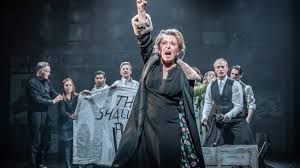
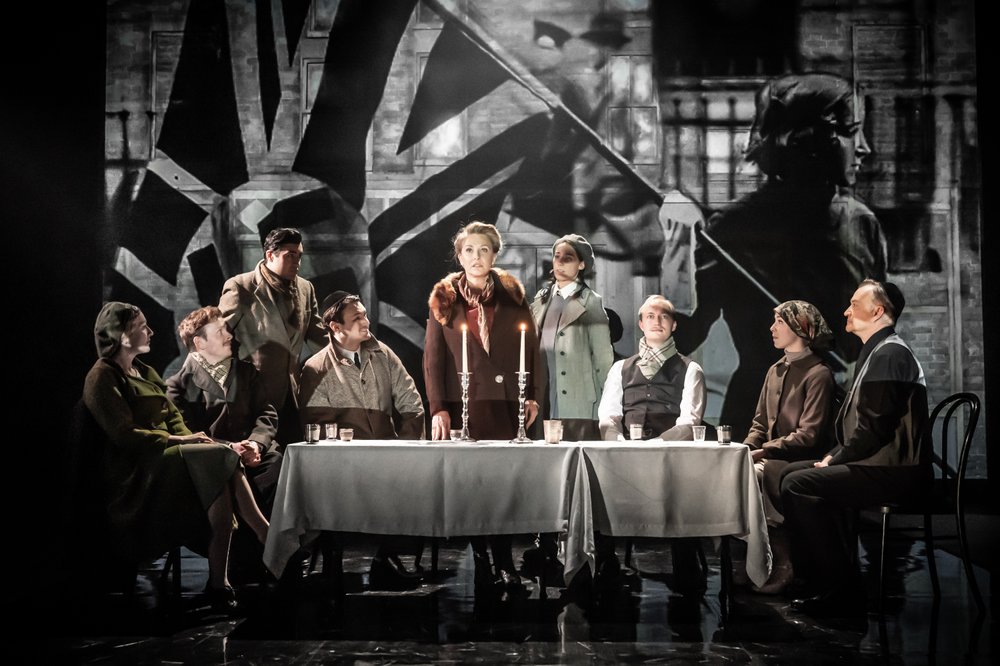
This new adaptation of  Shakespeare’s “problem play” sees actress and writer, Tracy-Ann Oberman and director Brigid Larmour rework The Merchant of Venice for a female Shylock who is a widow and a mother. This female money lender is based on Annie, the great-grandmother of Oberman and all those strong women who emigrated to Britain after the 1905 progroms in Russia. Tracy-Ann Oberman embraces the discomfort of this role as the beleaguered moneylender demanding her pound of flesh, giving a strong impassioned performance in this still widely debated play that questions Shakespeare and his views on Judaism.

The sound of shattering glass offstage indicates that the brewing antisemitism of Thirties Europe is alive and flourishing in the East End of London.This production is set in 1936 to the backdrop of the rise of Oswald Mosley and his British Union of Fascists party and the resulting riots during The Battle of Cable Street on 4th October 1936  when working class people came together in support of the Jewish community. The deeply divisive aspects of this play are further highlighted by the fact that it was also adopted by the Nazi regime in Germany where the characterisation of Shylock was used to validate antisemitism. After Kristallnacht The Merchant of Venice was performed all across Germany.

Here Larmour and Oberman do not shy away from the complexity of their Shylock but balance it neatly against a background of privilege and arrogance as the Venetian noblemen became rather less noble as entitled  Bullingdon Boys in the vein of Boris Johnson, David Cameron and George Osborne caricatures. Their Portia is a cool willowy blonde society heiress equally at home in riding jodhpurs or a bias cut ivory satin evening dress. Clearly modelled on the infamous Diana Mitford, wife of Oswald Mosley who married him at the home of Joseph Goebbels, this is a woman giddy and lethal in her own sense of power.

Image credit: Marc Brenner

The set design and costumes by Liz Cooke work together wonderfully well to capture the gritty side of East End London and the sleek sophistication of society life. Everything about this production suggests a real love for the project and great attention to detail. The music of the period blends Yiddish music and classics such as the apt Stormy Weather. The screen images tell a story of the rise of Fascism and quiet poignant moments on stage such as a disparaging glance between Portia and Jessica say more than words ever could about a society where old money and breeding will always sneer at new money.

This is a strong cast with well balanced performances but ultimately it is the women who shine most brightly. As Portia, a pitch perfect Hannah Moorish hands out money and a ring to Brassanio, her new husband and Shylock finances the Merchant Antonio with her bond; it’s notable that these very different women are also moneylenders exacting and expecting their own pound of flesh. Tracy-Ann Oberman relishes a role that celebrates women she clearly feels incredibly proud off. Her call to arms in the closing sequence is a plea that we are better together…perhaps the placing of some of the audience on stage is also a powerful unifier. In difficult times we all have to make choices where we stand…if we do not then those choices can be ripped away. The most powerful moment in the production is not Oberman onstage but sitting on the rough wooden step. Momentarily beaten by the bullying elite, she is clutching a tiny brown suitcase just like all those still stacked together as a memorial to all those sent to camps such as Auschwitz.

HOME 15th – 25th March 2023

Too Much World At Once

Paddy Stafford as Noble and Ewan Grant as Ellis. Image credit: Chris Payne.

Written by Billie Collins

Directed by Adam Quayle

HOME

The biggest things happen

In the quietest of ways

And we don’t even notice

Don’t even see it

Don’t make a fuss

Or a dance

Until

Too Much World At Once is an impressive theatre debut for Billie Collins. This coming of age story has big aspirations; looking at themes around queerness, mental health issues and environmental disaster. There is a real lyricism in the writing and a strong feel for naturalistic dialogue. It’s no mean feat to write a fifteen year old boy who turns into a bird and readies himself to fly thousands of miles to his neurotic sister who is doing her bit for climate change by gathering data on albatrosses on a remote island in Antarctica. Meanwhile closer to home his Mum is struggling to connect and parent in a fractured family, while teaching and trying quite literally to hold the family home together. New boy Ellis is a breath of fresh air to both mother and son, bringing colour to their lives in ways that go beyond his nail polish and rainbow take on school uniform. It’s a lot to cram into two hours on a small stage but director Adam Quayle does a excellent job of bringing the writers’ vision to life. Quayle who is the Joint Artistic Director of Box of Tricks has made this ambitious debut look and feel authentic.

Alexandra Mathie, Paddy Stafford, Ewan Grant and Evie Hargreaves. Image credit: Chris Payne.

The staging by designer Katie Scott is really beautiful in its simplicity. The central dias is shaped like the Earth with a backdrop of decaying wood…orange boxes, simple wooden furniture, bare window frames and driftwood that look like they may have been washed ashore. Overhead hangs a chandelier of driftwood that is reminiscent of the sword of Damacles. This staging is compact but highly effective in driving the narrative of the play. It’s further enhanced by sensitive and imaginative lighting by Richard Owen. At times the soft spread of light looks like the oceans of  Earth or the rich splatter shades of guano. The lighting effects are at times simply gorgeous as in the closing moments where the the cast are lit like a rich tableau that is truly memorable.

The four actors are all well cast and give good performances. Paddy Stafford as central character Noble embodies the withdrawn boy who has closed off from his mother and desperately misses his sister. He gives a highly effective performance as he transitions into a bird and the occasional delicate movements of his head evoke a curious, perhaps wary bird. Evie Hargreaves plays his sister Cleo, a research scientist on Bird Island who is pulsating with nervy energy, passionate about conservation but overwhelmed by the harsh reality of the task and her surroundings in Antarctica. Alexandra Mathie is Fiona, their mother and the local science teacher. She is utterly believable as a brusque Northerner who seems more sentimental over her crumbling family home than sensitive to the emotional needs of her children. The force of nature in the play is Ewan Grant as Ellis, a newcomer to the school and excluded by his peers due to his sexuality. Grant exudes the enthusiasm and openness of a Labrador puppy bringing an upbeat and humorous energy to the production. He is the perfect foil to this family who have lost their way and each other.

Collins writes with the confidence of a natural poet. There is an innate lyricism and a sense of magical storytelling in this piece. It will be exciting to see her work develop as a playwright. The central flaw within Too Much World At Once is precisely that…there is a lot of world and not enough about who the characters are within this world on stage. This is an exciting premise for a play but the characters feel underdeveloped at times. The mother has some back story and context yet it is frustrating to watch this woman who sits painting the nails of a boy her son barely knows instead of battering down the doors of the local police when her 15 year old child has been missing for days. A lot of the action in this narrative is driven by what has happened within the fractured dynamics of this family unit yet these are barely touched upon. What has happened in the marriage? A deeply depressed and highly anxious daughter…is she living out her mothers’ unfulfilled ambitions? Most frustrating is the central character Noble as he never feels fully fleshed out…but perhaps he is just a fledgling in a damaged nest.

Director Adam Quayle has done a lot to make a potentially tricky play come to life on a small stage. At times the production can seem unwieldy or too busy as the chorus moves around swooping like birds or moving chairs like they are being swept away in a storm. This would all probably lend itself more effectively to a larger stage. The sound design by Lee Affen adds additional charm as he works magic to bring the world of nature and the elements to life onstage. This is a big play on a small stage but perhaps aptly so…

And this is all I know…that it’s a good world to be small in. And there is so much here to love.

HOME 3rd March -11th March 2023

Box of Tricks Theatre tour

SONG FROM FAR AWAY

Will Young as Willem. Song From Far Away. HOME Image credit: Chris Payne

Written by Simon Stephens and Mark Eitzel

Directed by Kirk Jameson

HOME

Song From Far Away is an evocative study of grief, emotional repression and isolation that is at turns both delicate and brutal. This monologue  with song perfectly blends the talents of playwright Simon Stephens and songwriter Mark Eitzel. It feels like a musical for those of us who want to see something that feels more ethereal like the vibe of Cocteau Twins rather than a big West End number. Will Young is a singer, actor and writer who excels as the emotionally repressed and weary cynic that is Willem. Like his character Willem, Young has also lost his only brother but if the performer is channeling his own grief, anger or frustration it is subtle and never remotely self indulgent.

Grief is like a fault line that opens up inside of us and irrevocably changes our emotional landscape. When we speak of grief as a journey or a process, perhaps what we are really describing is how we accommodate this new version of ourselves that still fits our outward clothing but internally feels alien and strange. We see the world in double vision…part familiar terrain and part unchartered waters. Song From Far Away takes Willem from his adopted New York, once New Amsterdam, back to his childhood home of Amsterdam for the funeral of his 20 year brother Pauli. The monologue is in form of letters written to Pauli as  Willem reluctantly navigates a return to his childhood home.

Will Young gives a controlled and emotionally nuanced performance as a hedge fund manager rich in wealth but pauper poor in empathy. Willem is emotionally guarded and aloof and his initial response to hearing his brother has died is one of irritation. Young channels Willems’ disdain for others into micro gestures, facial expressions and clipped tones that convey the character as emotionally stunted and terribly damaged by his family dynamics. This is story telling with caustic wit and casual cruelty yet punctuated by moments that catch Willem by surprise. In those, Young can dazzle with the small agonies of walking into his brothers’ bedroom and finding a sock drawer left open and a half read Kafka novel never to be unfinished or a sudden rush of joy as his little niece Anka singles him out to play with.

The staging by Ingrid Hu is sleek and minimalist, as beige as an airport lounge, a Manhattan loft apartment or a perfectly tended dutch townhouse. Marbled walls and sweeping curtains frame vast windows that act is a backdrop to the magic of quietly falling snow or the hazy sparkle of fireworks dancing in a night sky. The ceiling occasionally lowers or rises, and walls and curtains ebb and flow echoing the emotional tides of grieving. The contracting and expanding like a heart that carries on despite another having stopped forever. Jane Lalljee uses light to move the scenes letter by letter as Young recounts the week after his brothers’ death. The hazy, dreamy lighting is punctuated by occasional plumes of amorphous smoke that create almost a sense of another being circling Willem as he reads to Pauli.

A song fragment heard in a bar lodges in his memory and encapsulates his sense of loss and fragmentation. Young hums and later sings as the song takes form and something seems to open up in Willem. Young sings exquisitely and wistfully. This feels like a prayer to loss and the possibilities of love and connection. Young manages to rein in his performance so we never lose the sense of Willem on stage rather than Young, the singer.  Stephens and Eitzel beautifully convey a sense of rootless dislocation and the complexities of family, relationships and grief. Director Kirk Jameson has been sensitive and controlled in his directing. The production retains a strong flavour of European theatre and the style of Ivo Van Hove who originally commissioned the play in 2014. Jameson has retained the contradictions and sense of alienation in the production but allowed the writing to feel equally at home at HOME…rather fitting as a homecoming for Simon Stephens who is Stockport born and bred.

HOME 22nd Feb – 11th March 2023

                    BEGINNING

Gerard Kearns and Erin Shanagher in BEGINNING at The Royal Exchange. Image credit: Helen Murray

Written by David Eldridge

Directed by Bryony Shanahan

ROYAL EXCHANGE THEATRE

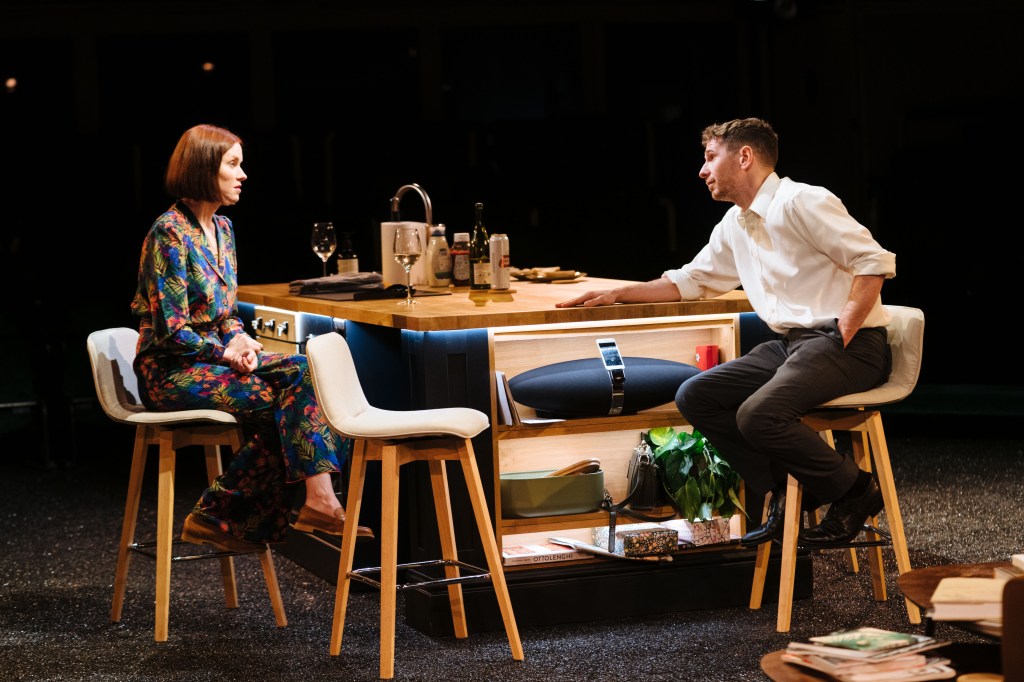
The first in a trilogy, David Eldridge wrote BEGINNING in 2015 and had a hugely successful run when it made its debut at the National Theatre in 2017. The play runs in real time over the course of an evening after a house warming party ends. Laura has a smart new flat in West Didsbury and the last guest left is Danny who is a newcomer to her social circle. Eldridge takes this boy meets girl drama and manages to subvert what one might expect by exploring the immediacy and intimacy of two vulnerable people navigating possibilities. The sheer simplicity of Laura articulating what she wants without any artifice creates a beautifully multi-layered drama as the play explores the complexity of what happens when two people caught in a moment reveal their back stories and how they impact on their choices.

The set design by Ty Hay is an estate agents’ dream with a sleek kitchen island complete with Smeg oven, dishwasher and wine chiller while the lounge furniture looks like an ad for LOAF. Surfaces are littered with the debris from the recent party and the designer rug has a fresh cigarette burn. Either side of the set loom street lamps and the stage gleams with smooth fresh tarmac. The overall effect is as subtle as the storytelling, allowing for lots of movement by the two actors as they at times literally dance around each other. The tarmac effect sleekly eludes to fresh starts and gleaming possibilities while the glowing street lamps suggest a voyeuristic feel to this production. Watching the actors for nearly two hours as they learn about each other feels very much as if we the audience are peering in on our neighbours in a gripping Will they/Won’t they scenario.

Image credit: Helen Murray

Laura is a 38 year old company MD with a new flat in West Didsbury while 42 year old divorced Danny is back living at his Mums’ house. Erin Shanagher and Gerard Kearns are perfectly cast as these wounded characters who are navigating points in their lives that they had not foreseen. Shanagher is wonderful as she makes quicksilver shifts from feisty to goofy to weary and anguished. Her Laura is endearing and brave in her vulnerability as she navigates the evening and propositions the uncertain and wary Danny with the possibility of sex, breakfast and a baby. Kearns gives a perfectly pitched performance in his laddish ordinariness and stained shirt and his Danny is a revelation as he opens up about himself. This is a man mourning being a dad who gets to be nothing more in his daughters’ life than a monthly direct debit and seems to have lost hope for his future. There is a single moment where Laura is dancing her heart out to a Bros track and Danny is watching and clearly amused…what tracks across Kearns’ facial expression is a dawning realisation that he could really fall in love with this woman…theatre at its best!

Beautifully crafted writing by Eldridge and mature and caring direction by Bryony Shanahan coupled with strong performances by Shanahan and Kearns make for a winning production. It’s a brave move to hope an audience can be absorbed in watching 2 people cook and eat fish finger Butties in real time, debate Strictly and the merits of a Ginsters and dance around a kitchen. Beginning draws the audience into routing for this burgeoning relationship despite there being more missteps than slick moves in this courtship dance. Utterly absorbing in its sharply observed take on loneliness and longing, this play is funny, poignant and exciting as the couple navigate the stepping stones and roadblocks peppering their first night together.

Royal Exchange Theatre 16th Feb – 11th March